Best Tankless Water Heater Recommendations for Reliable on-Demand Hot Water
Finding the right tankless water heater depends on your hot-water needs, electrical capacity, and space. This guide highlights five dependable options ideal for homes, apartments, or small businesses that want instant hot water without a storage tank. The top picks suit different scenarios: compact apartments, whole-home setups, or point-of-use needs. Below is a quick summary table to help you compare at a glance.
| Product | Best For | Key Benefit | Approximate Output |
|---|---|---|---|
| Rheem 18kW 240V | Whole-home or multi-point use | High power with accurate temperature control | Up to 4.4 GPM |
| EcoSmart ECO 11 | Energy-efficient small apartments | Self-modulating, space-saving | Up to ~1.5–2.0 GPM typical |
| Orbek 14kW | Mid-demand single- or multi-use | Good efficiency with clear setup guidance | Up to 3.38 GPM |
| Rheem RTEX-24 24kW | High-demand homes | Higher temperature rise for tough climates | 24kW output |
| AIYEZIDT 3000W 110V | Point-of-use at a single sink | Compact, plug-in portability | Up to 82–131°F rise depending on flow |
Rheem 18kW 240V Tankless Electric Water Heater, Gray

The Rheem 18kW unit uses external digital thermostatic control with an LED display that reads within ±1 degree, alongside the most advanced self-modulation to match hot-water demand. It features durable copper immersion heating elements and is field serviceable. This model is best for homes needing reliable whole-house hot water or multi-point use with precise temperature management. A key caution is that high-demand households require appropriate electrical service and proper panel space to accommodate the 18kW input.
EcoSmart ECO 11 Electric Tankless Water Heater, 13KW at 240 Volts

The EcoSmart ECO 11 emphasizes energy efficiency and compact design. It uses patented self-modulating technology to adjust power for continuous, on-demand hot water with precise temperature control within about 1 degree. It is particularly well-suited for small apartments or secondary use points, delivering space savings and lower energy use. The unit is designed to be mounted on a wall, which helps free up floor space in tight living areas.
Tankless Water Heater Electric 3000W 110V (Orbek)

The Orbek 14kW model provides a solid balance of performance and practicality for households needing hot water at 2–3 fixtures. It requires a 240V/60A two-pole breaker and proper wiring. It’s a strong choice for homes with moderate hot-water demands or where a mid-range installation is preferred. A limitation is that the unit’s output is less than higher-power models, so extremely high simultaneous flow might require a larger system.
Rheem 11kW 240V Tankless Electric Water Heater
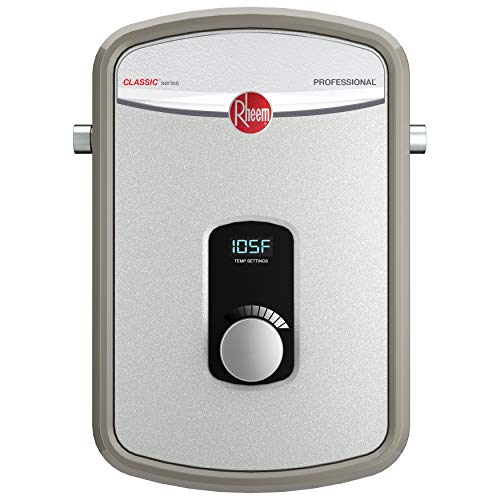
This model uses an ON/OFF dial with an adjustable digital temperature display and self-modulating power control. With a flow rate up to 2.68 GPM, it’s well-suited for smaller homes or bathrooms where hot water is needed in one or two fixtures. Best for users who want straightforward operation and a compact footprint. A limitation is that lower power means reduced simultaneous hot-water capability compared with higher-kW units.
Tankless Water Heater Electric 110V 3000W (AIYEZIDT)
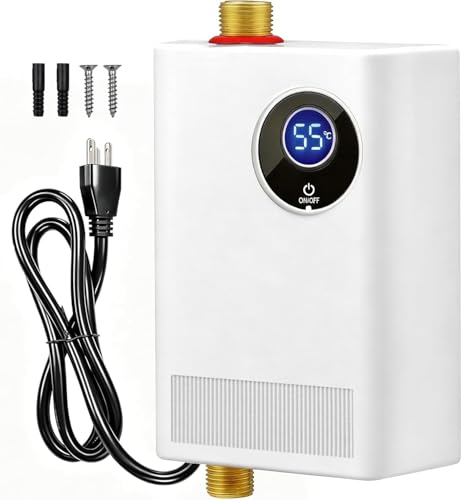
The AIYEZIDT 110V unit is a compact, plug-in option designed for under-sink use. It delivers instant hot water at the point of use, with a digital display and multiple safety protections. It’s best for small-scale tasks like quick hand-washing or dishwashing at a single location. A notable limitation is that it is not suitable for showers or multiple taps at once due to its lower power.
Buying Guide
What should you consider when choosing a tankless water heater?
- Flow rate vs. temperature rise: Higher kilowatts deliver more heat and higher GPM. Match the unit to your climate and household water usage to avoid cold-water sandwiches.
- Electrical service: Many models require dedicated breakers and sufficient amperage. Verify your panel space and service capacity before ordering.
- Installation location: Wall-mounted units save space but require proper ventilation and safe mounting. Point-of-use models work well under sinks or in cabinets.
- Temperature control: Look for precise digital thermostats and self-modulating technology to maintain consistent water temperature with energy efficiency.
- Space and footprint: If you have limited room, consider compact models like EcoSmart ECO 11 or under-sink options for targeted use.
- Maintenance and serviceability: Field-serviceable parts and accessible elements can reduce downtime during repairs.
FAQ
- What size tankless water heater do I need for a 2-bath home?
Assess the number of fixtures and your climate. A higher wattage unit (e.g., 18–24 kW) may be needed for simultaneous use in multiple bathrooms, while smaller setups may be served by 11 kW models. - Can I install a tankless heater myself?
DIY installation is possible for some low-voltage or plug-in models, but most 240V units require a licensed electrician and professional plumbing to ensure safety and code compliance. - Do tankless heaters save energy?
Yes, because they heat water on demand rather than maintaining a hot tank. Efficiency depends on usage and installation quality; many units claim high thermal efficiency when properly used. - How do I size a tankless heater for my home?
Consider peak simultaneous temperature rise and gallons per minute needed. Geographical water temperatures influence the required wattage, measured in kilowatts and GPM capacity. - Are point-of-use units sufficient for a whole home?
Point-of-use models are ideal for single sinks or small tasks. Whole-home solutions typically require higher-kW models and multiple units or a central system. - What maintenance is required for tankless heaters?
Regular descaling in hard-water areas, checking connections, and replacing any worn sealing components help maintain performance.