Best Solid State DC Contactor Options for Reliable Electrical Control
Solid state DC contactors, or SSRs, provide fast, silent switching for DC control signals and AC loads. This guide highlights top SSR models that handle DC input and AC output, helping you choose the right device for automation, heating, cooling, or CNC systems. The selections favor compact modules with clear data on input voltage, output range, and current. Best for: industrial technicians deploying compact, maintenance-friendly relays; engineers needing clean switching without mechanical wear; and hobbyists building precise control circuits. Below, you’ll find five suitable models, plus a buying guide and common questions to finalize your decision.
Summary of top picks
| Product | Best For | Key Benefit |
|---|---|---|
| CG Solid State Relay SSR-25DD (DC-DC input, DC output) | Compact DC-to-DC control | Clear 25A rating with thermal grease option |
| BlueStars SSR-25DD (DC-DC input, DC output) | Easy installation, detailed specs | Faster dissipation and robust construction |
| CG Solid State Relay SSR-100DD | Higher current applications | 100A capacity in a small form factor |
| CG Solid State Relay SSR-25DA (DC input, AC output) | DC control for AC loads | Versatile 24-480VAC output |
| CGLE SSR-40DD | Balanced power handling | 40A with similar package size |
CG Solid State Relay SSR-25DD DC to DC
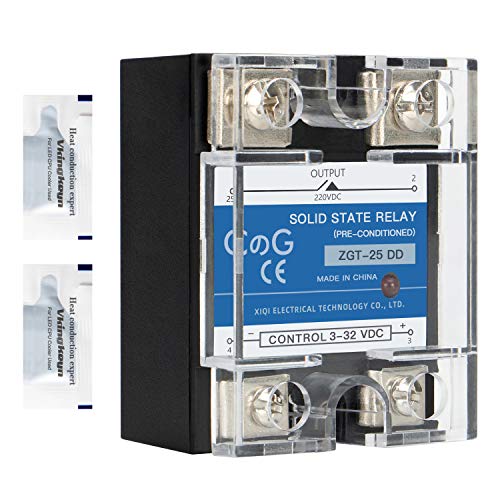
Product name: SSR-25DD, DC to DC input 3-32VDC, output 5-240VDC, 25A 50/60Hz. Package includes thermal grease for faster heat dissipation. Dimensions are about 58 x 45 x 32mm; weight around 116g. Material: metal, plastic, electronic parts. Best for compact DC control tasks where a 25A switch is needed.
Best for: technicians wiring compact DC control circuits in automation or heating/cooling modules where space is limited and a quiet switch is preferred. Caution: ensure input control is within 3-32VDC and that DC output is compatible with the load voltage range to avoid misoperation or overheating.
BlueStars SSR-25DD Solid State Relay

Product name: SSR-25DD, DC 3-32V input, DC 5-200V output, 25A 50/60Hz. Package includes detailed installation instructions, with emphasis on temperature management and long-term reliability. Approximate size 58 x 45 x 32mm; weight around 168g. Material: metal, plastic, electronic components.
Best for: users who want explicit installation guidance and robust construction for automatic processing, CNC machinery, or heating/cooling controls. Limitation: spec notes emphasize precise 3-32VDC input and 5-200VDC output; confirm your exact load voltage falls within this range to avoid performance issues.
CG Solid State Relay SSR-100DD

Product name: SSR-100DD, DC to DC input 3-32VDC, DC output 5-240VDC, 100A, 50/60Hz. It shares the same compact form factor as the 25A models, with a larger current rating for heavier loads. Dimensions: 58 x 45 x 32mm; weight about 116g. Material: metal, plastic, electronic parts.
Best for: control tasks requiring higher current for DC-to-DC switching, while preserving a small footprint. Caution: ensure your wiring gauge and supply can safely carry 100A to avoid overheating or wiring issues.
CG Solid State Relay SSR-25DA DC to AC

Product name: SSR-25DA, DC input 3-32VDC, AC output 24-480VAC, 25A, 50/60Hz. Size and weight similar to other CG models, with thermal grease included for heat management. Material: metal, plastic, electronic parts.
Best for: converting DC control signals to AC loads in compact automation setups or HVAC gear. Caution: verify your AC load voltage is within 24-480VAC to prevent under/over-voltage operation and ensure safe switching.
CG Solid State Relay SSR-40DD

Product name: SSR-40DD, DC input 3-32VDC, DC output 5-240VDC, 40A, 50/60Hz. Compact package, includes thermal grease. Dimensions around 58 x 45 x 32mm; weight about 116g. Material: metal, plastic, electronic parts.
Best for: users needing a mid-range current option with a compact footprint for DC-to-DC switching in automation panels. Caution: ensure heat management is adequate; under heavy duty use, monitor temperature to avoid thermal throttling.
Buying Guide
What should you consider when choosing a solid state DC contactor (SSR)?
- Current and voltage ratings: Match the SSR rating to your load’s current and voltage, considering possible startup surges.
- Input and output voltages: Ensure the DC control voltage (input) and the DC or AC load voltage (output) align with your system requirements.
- Heat management: Many SSRs require thermal grease and proper mounting to dissipate heat; consider ambient conditions and enclosure space.
- Control method and compatibility: DC control signals driving AC or DC outputs affect wiring and safety practices; verify compatibility with existing controllers.
- Physical footprint: If panel space is limited, prioritize slim, rail-mountable designs and check whether included heatsinks are needed.
- Installation notes: Look for clear installation instructions and robust construction to reduce maintenance needs in industrial environments.
Practical comparison questions
- Is the load strictly DC, or will you switch AC loads as well? Choose DC-to-DC or DC-to-AC types accordingly.
- Do you need a compact module with a heatsink or is passive cooling sufficient?
- What is the maximum current the load will draw during startup, and does the SSR handle that safely?
- Will you operate in environments with vibration, moisture, or dust that demand rugged components?
FAQ
- What does SSR stand for? Solid State Relay, a non-mechanical switch that uses semiconductors for switching.
- Can SSRs replace mechanical relays in all applications? Not always; some uses require mechanical latching or isolation features not present in all SSRs.
- Are there heat-sinking requirements? Yes, especially for higher current ratings; improper cooling can reduce life or performance.
- What should I verify before purchasing? Verify input control voltage range, output voltage range, current rating, and enclosure compatibility.
- Do SSRs produce audible noise? Generally no; they switch silently, which is advantageous in noise-sensitive environments.
- Are these compatible with standard DC control signals from PLCs? Most are designed for common DC control voltages (3-32VDC) used in PLCs and microcontrollers.