Best Solar Roof Ventilation Fans for Hot Attics and Warm Homes
Choosing a solar roof ventilation fan can dramatically cut attic temperatures, reduce humidity, and free your home from high energy costs. This guide highlights five top options, comparing performance, features, and suitability for American homes. Each product below is equipped with solar power to run off-grid or during power outages, with thermostats, remote controls, and weatherproof housings to withstand diverse climates. Use the buying guide to determine which model best fits your attic size, climate, and installation needs.
| Product | Coverage Area | CFM | Key Feature |
|---|---|---|---|
| iLiving Hybrid Ready Solar Roof Attic Exhaust Fan | Up to 2900 Sq.Ft. | 1150 | Smart Thermostat; IP68 motor; adjustable solar panel |
| DC HOUSE Solar Attic Fan 32W | Up to 3000 Sq.Ft. | 1600 | 100% off-grid operation; sunrise-to-dusk activation |
| Hon&Guan Solar Attic Fan | Up to 2500 Sq.Ft. | 2000 | Two modes; thermostat control; AC/DC adapter option |
| OmniPV Solar Attic Fan | Up to 1600 Sq.Ft. | 1600 | Built-in thermostat; 110V smart adapter |
| GROWNEER 40W Solar Attic Fan | Up to 2000 Sq.Ft. | 2000 | Smart thermostat; 24/7 operation via remote |
iLiving Hybrid Solar Roof Attic Exhaust Fan

The iLiving unit combines solar power with a smart thermostat system for climate-aware attic cooling. It includes a 40-watt solar panel, 1150 CFM capacity, and cooling coverage up to 2900 square feet. An IP68-rated brushless motor supports prolonged outdoor use, while adjustable solar panel angles (0°, 15°, 30°, 45°) help optimize sun exposure. The thermostat range spans 50°F to 122°F, and an enable/disable feature provides flexible control. A long warranty adds assurance for long-term performance in diverse U.S. climates.
DC HOUSE Solar Attic Fan 32W 1600CFM
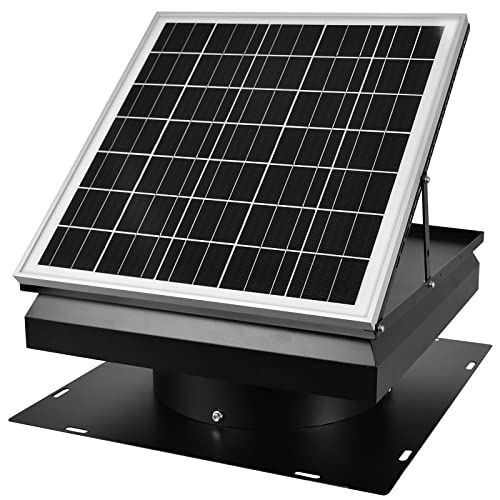
Designed for off-grid operation, this 32-watt solar attic fan delivers up to 1600 CFM and can reduce attic temperatures significantly. It activates with sunrise and powers down at dusk, relying on premium monocrystalline solar panels. It is engineered to withstand harsh conditions and works well when paired with existing vents for enhanced whole-house airflow. The design targets high heat and humidity, helping to protect roof structures and improve indoor comfort while avoiding electrical wiring complexity.
Hon&Guan Solar Attic Fan With Thermostat
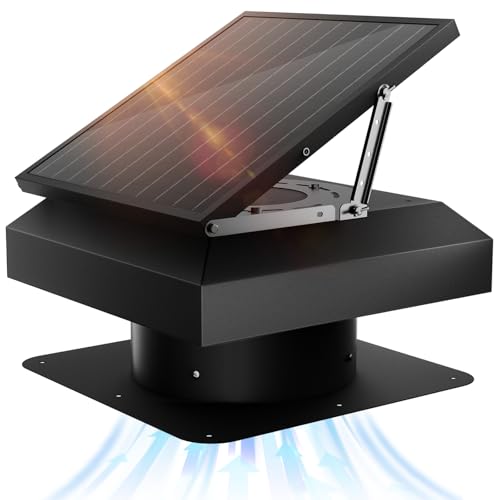
Hon&Guan’s solar attic fan delivers robust airflow of up to 2000 CFM, cooling spaces up to 2500 square feet. It features dual operation modes and a thermostat to regulate performance automatically. The unit includes an AC/DC adapter option for continuous operation, even when sunlight is insufficient. With adjustable 0–70° positioning and weather-resistant construction, this model offers flexible mounting and reliable venting for varied attic layouts and regional climates.
OmniPV Solar Attic Fan

OmniPV combines a 40-watt solar panel with a 1600 CFM motor to move ample air while maintaining energy efficiency. The unit emphasizes a low-noise, weatherproof design suitable for homes, garages, workshops, and RVs. A built-in thermostat simplifies operation, automatically turning the fan on or off at preset temperatures, and a 110V smart adapter expands compatibility with household electrical systems for seamless integration in mixed-supply setups.
GROWNEER 40W Solar Attic Fan With Smart Thermostat
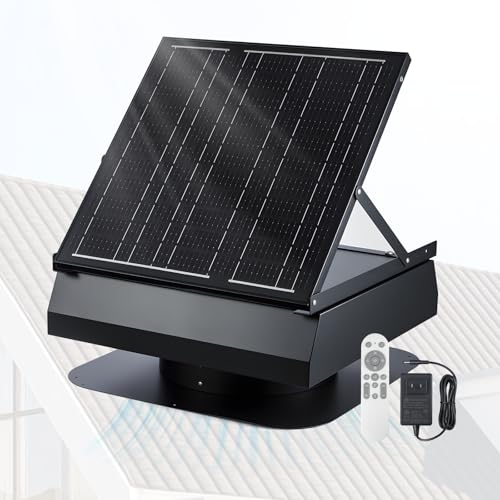
GROWNEER offers a 40-watt solar attic fan with a smart thermostat and 2000 CFM output, suitable for spaces up to 2000 square feet. The system supports 24/7 operation through remote control and an accompanying extension adapter, enabling flexible positioning without attic access. The thermostat automates activation to mitigate heat and humidity, contributing to cooler attic temperatures and lower cooling loads in adjacent living spaces.
Buying Guide: Key Purchase Considerations
- Attic Size and Coverage: Match CFM and square-foot coverage to your attic volume. Under-ventilating can leave hot spots, while over-ventilating may waste solar energy in milder conditions.
- Solar Panel Power and Efficiency: A higher wattage panel generally yields more airflow, especially on sunny days. Look for monocrystalline panels for better efficiency in partial sun.
- Thermostat and Control Options: Built-in thermostats optimize operation by temperature thresholds. Remote controls and smart adapters add convenience for adjustment without climbing.
- Weather Resistance and Durability: IP ratings, brushless motors, and weatherproof housings extend life in heat, rain, wind, and dust common to attics and rooftops.
- Noise Level: Consider brushless DC motors and blade design to ensure quiet operation, especially in inhabited homes or multi-room setups.
- Wiring and Installation: Some models offer AC adapters for continuous operation or hybrid modes. Check compatibility with existing vents and roof types for straightforward installation.
- Energy and Cost Implications: While solar reduces electricity use, initial costs vary. Evaluate payback timelines based on climate, sun exposure, and cooling needs.
- Warranty and Support: A long warranty signals confidence in durability; confirm what is covered and whether service parts are readily available.
- Maintenance: Look for easy access to filters or blades and a motor designed for outdoor exposure to minimize upkeep.