Best Solar Powered Water Filtration Systems for Outdoor Adventures
Solar powered water filtration provides hands-free purification on the go, ideal for campers, hikers, and emergency kits. This guide highlights five top options that leverage solar charging or solar-assisted features to deliver clean water when you need it most. The highlighted buyers are seeking reliable, portable filtration for campsites, bug-out bags, or remote travels. Below you’ll find quick product summaries, a comparative table, and a practical buying guide to help you choose.
| Product | Best For | Key Benefit | Limitations |
|---|---|---|---|
| 3-in-1 filtration with solar charging and hand pump fallback | Bulky setup may be slower in non-ideal light | ||
| 0.01-micron filtration with 5200mAh battery and solar charging | Higher upfront size; must optimize solar exposure | ||
| Automatic electric flow, solar charging, USB-C, and LED light | Electric components require care in wet environments | ||
| Extremely compact, 0.1 micron absolute filter | No solar charging built-in; manual pumping needed via kit | ||
| Gravity-fed with compact 3L bag and 0.1-micron UF | Not solar-powered; gravity-based operation only |
Note: The table above compares products primarily on solar capability, filtration precision, and portability. If solar power is essential, prioritize BKLES, ITEHIL, and Greeshow for built-in or integrated solar features. For ultra-lightweight or gravity-based setups, Sawyer and SimPure offer durable, non-solar alternatives.
BKLES 3-in-1 Solar Electric Water Filter

The BKLES unit combines solar charging with electric purification and a hand pump as a backup. It uses dual 0.01-micron ultrafiltration membranes within a 6-stage system (PP cotton, KDF, activated carbon, coconut carbon fibers). Best for campers who want automated filtration in sunlight and a hand-pump option for power outages or dense shade. The device aims to improve taste and overall water quality and is SGS, FCC, and UL certified. Best for: extended camping trips, emergency kits, and backpackers who prioritize high filtration performance with solar support. Caution: heavy use in low-light conditions may reduce efficiency; ensure a clear line-of-sight to sun for optimal solar charging.
ITEHIL Portable Electric Water Filter
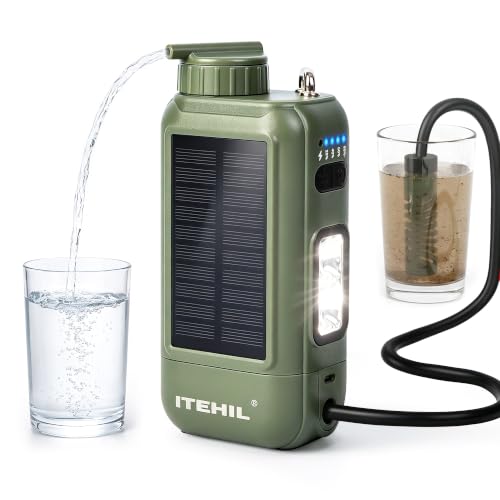
The ITEHIL device uses a dual filtration system (Ahlstrom membrane plus pre-stage ultrafiltration) delivering 0.01-micron purification. It can process river or stream water and doubles as an emergency power bank and light, with SGS NSF and FDA standards for assurance. Best for travelers needing reliable, compact filtration that doubles as an off-grid power source. Caution: battery life matters on extended trips; manage charge cycles to preserve longevity. Best for: long hikes, camping trips with variable sun, and emergency preparedness kits.
Greeshow Portable Electric Water Filter

Greeshow offers an automatic electric purification system with a 0.01-micron hollow fiber UF membrane and a five-stage filtration process. It supports solar charging, a hand crank, and USB-C charging, making it versatile for off-grid scenarios. It includes a LED light for low-visibility conditions and serves as a compact power bank as well. Best for: bug-out bags, emergency kits, and scenarios where multiple charging options are valuable. Caution: ensure dry storage and protect electronic components from moisture when camping in rain or near water sources.
Sawyer SP128 Mini Water Filtration System

Sawyer’s SP128 Mini is a compact, palm-sized filter with a 0.1-micron absolute pore size. It weighs about 2 ounces and can connect to a drinking pouch, standard bottles, hydration packs, or be used with a built-in straw. Best for: ultra-light day trips, travelers who value portability, and quick purification with minimal gear. Caution: It does not include solar charging, so plan for sunlight or extra power for extended purification needs; ideal as a supplementary filter in a larger solar setup.
Waterdrop Gravity Water Filter Straw
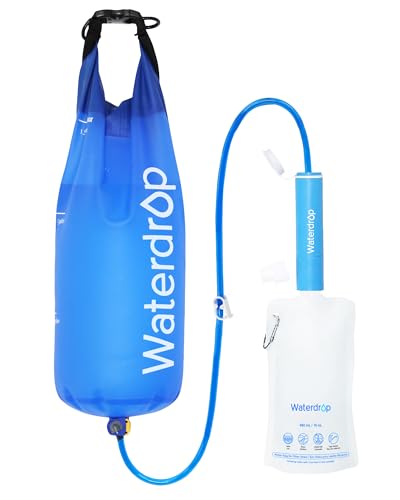
The Waterdrop Gravity Water Filter Straw uses a 5-stage filtration system with a 0.1-micron ultrafiltration membrane and a 1.5-gallon gravity-fed bag. It’s designed for group use, with a maximum flow up to 700 ml/min. Best for: family trips, group camping, and scenarios where gravity filtration reduces the need for pumping or power. Caution: gravity setups can be slower than electric units, and transporting the large bag adds bulk; consider bag capacity when planning hikes.
Buying Guide: Key Considerations For Solar-Powered and Portable Filtration
- Filtration Precision: Look for 0.01-micron ultrafiltration or better if you’re aiming to remove bacteria and parasites. Consider whether hollow fiber membranes or multi-stage cartridges fit your water sources.
- Power Source and Reliability: If solar is a priority, choose models with built-in solar charging or dual power options (solar + hand crank or USB-C). Evaluate battery capacity for longer trips, and plan sun exposure to maximize uptime.
- Portability: Weigh weight and packability. Ultra-light filters (like the Sawyer Mini) are perfect for day trips, while multi-function solar units may be heavier but offer more features for longer expeditions.
- Durability and Build: For outdoor use, select devices with sturdy housings, waterproof components, and easy tear-down for maintenance. SGS/FDA/NSF compliant labeling can provide extra assurance of quality.
- Maintenance and Replacements: Check the availability of replacement filters and spare parts. Some units require periodic membrane replacements or pre-filter cartridges to maintain performance.
- Additional Features: Emergency lighting, power banks, or compatibility with backpacking gear can offer practical advantages in emergencies or long treks.
- Source Water Versatility: If you’ll encounter various water types (rivers, lakes, flood-water), ensure the unit handles turbidity, odors, and heavy metals to maintain drinkable water.
FAQ
- What is a practical range for solar-powered water filters?
Most solar-assisted units provide continuous operation with adequate sun, but plan for backup pumping or battery life in shaded or overcast conditions. - Can these devices remove all contaminants?
Filtration at 0.01 microns removes bacteria and parasites; some units also reduce heavy metals and chemicals. Verify each model’s filtration claims with provided specifications. - Are solar filters reliable in rain or cloudy environments?
Performance can decrease without sufficient sunlight; many models offer hand-pump or USB charging as alternatives. - Is it necessary to carry extra batteries or spare membranes?
For extended trips, yes. Spare membranes or cartridges ensure continued operation when filters wear or clog. - Which product is best for a bug-out bag?
A compact, multi-charge unit with a small solar panel, or a compact purifier with a backup crank, such as the Greeshow family, balances portability and reliability. - How should I maintain solar-powered purifiers?
Keep solar panels clean, protect electronics from moisture, pre-filter dirty water, and store components in a dry, cool place when not in use.