Best Solar Powered Electric Fence for Cattle
Choosing the right solar-powered electric fence charger can help protect livestock, deter predators, and reduce maintenance on remote pastures. This guide highlights five top options, based on portability, power, and reliability for cattle and other livestock. Each product section includes a concise feature summary, practical uses, and installation notes to help you compare at a glance.
| Product | Brand | Typical Range | Best For |
|---|---|---|---|
| Zareba ESP5M-Z | Zareba | Up to 5 miles (ideal); up to 2.5 miles with light weeds | Small to medium pastures, easy mounting |
| S1000 1 Joule Solar Fence Charger | Realpoultry | Up to 50 miles (depending on wire and strands) | Remote pastures, rotational grazing |
| ANDMON MINI400 | ANDMON | Up to 30 miles | Versatile, day/night mode, multiple power options |
| ANDMON MINI250 | ANDMON | Up to 5 miles | Compact setups, low to moderate fencing needs |
| Gallagher S30 | Gallagher | Typical 4 miles; up to 20 miles ideal range | Medium pastures, predator deterrence |
Below you’ll find detailed product sections, followed by a buying guide to help you select the right charger for your operation.
Zareba ESP5M-Z Solar Powered Fence Energizer

The ESP5M-Z provides a practical 5-mile rating, suitable for energizing up to five miles of fencing under ideal conditions. In light weeds, expect performance around 2.5 miles. It offers built-in mounting brackets for common post types, allowing quick installation on T-posts, Y-posts, or round wood posts. The unit is tested in the U.S. after manufacturing and ships with a one-year limited warranty that includes lightning damage coverage, reinforcing reliability for outdoor, remote locations.
S1000 1 Joule Solar Fence Charger

This unit boasts a robust low-impedance design with a 1 joule stored output, capable of powering up to 50 miles of fence, depending on wire type and the number of strands. It is designed for portability in remote pastures, featuring a 12V/12AH sealed lead-acid battery and a 15W solar panel that can operate for up to eight days without sun. Installation is straightforward with a built-in solar setup and an internal GEL battery, and it’s suitable for rotational grazing and wildlife exclusion.
ANDMON MINI400 Solar Fence EnergisER
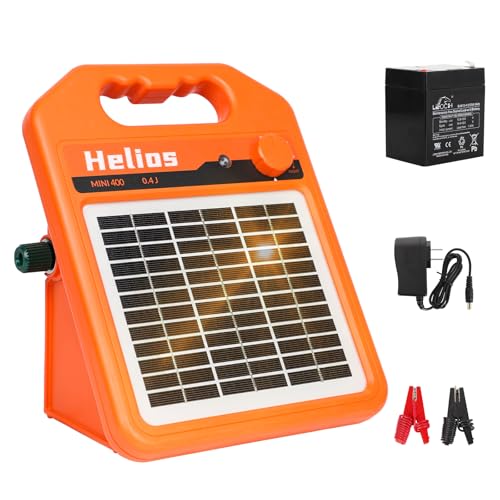
The MINI400 offers 0.4 joules of stored energy and can power up to 30 miles of fence. It features Day/Night mode to optimize energy use, delivering pulses more frequently during the day and less frequently at night. It can be powered by solar energy or a DC charger, delivering flexibility for diverse environments. Installation is simple, with compatibility for Y, T, and wooden posts, making it adaptable for various fencing layouts and livestock management practices.
ANDMON MINI250 Solar Fence Charger

The MINI250 provides up to 5 miles of fencing with a 0.18 joule output (0.25 joules stored). It includes a 12V/4.5AH sealed lead-acid battery and operates up to 21 days without sunshine. It features Day/Night Mode for energy efficiency and is designed for easy installation on standard posts, offering a versatile option for smaller pastures or portable fencing needs.
My Animal Command Solar Powered Fence Energizer

With a high-capacity 0.25 joule output (0.55 joules stored) and a rechargeable lithium battery, this unit delivers a humane pulse in the 9000–11000V range. It features a built-in 74.88 WH solar panel to maintain operation during extended periods without sun. The charger is weatherproof (IP54), easy to install, and includes earthing rod and cable connectors. It is suitable for cattle, horses, sheep, goats, pigs, and other livestock, and supports mounting on various post types for flexible fencing layouts.
Buying Guide
- Power and range: For larger cattle pastures, prioritize higher stored joule output and longer ideal-range ratings. Consider low-impedance designs to ensure stable performance over longer fences.
- Post compatibility and installation: Look for chargers with built-in mounting brackets and compatibility with T-posts, Y-posts, and wooden posts for quick, versatile installation.
- Power source flexibility: Day/night modes and dual power options (solar plus DC charging) offer resilience in varied weather. Battery type and capacity influence how long a unit runs without sun.
- Weather resistance and durability: Choose models with weatherproof enclosures and robust construction, especially if pastures face harsh conditions or predators.
- Maintenance and warranty: A unit with a solid warranty and reliable local support reduces long-term costs and downtime.
- Portability vs. permanence: Portable chargers are ideal for rotating pastures or remote locations, while mounted units benefit fixed paddocks and beehive protection.
- Predator deterrence and livestock safety: Ensure the charger delivers consistent, humane pulses that effectively deter wildlife without stressing animals.
- Installation accessories: Many packages include ground leads, fence leads, and mounting hardware—verify what’s included to avoid extra purchases.
When selecting a solar fence charger, balance pasture size, animal type, and environmental conditions. For remote grazing or frequent moves, portability and solar reliability are essential. For permanent installations in predictable environments, higher output and rugged durability offer long-term value. Always align product specifications with your fencing layout, wire type, and the number of strands to maximize performance and animal safety.