Best Solar Powered Air Vent Fans for Efficient Ventilation
Keep spaces like greenhouses, sheds, chicken coops, and attics cool and ventilated with solar powered air vent fans. This guide reviews top options, highlighting power, airflow, noise, and ease of installation. Learn how solar vents can reduce energy costs while maintaining a healthier indoor environment.
| Product | Brand | Key Benefit |
|---|---|---|
| PQINS 7.1″ Solar Greenhouse Fan (2 Pack) | pqins | High airflow up to 900 CFM per unit, flexible two-fan setup |
| SHENVITASO 25W Solar Exhaust Fan (8″) | SHENVITASO | Day/night operation with power adapter, anti-backflow valve |
| SwellishColor 25W Solar Roof Vent Fan (8″) | SwellishColor | Durable construction, up to 240 CFM |
| DC HOUSE Solar Attic Fan (32W, 1600 CFM) | DC HOUSE | High airflow, weatherproof, off-grid operation |
| OmniPV Solar Attic Fan (40W, 1600 CFM) | OmniPV | Low noise, thermostat control, weatherproof |
Note: All selections prioritize solar power operation, relatively high airflow, and suitability for small to mid-size spaces such as sheds, greenhouses, and attics. Each option includes its own solar panel or adapter for flexible installation.
PQINS 7.1″ Solar Greenhouse Fan 2 Pack

The PQINS solar fans feature a hi-velocity copper brushless motor and ultra-thin blades, delivering up to 3800 RPM and 900 CFM per fan. This kit includes two independent units, each with its own solar panel and a 16.5 ft extension cable. The system is designed to ventilate spaces of 150–230 sq ft, with automatic high-speed operation on sunny days and reduced speed on cloudy days. Installation flexibility allows one intake and one exhaust fan or two inlets/outlets, depending on placement needs.
SHENVITASO Solar Exhaust Fan (8″)

This 25W solar exhaust fan comes with an adjustable 8″ blade, a high-efficiency solar panel (up to 21.5% photovoltaic conversion) and a 16.4 ft cord for flexible placement. It operates at up to 2300 RPM for strong airflow (430 CFM) and includes an anti-backflow valve with a built-in iron block to keep unwanted air and pests out when the fan is off. It can work with a power adapter for night or rainy-day operation, ensuring continuous ventilation.
SwellishColor 25W Solar Roof Vent Fan (8″)

This 25W solar roof vent uses a monocrystalline solar panel and a durable, corrosion-resistant construction. It delivers up to 240 CFM of ventilation for attics, garages, and small solar-powered exhaust needs. The unit emphasizes energy savings by relying on sunlight and includes features like a tempered glass panel and sturdy aluminum frame to maximize solar absorption and long-term performance.
DC HOUSE Solar Attic Fan (32W, 1600CFM)
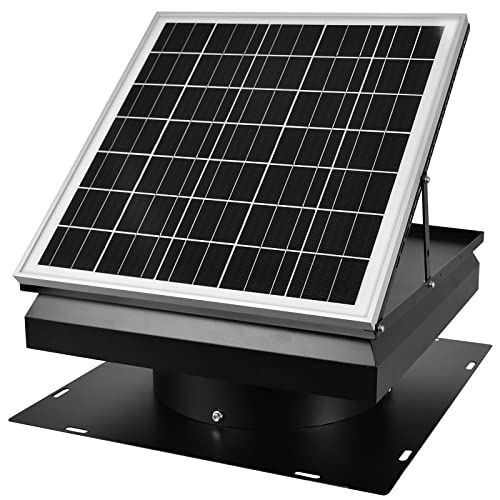
The DC HOUSE unit uses a 32W monocrystalline solar panel and a brushless DC motor to deliver up to 1600 CFM of airflow. It’s designed for attic and garage ventilation with weatherproofing to withstand outdoor conditions. The off-grid operation helps lower energy costs while maintaining comfortable indoor temperatures during sunny days.
OmniPV Solar Attic Fan (40 W, 1600 CFM)

The OmniPV attic fan pairs a 40W solar panel with a 1600 CFM capacity and a low-noise brushless DC motor. It features weatherproof housing and an integrated thermostat, providing automatic operation based on ambient temperature. The system is suitable for large spaces like homes, garages, greenhouses, and workshops seeking reliable solar-powered ventilation.
Buying Guide: Key Considerations For Solar Vent Fans
- Airflow and space: Match CFM ratings to the room size. Larger spaces require higher CFM to achieve effective ventilation, while smaller sheds or greenhouses can be adequately served by 400–1200 CFM units.
- Power source and reliability: Solar panels can power fans directly in sunny conditions or with adapters for night use. Consider systems with automatic on/off, thermostats, or dual power options for 24/7 operation.
- Installation flexibility: Look for units with separate panels or long extension cables, and mounting options that allow intake/exhaust placement in optimal positions to maximize airflow.
- Durability and weather resistance: Outdoor solar fans should have weatherproof housings (IP ratings), corrosion-resistant materials, and secure mounting to withstand wind and rain.
- Noise and efficiency: Brushless DC motors offer quiet operation and higher efficiency. Quieter systems are preferable for living or working spaces close to the vent location.
- Maintenance: Consider ease of cleaning, access to components, and availability of replacement parts like panels, motors, or gaskets for long-term use.
- Back-up options: Some models include AC adapters for nighttime use or rain days, ensuring consistent ventilation regardless of weather.
- Energy impact: Solar-powered fans reduce grid energy use and work best in well-lit environments; assess roof exposure and shading to estimate performance.
Across these options, buyers can pick configurations that fit various spaces—from concentrated chicken coops to broad attics—while prioritizing solar efficiency, airflow, and durability. When evaluating a model, compare CFM ratings, panel efficiency, weatherproofing, and whether a back-up power option is included for extended, all-day ventilation.