Best Solar Power With Battery Backup for Home and on the Go
Discover reliable solar power options with battery backup to keep essentials powered during outages, camping trips, or off-grid living. This guide highlights five top portable and home-ready solar generators, focusing on capacity, recharge speed, expandability, and safe power delivery. Compare real-world performance and features to choose a system that fits your needs and budget without compromising safety or convenience.
Summary Table of Selected Products:
| Product | Brand | Capacity (Wh) | Max Output (W) | Recharge Speed | Expandable? | Link |
|---|---|---|---|---|---|---|
| Anker SOLIX C1000 Gen 2 | Anker | 1056 | 2400 (surge) | UltraFast 58 min full | Yes (Expandable with modules) | https://www.amazon.com/dp/B0C5C89QKZ?tag=infinitepower06-20 |
| Jackery Solar Generator 300 | Jackery | 293 | 300 | About 2 hours to 80% | Yes (SolarSaga 100) | https://www.amazon.com/dp/B0BMWDGJLB?tag=infinitepower06-20 |
| EF ECOFLOW Delta 2 | EF ECOFLOW | 1024 | 1800 | 0-80% in 50 mins | Expandable with extra batteries | https://www.amazon.com/dp/B0B9XB57XM?tag=infinitepower06-20 |
| Jackery Explorer 300 | Jackery | 293 | 300 | About 2 hours to 80% | Yes (SolarSaga 100) | https://www.amazon.com/dp/B082TMBYR6?tag=infinitepower06-20 |
| OUPES Mega 1 Portable | OUPES | 1024 | 2000 | 36 mins AC, 26 mins combo | Extendable to 5120Wh | https://www.amazon.com/dp/B0DG8JQNS4?tag=infinitepower06-20 |
Anker SOLIX C1000 Gen 2 Portable Power Station

The Anker SOLIX C1000 Gen 2 delivers strong performance with a 1,056Wh LiFePO4 battery and a robust 2,000W continuous output, peaking at 3,000W. It supports UltraFast charging, reaching 80% in about 43 minutes and a full charge in under an hour when using AC input and the app-enabled UltraFast setting. Its LiFePO4 chemistry provides long-cycle durability, with up to around 3,000 battery cycles, making it suitable for frequent outages or extended off-grid use. The unit is noted for its compact size and portability for use at home, in an RV, or during outdoor adventures.
Key features include fast recharge, multiple ports for powering up to 10 devices, and portability. The expandable ecosystem allows for additional modules or accessories to increase capacity as needs grow. Such versatility makes it a strong candidate for emergency backup, work-from-anywhere setups, and off-grid living where reliability matters.
Jackery Solar Generator 300

The Jackery Explorer 300 pairs a compact 293Wh battery with reliable 300W continuous output, ideal for small outdoor setups or backup needs. It recharges via multiple paths—AC wall outlet, car outlet, or Jackery SolarSaga 100 solar panel—providing flexible options for camping, RV trips, or during a blackout. The unit weighs about 7.1 pounds, enhancing portability. It supports simultaneous charging of several devices through two AC outlets, USB-C, USB-A, and other ports, enabling a mix of drones, laptops, cameras, and phones to stay powered. The system emphasizes safe, steady power for off-grid activities.
With fast recharging to 80% in a couple of hours and easy expansion through add-on solar panels, this model serves as a dependable go-to for enthusiasts who value compact design without sacrificing essential functionality.
EF ECOFLOW Delta 2 Portable Power Station

The EF ECOFLOW Delta 2 features a 1,024Wh LiFePO4 battery and an impressive 1,800W continuous output, with a surge capacity of 3,000W. It includes 15 outlets for broad device compatibility and supports fast charging, achieving up to 80% charge in about 50 minutes via AC input. The Delta 2 excels in home backup scenarios, camping, and RVs, offering expandable capacity through additional battery modules to meet growing power demands. Its safety-grade features and efficient energy management make it a practical choice for reliable, quiet, and clean power.
Jackery Explorer 300 (Second Listing)

The Explorer 300 remains a compact, versatile option with a similar 293Wh capacity and 300W output, ideal for hikers, campers, and emergency outages. Features include two Pure Sine Wave AC outlets, PD USB-C, and multiple USB ports to recharge a range of devices. It prioritizes portability while maintaining the power necessary to handle essential electronics, cameras, laptops, and small appliances. While small in size, it supports several charging methods and is compatible with the Jackery SolarSaga 100 panel for solar recharging on the go.
OUPES Mega 1 Portable Power Station
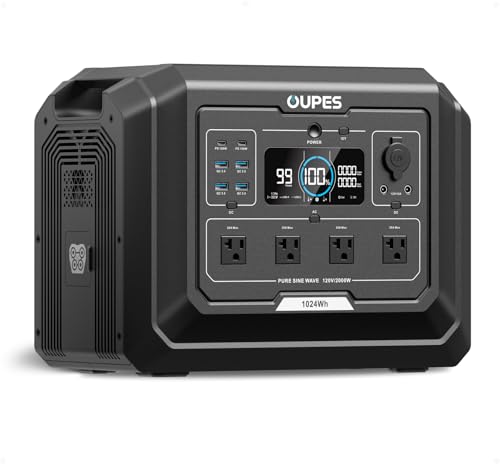
The OUPES Mega 1 provides 2,000W continuous output (4,500W surge) from a 1,024Wh LiFePO4 battery, designed for robust performance in emergencies and extended off-grid use. It showcases revolutionary fast-charging speeds, reaching 0-80% in 36 minutes via AC input and as fast as 26 minutes when combining AC and solar inputs. A standout feature is modular expansion, allowing connections to extra B2 Extra Batteries to scale capacity up to 5,120Wh without complex wiring. This makes it suitable for larger households, RV setups, and scalable emergency power systems.
Buying Guide: Key Considerations And Comparisons
- Capacity vs. needs: Choose Wh capacity based on essential appliances you want to run during an outage. For minimal needs, 300–1,000Wh is sufficient; for whole-home backup, 2,000–3,000Wh or more is preferable.
- Power output (continuous vs. surge): Continuous watts determine how long devices stay powered, while surge watts handle high-draw appliances (like refrigerators or power tools) briefly.
- Battery chemistry and durability: LiFePO4 offers longer cycle life and stability in varying temperatures, ideal for long-term reliability and outdoor use.
- Recharge speed: UltraFast or rapid charging reduces downtime. Consider AC-only, solar-assisted, or mixed charging modes to match your lifestyle.
- Solar compatibility and expandability: If solar is important, verify panel compatibility and the ability to add extra batteries or modules to scale capacity.
- Port variety and safety: A broad port selection (AC, USB-C, USB-A, DC car ports) enhances device compatibility. Look for safety features like overcurrent, short-circuit, and temperature protection.
- Portability vs. capacity: Heavier, higher-capacity units offer more power but are less portable. Balance weight, handle design, and form factor for your use case.
- Price and support: Compare warranties, customer support, and accessory ecosystems. Longer warranties often accompany higher-quality cells and better durability.
- Tax incentives and policies: Some larger systems may qualify for tax credits or utility programs depending on location and qualifying equipment.
Overall, the best option depends on your primary use case: compact outdoor trips and daily charging, or home backup with extended runtime. For frequent outages or off-grid living, prioritize higher capacity and expandability. For light use and portability, smaller models with fast recharge can meet most daily needs. Safety, reliability, and a robust accessory ecosystem are core factors to weigh alongside price.