Best Solar Power for Off Grid: Top Kits and Generators for Independent Living
For off-grid living, selecting a reliable solar power system is essential. This guide reviews five leading options that balance capacity, reliability, and ease of use for homes, cabins, RVs, and emergency backup. Each product includes a brief overview of what it can handle, helping you choose a system that matches your energy needs and climate. Below is a quick summary table of the featured setups to compare capacity, storage, and form factor at a glance.
| Product | Type | Estimated Capacity | Notes |
|---|---|---|---|
| ECO-WORTHY Home Off-Grid Solar Power System | Hybrid Kit | 10 kW / 20 kW peak; 15.36 kWh | Plug-and-play; 3x48V100Ah LiFePO4 |
| Jackery Solar Generator 1000 v2 (200W Panel) | Portable Power Station | 1,070 Wh | Fast charge, outdoor ready, long lifespan |
| ECO-WORTHY 5KW Off Grid Solar System Complete Kit | Hybrid System | 5 kW inverter; 4x48V100Ah | Series-connected panels and batteries; simple wiring |
| Jackery Solar Generator 1000 v2 (2x100W Panels) | Portable Power Station | 1,070 Wh | Enhanced solar input; versatile for outdoor use |
| ECO-WORTHY 10000W Complete Off-Grid Kit | High-Capacity Kit | ~40 kWh daily under good sun | Modular inverters; 4x48V100Ah batteries |
ECO-WORTHY Home Off-Grid Solar Power System

The ECO-WORTHY 10KW hybrid kit integrates a robust solar inverter with a large-capacity battery pack and an array of high-output solar panels. It features a rated output of 10KW with a 20KW peak capacity and supports both 120V and 240V single-phase outputs, making it suitable for homes or cabins that need reliable, scalable power. The 48V 100Ah LiFePO4 batteries deliver steady storage, and the 410W monocrystalline panels balance efficiency with shading tolerance. The system emphasizes plug-and-play connectivity, CAN/RS485 communication, and a compact rack-compatible design for space-limited installations.
Key features include a modular battery pack that can be expanded with parallel or series connections, a flexible AC input mode to optimize energy costs, and heat-strengthened glass panels designed for long-term resilience. This kit aims to simplify off-grid setup while delivering dependable energy for essential appliances and daily needs. Installation should consider local sun exposure, roof or ground mounting, and adequate ventilation for the hybrid inverter.
What to consider
- System expansion: Check if the inverter and battery modules support future growth as energy needs rise.
- Maintenance: LiFePO4 batteries typically offer long cycle life but may require temperature-aware storage planning.
- Space requirements: The 3U server-rack style battery could influence where you place the kit.
Jackery Solar Generator 1000 v2 With 200W Panel

The Jackery Solar Generator 1000 v2 pairs a high-capacity 1,070Wh portable power station with a 200W solar panel input, delivering 1,500W continuous AC output and a 3,000W surge. It’s designed for outdoor use, RVs, and emergencies thanks to its light frame (about 23.8 pounds) and foldable handle. The system supports rapid charging via the Jackery App—reaching full charge quickly when sunlight allows. Its durable lithium iron phosphate (LiFePO4) battery is rated for thousands of cycles while preserving a large portion of its capacity, providing reliable, predictable power over years of use.
Ideal for campers or as a lightweight home backup in power outages, this kit emphasizes portability and quick deployment. The integrated safety features and smart charging help protect connected devices, though total daily energy is limited by the 1,070Wh capacity. Consider pairing with additional panels if higher daytime energy needs are anticipated.
What to consider
- Portability vs. capacity: Weigh the benefits of a compact unit against larger home-scale needs.
- Expansion: Check compatibility with additional Jackery accessories or third-party solar panels.
- Intended use: Best suited for temporary off-grid scenarios or supplementary power at a site.
ECO-WORTHY 5KW Off Grid Solar System Complete Kit
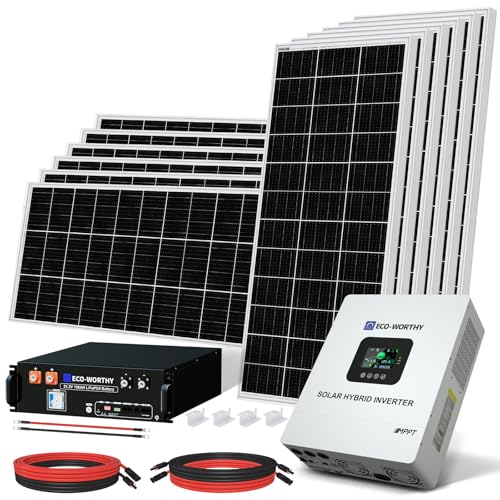
This 5KW off-grid kit provides a balanced solution for independence without overbuilding. It includes 12 panels of 195W each (2340W total) and a 5KW hybrid inverter with a built-in charge controller, simplifying wiring and installation. The 48V 100Ah batteries, connected in series, deliver a practical storage capacity suitable for prolonged outages or day-to-day autonomy. The system supports parallel operation, allowing for more 120V/208V/240V outputs when multiple inverters are used. It’s designed for straightforward, scalable energy independence with a focus on reliability and safety.
Considerations include battery placement in a ventilated area, cable sizing for long runs, and how you’ll monitor consumption during cloudy days. Since it uses a server-rack-friendly battery format, space planning is essential for a tidy installation. The UL 9540A-compliant battery ensures safety standards align with home or small commercial use.
What to consider
- System scale: Ensure the kit matches current and near-future energy demands.
- Wiring simplicity: Built-in controller reduces installation complexity.
- Safety standards: Look for UL/UL 9540A compliance for storage components.
ECO-WORTHY 400 Watt Premium Solar Panel Kit

The Premium Solar Panel Kit delivers four 100W monocrystalline panels, a 40A MPPT controller, Bluetooth module, and mounting hardware. Each panel offers high efficiency with 21% cell efficiency and rugged construction to withstand wind and snow loads. The MPPT controller promises high tracking efficiency and a modern charge-management system to maximize battery life. This kit is well-suited for off-grid cabins or RV setups seeking a compact, dependable solar array with smart monitoring.
Key considerations include how the Bluetooth module can help you monitor performance remotely and whether your storage system can utilize the full potential of the 400W array. Installation should account for shade-free exposure and appropriate mounting angles to optimize daily output across seasons.
Jackery Solar Generator 1000 v2 With 2x100W Panels

This Jackery setup combines the Explorer 1000 v2 power station with two 100W solar panels, enhancing daytime charging capabilities while maintaining portability. The unit provides a robust 1,500W continuous output and 3,000W surge, suitable for powering essential appliances during outages. Fast charging via the app and a battery designed for thousands of cycles contribute to longevity. The system is particularly appealing for outdoor enthusiasts or as a supplementary home-off-grid power source when kept connected to solar input during sunny periods.
Key considerations include panel orientation, potential need for an extra panel for higher daytime energy capture, and ensuring the system remains within safe operating temperatures during peak sun. This option excels when mobility and quick deployment are priorities alongside reliable power delivery.
Buying Guide: Key Purchase Considerations For Off-Grid Solar
- Total energy demand: Estimate daily watt-hours for essential appliances and heating/cooling to determine needed capacity and storage.
- System topology: Decide between a hybrid vs. pure off-grid configuration based on whether you want grid-tied charging options or complete independence.
- Storage technology: LiFePO4 batteries offer stability, long cycle life, and safe chemistry; verify cycle counts and operating temperature ranges.
- Inverter capacity: Match inverter rating to peak loads (consider surges from appliances like AC or microwaves) and whether you need split-phase outputs.
- Expandability: Look for modular designs that allow adding batteries, panels, or additional inverters as energy needs grow.
- Monitoring and control: Confirm whether the system includes remote monitoring, app control, and CAN/RS485 communication for integration with other solar controllers.
- Durability and warranty: Check panel efficiency under shading, coating, frame robustness, and battery warranty length and conditions.
- Installation site: Assess sun exposure, mounting location, shade, wind loads, and ventilation for inverters and batteries.
- Safety standards: Ensure compliance with UL or equivalent standards for storage components and wiring.
- Maintenance plan: Understand routine checks, cleaning of panels, and battery health management to maximize lifespan.