Best Solar Panels to Charge RV Batteries for Reliable Off-Grid Power
Looking for reliable solar panels to charge RV batteries? This guide highlights five top options that balance efficiency, durability, and ease of use for RV enthusiasts, campers, and trailer owners. Each product is evaluated for who it’s best for and why it fits a 12V battery system. Use this overview to compare MPPT capabilities, portability, and installation flexibility to pick the right kit for your RV lifestyle.
| Product | Best For |
|---|---|
| Voltset 12V Solar Battery Charger | Best budget-friendly trickle charging for RVs and boats |
| ZOUPW 100W Portable Solar Panel | Best all-around portability with extensive compatibility |
| SOLPERK 100W Solar Battery Charger | Best for high efficiency and rugged use |
| POWOXI 7.5W Solar Charger | Best compact option for minimal setups |
| Topsolar 100W Kit with Controller | Best complete system for off-grid charging |
Voltset 12V Solar Battery Charger

The Voltset kit uses a high-efficiency MPPT solar charger to deliver 20-30% faster charging for 12V batteries. Its A+ monocrystalline panel harnesses more sun with less time waiting, making it ideal as a trickle charger for cars, RVs, boats, and trailers. It includes multi-layer protection and a smart controller to prevent backflow at night, extending battery life and reducing maintenance needs.
Best for: RV owners who want a compact, maintenance-friendly charger that protects and prolongs 12V battery health. Better for lightweight setups and occasional charging rather than sustained high-power use. Caution: limited wattage means slower charge for large battery banks.
ZOUPW 100W Portable Solar Panel

This foldable, tempered-glass panel delivers up to 100W with a built-in PWM controller suitable for 12V systems and power stations. It includes a 5-in-1 charging cable for broad compatibility and a portable form factor with kickstands for flexible sun exposure. The kit is designed for RVs, camping, and off-grid use.
Best for: Campers who need a versatile, high-capacity portable panel with broad connector compatibility. Choose this if you prioritize outdoor setup flexibility and simple plug-and-play charging. Limitation: heavier than ultra-compact options and requires some space when unfolded.
SOLPERK 100W Solar Battery Charger

The SOLPERK kit features a high-efficiency MPPT controller claimed to yield 30% more power and strong waterproof protection. It is designed for RVs, boats, trailers, and other 12V applications, with a monocrystalline A+ panel and easy plug-and-play setup. The controller provides robust safeguards against overcharging, discharging, and surges.
Best for: users seeking robust, weatherproof performance and higher efficiency in a mid-to-large 12V system. Better for longer sunny days of RV use. Caution: some users may find the system more complex to install than basic kits.
POWOXI Upgraded 7.5W Trickle Charger
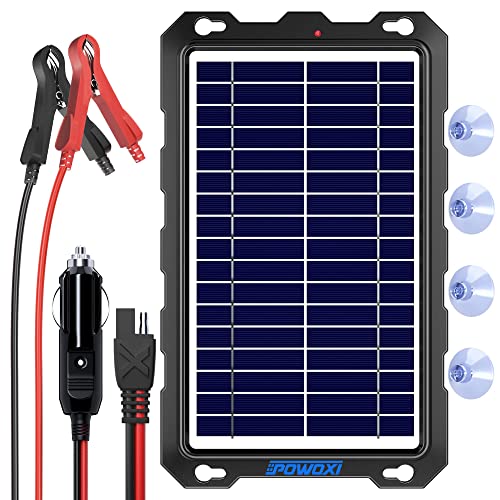
This compact 7.5W solar charger uses an intelligent charge controller with built-in protection and a durable, weatherproof build. It offers high conversion efficiency in a small footprint and is designed to maintain smaller 12V batteries. It does not store energy and is best as a maintenance charger for limited solar exposure.
Best for: RVers with minimal solar needs or as a supplementary charger in shaded areas. Avoid this if you expect high daytime charging for large battery banks or extended boondocking.
Topsolar 100W Kit With Controller
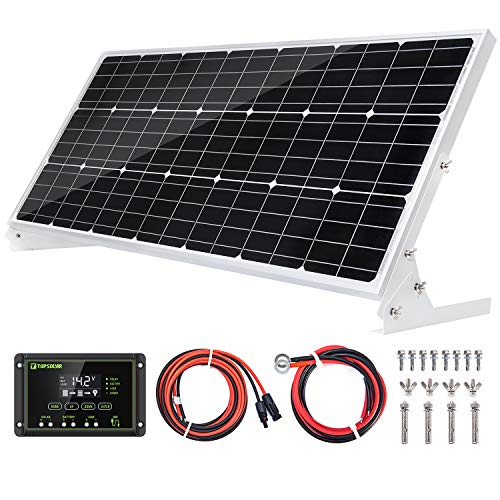
This complete 100W solar panel kit includes a 12V intelligent charge controller, mounting hardware, and cables. It’s designed for off-grid charging and supports charging across various 12V applications, including RVs, boats, and cabins. The system helps maintain battery charge during storage and remote use.
Best for: RV owners seeking an all-in-one solution with mounting hardware for straightforward installation. Better for sustained off-grid use than ultra-compact options. Limitation: may require more space and setup time than foldable kits.
Buying Guide
What should you consider when choosing a solar panel kit for RV batteries?
- Power needs: Match wattage to your battery capacity and daily usage. Higher wattage supports longer days of use and larger battery banks.
- Controller type: MPPT controllers optimize power under varied sun conditions; PWM controllers are simpler and often cheaper but less efficient.
- Portability vs. permanence: Foldable panels are portable and easy to store, while rigid panels suit permanent roof mounts.
- Battery compatibility: Verify compatibility with LiFePO4, AGM, Gel, Flooded, and Lithium Ion batteries to prevent damage.
- Durability and weather resistance: Look for waterproofing, tempered glass, and durable framing for outdoor RV conditions.
- Ease of installation: Pre-drilled holes, included cables, and clear instructions save setup time.
- Expandability: If you plan to scale, choose kits with modular components or common connector standards.
FAQ
- What is MPPT and why does it matter for RV charging?
MPPT stands for Maximum Power Point Tracking. It optimizes the voltage and current from the solar panel to deliver more usable power to the battery, especially in fluctuating sun conditions, improving efficiency by up to 20-30% in many setups.
- Can a 100W panel fully charge an RV battery?
A 100W panel can maintain or slowly recharge a typical 12V RV battery during sunny days, but actual charging depends on sun availability, battery size, and usage. For larger banks, consider higher-wattage kits or multiple panels.
- Is foldable better than rigid for RV use?
Foldable panels are ideal for portability and storage, especially in small RVs or during travel. Rigid panels are better for permanent roof mounting and simplified setups.
- What type of battery chemistry should I choose?
Common options include LiFePO4, AGM, and Gel. Select a charger compatible with your chosen chemistry to ensure safe charging and longer battery life.
- Do all these kits include mounting hardware?
Some kits include mounting hardware and cables, while others focus on the panel and controller. Check the product’s listed features to confirm what’s included.
- Can I run solar charging while driving?
Most 12V solar charging systems are designed to maintain or slowly charge batteries when parked or stored. Driving may affect charging efficiency due to alternating sun exposure and vehicle loads; use while parked for best results.