Best Solar Panels for Household Use: Efficient, Durable Options for Home Power
The following guide highlights five solar panel products well-suited for household use, offering a mix of high efficiency, portability, and scalability. Each entry provides key features, compatibility notes, and practical considerations for home energy setups. Use this overview to compare performance in real-world conditions and choose panels that align with your home’s electricity needs and installation constraints.
| Product | Brand | Key Strengths |
|---|---|---|
| ECO-WORTHY 400W Solar Panels (4×100W) | ECO-WORTHY | High total wattage, 23% efficiency, IP65 junction box |
| STAR 870 Watt Solar Panels (2×435W) | STAR | Large-scale output, full-screen design, maintenance-free |
| SUNGOLDPOWER UL61730 550W Panels (×10) | SGPWATT | High-quality cells, waterproof, versatile for off-grid |
| DOKIO 200W Portable Foldable Panel Kit | DOKIO | Portable, separate controller, easy RV/camping use |
| ZOUPW 100W Portable Solar Panel with 5-in-1 Cable | ZOUPW | 5-in-1 universal connectivity, IP67 ETFE coating |
ECO-WORTHY 400W Solar Panels

ECO-WORTHY provides a four-panel configuration adding up to 400 watts, built with monocrystalline cells and PERC tech for improved light capture. The system is designed for off-grid or hybrid home setups, including charging 12V/24V batteries for remote cabins, sheds, RVs, boats, or farm outbuildings. The IP65-rated junction box includes pre-installed bypass diodes to minimize shade losses, promoting steadier output in variable weather. With 23% efficiency and straightforward expansion potential, these panels support scalable home energy projects.
SUNGOLDPOWER UL61730 550W Solar Panels
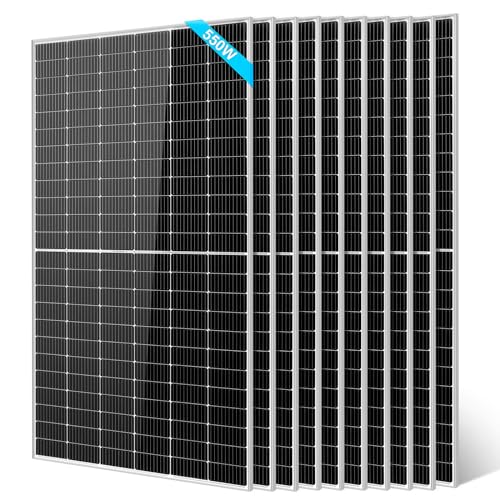
This set features a full-screen, maintenance-free design with 550 watts of output and a robust weatherproof build. The UL61730 rating indicates quality and safety compliance for residential, marine, and off-grid installations. The corrosion-resistant frame and high tolerance specifications support longer outdoor use, while pre-drilled mounting holes simplify roof or ground installations. Suitable for larger home energy projects or supplemental solar arrays for winter months when sun angles are lower.
DOKIO 200W Portable Foldable Solar Panel Kit

This foldable 200W kit is designed for mobility and emergency backup. A separate PWM controller protects the 12V system, and a long 9.84-foot cable enables flexible positioning in direct sunlight while keeping the controller shaded. Weighing under 10 pounds when folded and compact dimensions support easy transport, installation on RVs, boats, trailers, or temporary home setups where space or portability matters.
ZOUPW 100W Portable Solar Panel

ZOUPW offers a compact 100W solution with a 5-in-1 universal connectivity kit to fit a wide range of portable power stations. The 23.5% efficiency reflects a strong performance for its size, and IP67 ETFE-coated layers deliver durability in outdoor conditions. Adjustable kickstands allow tilting for better sun exposure, making it a practical option for camping, RV trips, or as a small home backup array where space is limited.
Buying Guide: Key Considerations For Household Solar Panel Purchases
- System size and goals: Assess daily energy usage, available roof or ground space, and whether you want to offset a majority of your home’s consumption or supplement it with a smaller kit.
- Panel type and efficiency: Monocrystalline panels offer higher efficiency and better performance in low light, while polycrystalline options may reduce cost per watt. For rooftops, higher efficiency saves space.
- Durability and weather resistance: Look for ETFE or tempered glass with corrosion-resistant frames and IP ratings. All-season performance matters for homes in varied climates.
- Mounting and installation: Roof mounting typically requires professional assessment, while ground-mounted or portable systems need stable framing and proper tilt for optimal sun exposure.
- Power management: A compatible charge controller (PWM or MPPT) and a suitable inverter determine how effectively panels convert DC energy to usable AC power for home appliances.
- Expandability: If you anticipate growing your solar capacity, choose modular panels and inverters that allow add-ons without a full system redoseign.
- Warranty and support: Confirm panel and controller warranties, regional service options, and ease of finding replacement parts if needed.
- Weight and transport: Portable kits are ideal for temporary setups or off-grid scenarios; heavier roof-mounted panels require proper hardware and professional mounting.
When evaluating these options, consider how each panel configuration aligns with your home’s electrical system, local sunlight patterns, and potential extension by future additions or battery storage. Efficiency, durability, and ease of installation are central to maximizing long-term savings and reliability.