Best Solar Panel Wind Turbine Combos for Off-Grid Power
The best solar panel wind turbine combo kits provide reliable, multi-source power for off-grid homes, RVs, boats, or cabins. These selections balance solar and wind inputs to help you generate electricity in varying weather. The top picks below are suited for different buyers: campers and tiny homes for portability, boaters for marine reliability, and remote cabins needing steady daily output. Use the quick comparison table to pick the right kit, then read each detailed product section for why it fits your needs.
| Product | Best For | Notes |
|---|---|---|
| VEVOR 12V 400W Solar Wind Power Kit | Off-grid homes and RVs | Balanced 2x100W solar + 200W wind |
| Giosolar 1000W Solar Wind Combo Kit (6x100W) | Homes, cabins, boats | High panel count for steady sun |
| Giosolar 1000W 12V Wind Turbine Kit | Off-grid cabins and boats | 12V wind-first hybrid |
| Pikasola Wind Turbine Kit 400W | RVs and small homes | Compact wind-first option |
| Giosolar 340W Solar Wind Kit | Portable setups | Smaller, easy install |
VEVOR 12V 400W Solar Wind Power Kit
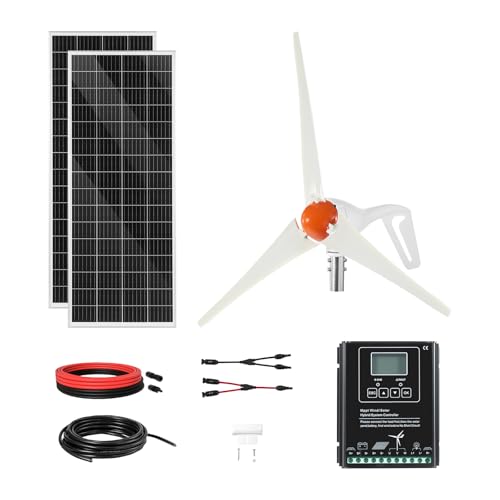
Best for mixed weather environments where a compact, all-in-one solution is preferred. This kit includes two 100W monocrystalline solar panels plus a 200W wind turbine and a hybrid MPPT controller, enabling up to around 1.6 kWh per day under favorable conditions. Best for off-grid homes, RVs, boats, and camping setups that need steady power with both sun and wind sources. A limitation is that output depends on wind speed and sun exposure, so performance varies by location.
- High-efficiency monocrystalline solar cells and robust glass for stable energy conversion.
- Operational range from 14°F to 149°F for outdoor reliability.
- 2.5 m/s start-up wind speed and 12 m/s rated wind speed optimize wind capture.
Who it’s best for: Buyers seeking an all-in-one hybrid kit for vehicles, tiny homes, or remote campsites with moderate wind and sun. Choose this if you want a bundled solution without sourcing components separately. Caution: if you live in an extremely windy area, you may want a larger turbine to maximize wind capture.
Giosolar 1000W Solar Wind Combo Kit for Home RV Boat Cabin

This kit bundles six 100W glass solar panels with a 400W wind turbine and a solar/wind charge controller. It is designed for larger off-grid installations such as homes, RVs, cabins, and boats needing higher daily output. Best for steady daytime solar input and moderate wind, with the caveat that it requires more space for solar panels and setup effort is greater than smaller kits.
- 100W solar panels with up to ~23% efficiency and IP65 protection.
- Pre-drilled panels and pre-attached cables simplify mounting.
- Corrosion-resistant aluminum frames suitable for diverse environments.
Who it’s best for: Buyers planning a more permanent off-grid installation or a larger RV/cabin setup where higher total daily energy is needed. Better for sunny climates with decent wind. Caution: the six-panel array requires more roof or yard space and a secure mounting plan.
Giosolar 1000W 12V Wind Turbine Kit
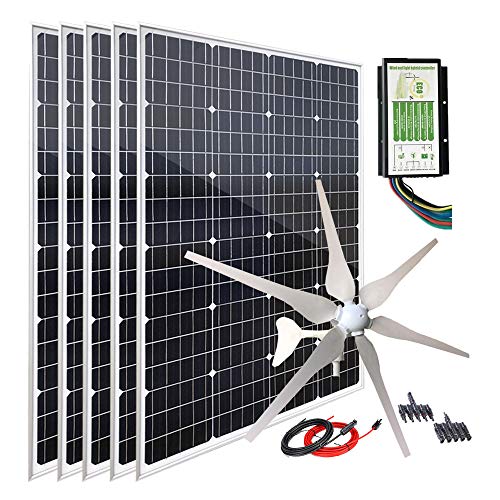
Best for location-focused wind power where solar access is limited. This kit combines a 400W wind turbine with 1,000W solar capacity in a hybrid system, designed for off-grid homes, RVs, boats, cabins, and similar applications. Selected for locations with reliable wind and variable sunlight. Limitation: wind performance can vary; plan for a higher wind turbine capacity if your site experiences calm periods.
- 120W monocrystalline solar panels with up to 21% efficiency.
- Pre-drilled holes and easy mounting considerations.
- Low start-up wind speed and robust aluminum frame.
Who it’s best for: Buyers who expect consistent wind resources or want a strong wind-turbine emphasis in a hybrid system. Choose this if you want a balanced system that can rely on wind when sun is scarce. Caution: solar output may underperform on long cloudy spells; ensure storage or alternative charging is available.
Pikasola 400W Wind Turbine Kit + 2x100W Solar Panels

Optimized for RVs, boats, or small homes needing a compact hybrid. The 400W wind turbine, combined with two 100W mono solar panels, supports a lightweight off-grid kit. Best for travelers and small-living setups where mobility matters. Limitation: the wind turbine is the primary power driver; solar input is modest, so plan for modest daily energy unless wind is reliable.
- 2.5 m/s wind start-up, low vibration operation.
- Full aluminum body with nylon blades for durability.
- Solar cells up to 24% efficiency with durable encapsulation.
Who it’s best for: Buyers seeking a portable hybrid system for RVs or marine use where weight and space are at a premium. Choose this if you prioritize mobility over a very large solar array. Caution: the two 100W panels limit daytime output; ensure storage or supplemental charging if long grey periods occur.
AUECOOR 1000 Watts Solar Panel Wind Turbine Hybrid Kit

Designed for people who want a robust hybrid system capable of handling day and night power needs. The kit claims 600W solar capacity with a 400W wind turbine, totaling strong daily output for off-grid farms, homes, or cabins. It emphasizes constant charging capability across weather scenarios. A potential limitation is the need for adequate space to install a larger solar array and turbine system safely.
- Six hundred watts of solar panel capacity with a 400W wind turbine.
- Designed for off-grid homes and remote installations.
- Includes solar charge controller and mounting hardware.
Who it’s best for: Buyers needing a higher-capacity hybrid kit for larger off-grid homes or cabins, where both sun and wind are essential. Choose this if you want strong hybrid power with available expansion in the future. Caution: install space and wiring complexity increase with system size.
Buying Guide
What should I consider when choosing a solar wind hybrid kit?
Assess energy goals, climate, and space. Larger solar arrays deliver more daytime power; higher wind turbine capacity boosts nighttime or windy-day output. Look for kits with a reliable MPPT controller to optimize charging under varying conditions. Consider storage options (batteries) and expansion potential.
How do I match wind and solar with daily needs?
Estimate daily consumption and design for worst-case weather periods. If your area is sun-rich but windy, prioritize solar panels; if wind is abundant, prioritize turbine capacity. A balanced kit helps smooth out daily fluctuations and reduces reliance on a single source.
What installation considerations matter?
Ensure proper mounting, weatherproofing, and cable routing. Monocrystalline panels resist weathering well; choose corrosion-resistant frames for outdoor use. Plan for proper tilt and orientation, and verify all safety requirements for roof or ground mounting.
Storage and maintenance questions
Assess battery storage needs if you want nighttime power. Regularly inspect blades, mounts, and connectors. Verify controller settings and keep components clean to maintain efficiency over time.
Site-specific tips
If you have limited space, favor compact kits with higher efficiency panels and a turbine tuned to local wind speeds. In remote cabins, prioritize ease of installation and robust hardware to withstand cold or wet conditions. For marine use, ensure corrosion resistance and secure mounting.
Compact vs. scalable kits
Compact kits are easier to install and transport but may offer limited daily output. Scalable systems enable adding panels or a larger turbine later, matching growing power needs without replacing the whole setup.
FAQ
- Q: Do hybrid kits require batteries?
- Q: Can I install these kits myself?
- Q: How much power will I actually get?
- Q: Are these kits weather-resistant?
- Q: What maintenance is required?
- Q: Can I upgrade later?
A: Batteries are commonly used for storage and smooth power delivery, especially for nighttime use. Verify if the kit includes batteries or if you need to purchase them separately.
A: Many components are designed for DIY installation, but ensure you follow safety guidelines and local codes. Complex systems may benefit from professional assistance.
A: Output depends on solar exposure, wind speed, and system efficiency. Hybrid controllers optimize charging, but results vary by location and weather.
A: Kits include weather-rated panels and durable turbine components, but external mounting and connections still need proper sealing and protection.
A: Regular inspections of blades, mounts, connectors, and controller settings help sustain performance. Clean panels and check weather seals periodically.
A: Many kits are designed for expansion, but verify compatibility with controllers, batteries, and mounting brackets before buying.