Best Solar Panel to Charge Marine Battery for Reliable Off-Grid Power
Answering the question, the best solar panel to charge a marine battery is a 12V trickle charger kit with a built-in MPPT controller and weatherproof build. It keeps boat, RV, or trailer batteries topped up without overcharging. The top picks below are ideal for different sailors, anglers, and boaters who want simple, maintenance-free charging while on shore power or out at sea.
Summary table of selected products:
- Voltset 12V Solar Battery Charger 20W with MPPT Controller
- SOLPERK Solar Panel Kit 20W with Smart MPPT Controller
- SUNER POWER Waterproof 20W Solar Battery Charger & Maintainer PRO
- SOLPERK 30W Solar Battery Charger + 10A MPPT Controller
- POWOXI 30W Solar Battery Charger with IP67 MPPT Controller
Voltset 12V Solar Battery Charger — 20W Kit

This 20W Voltset kit pairs a high-efficiency MPPT solar charger with a monocrystalline panel for fast charging of 12V batteries. Best for boat owners who want a compact, reliable trickle charger to maintain marine batteries during long, idle periods. The universal 12V compatibility covers LiFePO4, AGM, Gel, Flooded, and Lithium Ion batteries.
Why it’s selected: It offers smart protection to prevent overcharge, over-discharge, short circuits, and reverse polarity. The controller stops draining power at night, helping extend battery life. It’s ideal for RVs, boats, and trailers where space is at a premium.
Limitation: As a 20W panel, charging speed is modest on larger battery banks or during heavy usage in overcast conditions. It’s best for maintenance rather than rapid recharging.
SOLPERK Solar Panel Kit 20W — Smart MPPT
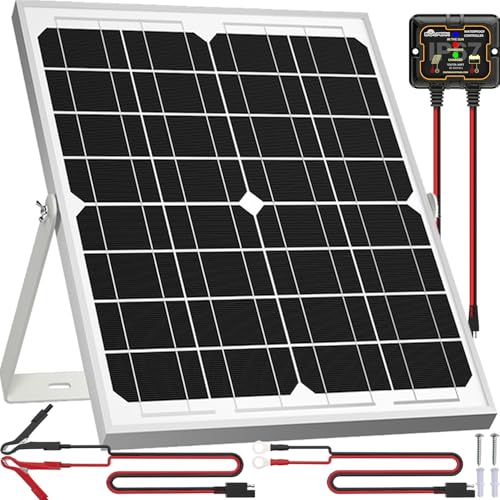
The SOLPERK 20W kit uses A+ monocrystalline cells for 21%-30% efficiency and includes an eight-amp MPPT controller. It maintains 12V batteries—LiFePO4, Lithium Ion, AGM, SLA, GEL, EFB, MF—across boats, cars, RVs, and trailers. The weatherproof build and adjustable mount add versatility for marine installations.
Best for: Boat or trailer owners who need a durable, all-weather charging solution with clear charging indicators. The kit’s weather resistance supports salt spray and spray-mist environments typical on decks and docks.
Caution: While robust, the system’s 20W rating may be insufficient for large battery banks or high daily energy use; consider higher-wattage options for larger vessels or frequent use.
SUNER POWER Waterproof 20W PRO — Ultra-Smart MPPT

SUNER POWER’s 20W PRO kit features Ultra-Smart MPPT with up to 99% tracking efficiency and 98% peak conversion, delivering 20%-30% better utilization than competing 12V chargers. The three-stage charging (Bulk, Absorption, Float) helps extend battery life, and the system resumes charging automatically after discharge.
Best for: Mariners who want maximized charging efficiency in varying light conditions and minimal maintenance with automatic recharging.
Limitation: The kit’s higher efficiency is valuable, but users may still experience slower charging on very large battery banks or during extended low-sun days compared to higher-wattage kits.
SOLPERK 30W Solar Panel Kit — 10A MPPT Controller

This SOLPERK kit uses a 30W solar panel with an advanced MPPT controller rated over 30% more efficient than standard controllers. It includes a 360° adjustable bracket for optimal sun exposure on boats or RVs, and the panel uses A+ monocrystalline silicon with up to 30% efficiency. It’s designed to charge and maintain 12V batteries, including LiFePO4 and AGM.
Best for: Users who need a higher wattage option for faster charging and more dependable maintenance on marine vessels or campers.
Limitation: The larger panel size requires more mounting space and may be heavier to handle on smaller crafts.
POWOXI 30W Solar Battery Charger — IP67 MPPT

POWOXI’s 30W kit features an independent IP67 waterproof MPPT controller integrated into a 2-in-1 system. It uses an advanced P&O incremental conductance algorithm to approach the maximum power point, delivering superior efficiency in both sunny and cloudy conditions. The three-stage charging (Bulk, Absorption, Float) supports a wide range of 12V batteries.
Best for: Boaters needing a high-wattage, self-contained charging solution with reliable performance in wet environments and variable sun exposure.
Limitation: The 30W rating may still be insufficient for very large marine battery banks or heavy daily usage; pairing with a higher-capacity system may be necessary for those scenarios.
Buying Guide
What size solar panel do I need for a marine battery?
Choose wattage based on daily energy use and battery bank size. 20W panels are ideal for maintenance on small batteries or episodic use. For larger boats or more frequent charging, consider 30W or more, preferably with an MPPT controller for higher efficiency.
Should I pick an MPPT or PWM controller?
MPPT controllers adjust the electrical operating point to maximize power output, especially in variable light or when the panel is not at peak sun. PWM controllers are cheaper but less efficient. For marine use where sun exposure varies, MPPT is generally the better choice.
How weatherproof must a marine solar kit be?
Look for IP ratings (IP67 or higher) and rugged mounting hardware. Salt air and spray demand sealed enclosures and corrosion-resistant frames. A waterproof panel and a secure mounting bracket reduce maintenance and extend life.
What battery types should I consider?
Most kits support LiFePO4, AGM, Gel, and flooded lead-acid batteries. If you use LiFePO4, verify compatibility with the controller’s charging profile to avoid overcharging and ensure safe operation.
Is a higher-wattage panel always better?
Higher wattage can mean faster charging, but it requires more mounting space and may add weight. For maintenance on a small marine battery, a compact 20W kit with MPPT is often ideal. For larger systems, 30W or more is advantageous.
Installation considerations
Install panels to maximize sun exposure, away from shade. Use a sturdy, weatherproof mounting bracket and secure wiring to prevent damage from salt spray and movement on the water. Consider a charge controller with clear status indicators for easy monitoring.
Maintenance and safety tips
Regularly inspect connections for corrosion. Clean panels with non-abrasive materials to maintain efficiency. Disconnect during heavy storms or lightning events and follow manufacturer guidelines for battery maintenance to lengthen lifespan.
FAQ
- What is the best solar setup for a small boat? A 20W to 30W kit with an MPPT controller is typically sufficient to maintain a modest 12V battery on a small boat.
- Do all solar kits work with LiFePO4 batteries? Most do, but verify compatibility with the charging profile for LiFePO4.
- Can solar panels be used on RVs and trailers? Yes; choose a weatherproof panel and a controller rated for outdoor use, with secure mounting brackets.
- Should I buy a kit with a mounting bracket? Yes, adjustable brackets improve sun exposure and simplify installation on boats and RVs.
- Is IP67 protection enough for marine use? IP67 is strong protection against water and dust; for saltwater environments, ensure corrosion-resistant hardware in addition to IP rating.
- Will a higher-wattage panel speed up charging? Generally yes, but charging depends on battery size, sun conditions, and controller efficiency.