Best Solar Panel System Battery Solutions for Off-Grid and Home Power
Answering common buyer questions: these solar panel system battery kits help you store daytime solar energy for night use or off-grid power. They are best for RV travelers, tiny homes, cabins, boats, and remote properties needing reliable energy storage. Below are five top options that balance capacity, compatibility, and ease of installation. The summary table highlights who each kit is best for and why.
| Product | Best For | Main Benefit |
|---|---|---|
| ECO-WORTHY 200 Watt 12V Complete Solar Panel Starter Kit | RV/off-grid beginners | All-in-one starter with inverter and battery |
| SOLPERK Solar Panel Kit 20W | Small trickle charging | Compact, durable 12V charger for maintenance |
| ECO-WORTHY 7.168KWH 800W Solar Panel Kit | RV and larger off-grid setups | High capacity, UPS integration for multiple appliances |
| Topsolar 100W 12V Solar Panel Kit | Budget-friendly 12V charging | Simple install for basic 12V charging needs |
| Voltset 12V Solar Battery Charger 20W | Portable battery maintenance | Smart MPPT charging with robust protection |
ECO-WORTHY 200W Complete Solar Starter Kit
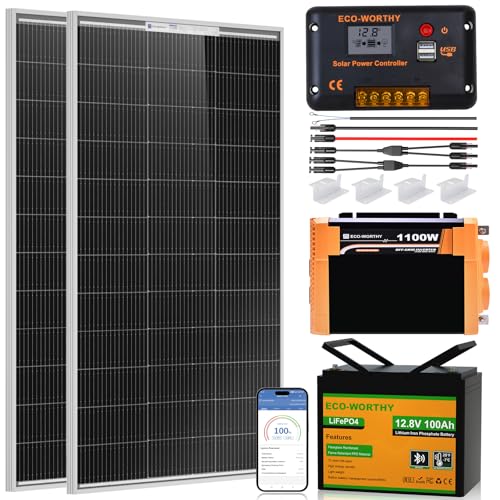
This all-in-one kit is designed for RV travelers and off-grid beginners. It includes two 100W solar panels, a 12.8V 100Ah lithium battery, an 1100W inverter, and a 30A PWM charge controller with wiring. The manufacturer promotes a four-step installation and claims daily generation around 800Wh with 1.28kWh stored capacity. Best for users who want a turnkey system without sourcing separate components. A potential limitation is fixed inverter size and controller capacity, which may constrain larger loads or future expansion.
SOLPERK 20W Solar Panel Kit
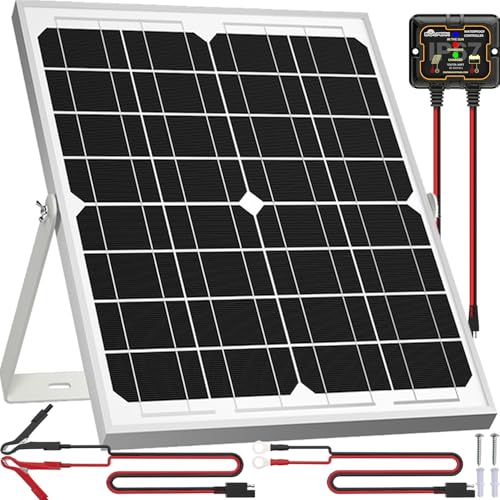
This compact kit provides a 20W monocrystalline panel with an 8A smart MPPT controller. It’s designed for trickle charging and maintaining 12V batteries such as LiFePO₄, AGM, and GEL across a range of vehicles and equipment—boats, RVs, trailers, and garden systems. Best for budget-conscious buyers who need reliable maintenance charging. Its small size means it won’t support heavy running loads, and higher-power needs will require a larger panel kit.
ECO-WORTHY 7.168KWH 800W Solar Panel Kit

This 800W off-grid kit targets RVs and basecamp setups needing more power. It features four 200W panels and a 3000W UPS inverter charger, plus lithium batteries and a Bluetooth/Wi-Fi capable management system. It claims to support up to 99% of RV appliances, including air conditioners and microwaves, with versatile charging modes. Choose this if you need higher daily output and an integrated UPS-like capability; however, parallel expansion details and unit compatibility should be verified for your specific home or vehicle configuration.
ECO-WORTHY 10000W Off-Grid Solar Kit

This high-capacity home-kit targets full-house backup with a 10kW output, 2950W PV capacity, and a 16.1kWh LiFePO₄ battery. It supports 120V/240V split-phase and parallel expansion for higher power needs, with smart monitoring features and a robust inverter. Best for those seeking a long-term, scalable home energy solution. Its large footprint and complexity may require professional installation and additional planning for integration with existing electrical systems.
Topsolar 100W 12V Solar Panel Kit
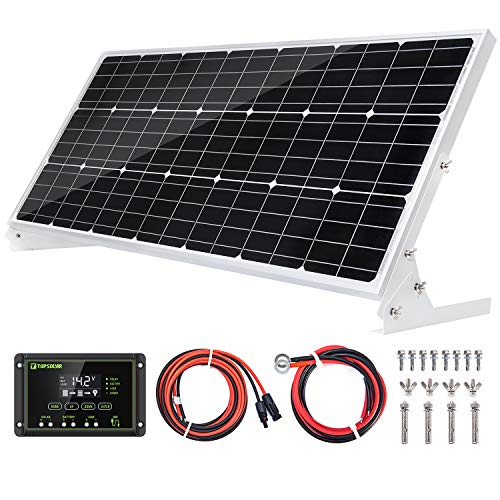
This kit targets 12V charging with a 100W panel, tilt-ready mount, an intelligent charge controller, and two cables. It’s suitable for off-grid charging in RVs, cabins, boats, or remote sheds. Best for straightforward, easy installation where modest energy intake is acceptable. A limitation is the limited daily output, which may not cover high-power devices or extended use without additional panels or storage.
Buying Guide: Choosing The Right Battery-Backed Solar Kit
- Power needs assessment: Match daily energy demand (Wh/day) to panel output and battery storage. High-load appliances require larger systems with multiple panels and ample storage.
- Battery chemistry and capacity: Lithium battery packs offer long cycle life and higher energy density, but verify compatibility with the system’s inverter and BMS. Consider Do-It-Yourself versus turnkey kits depending on installation skill.
- Inverter capacity: Ensure the inverter’s continuous and surge ratings cover your typical loads. Some kits include inverters that may limit future expansion.
- Charge controller type: PWM vs MPPT controllers affect charging efficiency. MPPT controllers are preferable for higher efficiency, especially in variable sun conditions.
- Expandability: If you anticipate growing your system, check parallel-capable inverters and battery banks, along with available space and mounting considerations.
- Portability and installation: For RVs or mobile use, size and weight matter. For homes, mounting options and weatherproofing are critical.
- Monitoring and control: Look for Bluetooth/Wi-Fi capable monitoring to track battery status, charging, and energy usage in real time.
FAQs
- What is the difference between a turnkey solar kit and individual components?
A turnkey kit includes most components needed for a basic setup, simplifying installation, while individual components allow customization but require more coordination and technical know-how. - Is a 20W panel enough for maintenance charging?
For small 12V battery maintenance or trickle charging, 20W can be adequate, but it will not power high-load devices. - Do I need a lithium battery with these kits?
Lithium batteries offer higher energy density and longer life, but some kits include lead-acid options or compatible lithium packs. Check compatibility with the inverter and BMS. - Can these systems power a home appliance like a fridge or AC?
Higher-capacity kits with adequate inverter ratings and battery storage can support common appliances, but verify wattage, surge needs, and continuous draw. - What maintenance is required for solar battery systems?
Regular inspection of connections, monitoring battery health, and ensuring proper charging cycles help extend life. Avoid prolonged deep discharges when possible. - Is professional installation necessary for large kits?
For high-capacity home or multi-unit setups, professional installation is recommended to ensure safety and code compliance.