Best Solar Panel Power System Kits for Off-Grid Living
Whether you’re planning an off-grid cabin, RV adventure, or backup power for emergencies, a reliable solar panel power system can keep essential devices running. This guide highlights five top off-grid solar kits from ECO-WORTHY and a leading portable option, explaining what to look for in a complete system and how to compare features like inverter capacity, battery compatibility, and panel efficiency.
| Product | Type | Key Power Output | Battery/Storage Mentioned |
|---|---|---|---|
| ECO-WORTHY 200 Watts Kit | Solar Panel Kit | 200W panel with 30A PWM controller | Not included in kit |
| ECO-WORTHY 48V Off Grid System 1200W | Complete Off-Grid Kit | 1200W system, 4.68KWh daily output | Includes 48V LiFePO4 battery |
| ECO-WORTHY 9.36KWH System | Complete Off-Grid Kit | 9.36KWh daily output (2340W panels) | Includes 48V 100Ah LiFePO4 battery pack |
| Jackery Solar Generator 1000 V2 | Portable Power Station | 1500W AC output, 1070Wh capacity | Integrated LiFePO4 battery (external charging via solar) |
| ECO-WORTHY 400 Watt Kit | Solar Panel Kit | 400W total with four 100W panels | Includes 40A MPPT controller |
ECO-WORTHY 200 Watts Panel Kit With PWM Controller

The ECO-WORTHY 200 Watts kit uses high-efficiency monocrystalline cells and a 30A PWM charge controller designed for RVs, campers, and other off-grid applications. It promises up to 800Wh daily under four hours of full sun, making it a practical starter system for small loads like lighting, laptops, and small appliances. The panel frame is corrosion-resistant aluminum, built to withstand wind and snow loads, with IP65-rated junction protection for long life in diverse environments.
ECO-WORTHY 48V Off-Grid System Kit — 1200W

This complete off-grid system centers on a 48V configuration with six 195W N-Type bifacial panels and a 3500W inverter, a built-in 80A MPPT controller, and a 20ms UPS switching feature. It’s designed for home or cabin use, capable of running essential appliances and devices with stable 110V/120V output. Parallel connection support expands capacity to cover larger loads as needed. Efficiency comes from high-efficiency N-Type cells, better heat resistance, and a robust mounting framework.
ECO-WORTHY 9.36KWH System Kit With Inverter
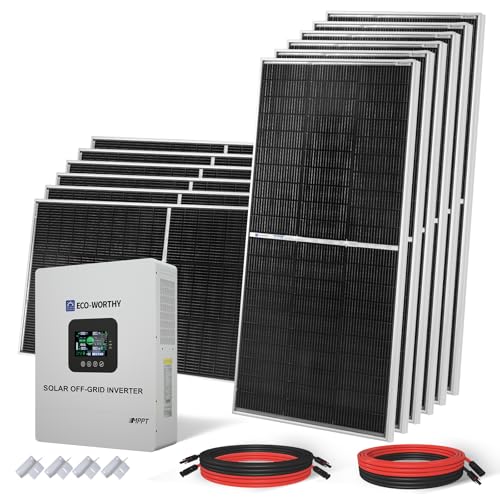
This larger ECO-WORTHY package provides a 9.36KWh daily output with a 2340W solar array and a 5000W 48V inverter. It includes a 100A MPPT controller and IP68-rated, durable construction designed for reliable off-grid operation. The 58.86″ x 26.18″ panels feature 25% efficiency and a double-sided generation capability, delivering additional energy under suitable light conditions. The system targets homes, sheds, cabins, and other energy-heavy off-grid scenarios.
Jackery Solar Generator 1000 V2 With 200W Panel

The Jackery Solar Generator 1000 V2 combines a portable power station with a 200W solar panel for outdoor versatility. It offers a 1,500W continuous AC output and a 1,070Wh LiFePO4 battery, with fast charging and a long 10-year lifespan due to durable cell technology. Its lightweight design and foldable handle make it a practical option for emergencies, camping, and off-grid trips where mobility is essential. The unit supports fast charging and efficient power management via its companion app.
ECO-WORTHY 400W Solar Panel Kit

The 400W Premium Kit includes four 100W panels, a 40A MPPT charge controller, a Bluetooth module, and mounting Z brackets. With IP-65 waterproof junction boxes and 3.2mm low-iron glass, the system emphasizes reliability and shading tolerance. The MPPT controller offers higher efficiency than PWM systems, helping maximize energy harvest, especially under variable sunlight. It’s suited for mid-sized off-grid setups in homes, RVs, or boats.
Buying Guide: Key Purchase Considerations
- System goals and load profile: Estimate daily energy needs (in kWh) and choose a kit with a suitable total wattage, inverter capacity, and storage if included.
- Panel technology and efficiency: Monocrystalline panels offer high efficiency and space efficiency, while bifacial designs can harvest light on both sides under proper conditions.
- Battery type and staging: LiFePO4 banks deliver longer life and safer chemistry, but consider voltage (12V, 24V, 48V) compatibility with inverters and charge controllers.
- Charge controller type: MPPT controllers maximize energy harvest, especially in variable conditions, and pair well with higher-wattage systems. PWM controllers are simpler and lower-cost but less efficient at scale.
- Inverter capacity and waveform: Pure sine wave inverters provide clean power for sensitive electronics; confirm continuous and surge ratings align with loads.
- Expansion and modularity: If you anticipate higher future needs, select systems with multi-unit parallel capacity or modular panels/inverters to scale gradually.
- Durability and weather tolerance: Look for corrosion-resistant frames, IP ratings, and wind/snow load specifications suitable for your location.
- Installation and maintenance: Consider ease of mounting, wiring complexity, and whether the kit comes with pre-wired components or needs additional accessories.
- Warranty and support: Check panel, inverter, and battery warranties; longer coverage can reduce lifetime ownership costs.
- Portability vs. permanence: Portable generators and solar kits suit travel and emergencies, while fixed systems target steady, long-term off-grid power.