Best Solar Panels for Mobile Charging: Top Outdoor Power Banks and Portable Panels
Finding reliable solar charging solutions for mobile devices is essential for outdoor adventures, camping, and off-grid trips. This guide highlights five capable solar-powered chargers that blend high capacity, multiple cables, and fast charging to keep phones, tablets, and other electronics powered when outlets are scarce. Each option brings distinct strengths, from multi-panel efficiency to built‑in cables and PD/QC fast charging. Use this overview to compare suitability for hiking, camping, or emergency preparedness, and decide which model best fits your needs.
style=”display:none”>Summary Table of Selected Products: Jinepin Power Bank Solar Charger 46800mAh; Hiluckey Solar Charger 25000mAh; Twelseaven 200W Portable Solar Panel; SOARAISE Solar Charger Power Bank 48000mAh; Tranmix Solar-Charger-Power-Bank 49800mAh
Product Summary Table
| Product | Brand | Key Strengths |
|---|---|---|
| Power Bank Solar Charger 46800mAh | Jinepin | Three foldable solar panels; built-in cables; PD 20W/PD 18W output; multiple-device charging |
| Solar Charger 25000mAh | Hiluckey | Four solar panels; QC 3.0 fast charging; multiple ports |
| 200W Portable Solar Panel | TWELSEAVAN | High efficiency 24% cells; 60W USB-C PD; wide compatibility |
| SOARAISE Solar Charger Power Bank | SOARAISE | 4 cables; 48000mAh; PD QC 3.0 fast charging; built-in flashlight |
| Tranmix Solar-Charger-Power-Bank | Tranmix | 49800mAh; 4 solar panels; 20W PD; built-in cables; wireless pad |
Jinepin Power Bank Solar Charger 46800mAh

The Jinepin solar charger integrates three foldable solar panels that open with a single press, delivering up to 960mA under optimal sunlight. This setup aims to recharge the power bank efficiently in outdoor settings, with a claimed sixfold improvement over single-panel designs. Built-in cables provide convenient on‑the‑go charging for various devices, including PD 20W USB-C output and PD 18W USB-C on the Type-C, plus a USB-A PD port for simultaneous use. A compact design makes it suitable for backpacks and camping trips.
Key considerations for this model include the practicality of foldable solar panels in windy conditions, the balance between solar charging speed and USB-C/USB-A outputs, and how many devices you commonly charge at once. Recharging via USB-C input is reported to take about five hours, offering a flexible option when sun is less intense.
Hiluckey Solar Charger 25000mAh

The Hiluckey model features four solar panels and a 25000mAh lithium polymer battery, focusing on high solar charging efficiency. It offers QC 3.0 fast charging at 5V/3A, supporting simultaneous charging across three ports: one USB-C and two USB-A. The design prioritizes outdoor use with a goal of extending device power during weeks-long trips, making it a reliable choice when sun exposure is consistent and you need to power multiple devices at once.
Users should weigh solar charging performance against battery capacity. If sun is intermittently available, the USB-A and USB-C outputs help ensure devices stay powered, though the time to fully recharge the pack itself depends on sunlight, making USB charging a practical fallback option.
TWELSEAVAN 200W Portable Solar Panel

This option centers on high efficiency and compatibility for power stations, boasting 24% conversion and a 200W max output when conditions permit. Its ETFE laminated case and 95% light transmission help sustain performance, while a broad MC4 8-in-1 connector set enables easy coupling with popular portable power stations from brands like Jackery and EcoFlow. It includes a PD60W USB-C port and an 18W QC3.0 USB port, allowing simultaneous charging of devices such as phones, cameras, and tablets.
Consider whether you already own a portable power station, as this panel is designed to play well with external batteries. The longer cable length provides flexibility in setup, but overall output will rely on strong sunlight and proper panel alignment.
SOARAISE Solar Charger Power Bank 48000mAh
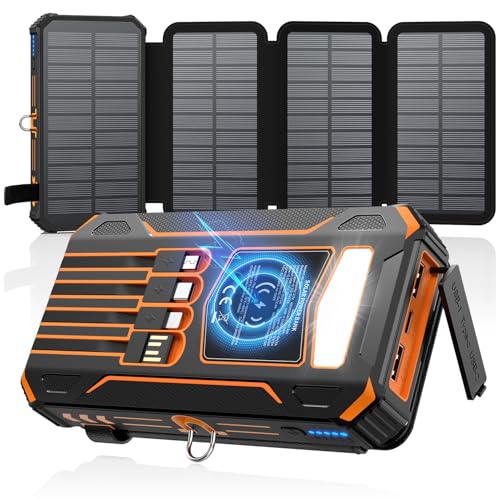
SOARAISE offers a massive 48000mAh battery with four solar panels designed to deliver faster solar charging. The unit features multiple cables for compatibility with several devices and a wireless charging pad for added convenience. It supports PD and QC 3.0 fast charging, enabling quick top-ups for smartphones and other devices while away from outlets, making it a practical option for extended outdoor stays or emergencies.
Key considerations include the practicality of direct solar charging versus USB recharging, the wireless charging capability in outdoor contexts, and the temperature tolerance of the large battery during prolonged exposure to sun or heat.
Tranmix Solar-Charger-Power-Bank 49800mAh

Tranmix combines a very high capacity of 49800mAh with four foldable solar panels and built-in cables to support multi-device charging. The unit includes three built-in cables (Type-C, Micro USB, Lightning) plus USB-A and a 15W wireless charging pad, enabling simultaneous charging of several devices—phones, tablets, and more. Its PD 20W fast charging port ensures rapid top-ups when sun is available, while the multiple cables simplify travel by reducing cable clutter.
When evaluating this model, assess the balance between the large battery capacity and the solar charging speed. In optimal sun you can maximize charging through solar, but in cloud or shade, USB recharging remains a practical alternative.
Buying Guide: Key Purchase Considerations
- Battery capacity and energy needs: Higher capacity is useful for longer trips or powering multiple devices, but it adds weight. Choose based on anticipated device count and daily power use.
- Solar panel configuration: Multi-panel systems generally perform better in sunlight. Foldable panels offer portability, while fixed panels may provide steadier exposure in camp setups.
- Charging ports and cables: Look for PD (Power Delivery) and QC (Quick Charge) support for fast top-ups. Built-in cables reduce gear while remaining versatile with USB-C, Micro USB, and Lightning options.
- Power output and device compatibility: Verify PD output wattage (e.g., 18W, 20W, 60W) and USB-A/USB-C port counts to match your devices, including laptops or tablets if needed.
- Durability and weather resistance: Water resistance, rugged shells, and dustproof design are valuable for outdoor use. Check IP ratings and material quality.
- Recharging method and speed: Evaluate solar charging efficiency under realistic sunlight and fallback charging via USB-C or micro USB. In overcast conditions, USB recharging often speeds up readiness.
- Portability vs. capacity: Some models emphasize lighter form factors with moderate capacity, while others prioritize massive batteries for extended trips. Balance weight with your activity level.
- Additional features: Wireless charging, LED flashlights, SOS modes, and compass carabiners can add practical value for camping and emergencies.
- Maintenance and safety: Look for built-in protection against overcharging and overheating, as well as reputable brands with safety certifications or long-term warranties.
Across these options, users should align the product’s strengths with their typical use cases—short hikes with quick top-ups versus multi-day expeditions requiring reliable off-grid power. The combination of high-capacity packs, multi-panel solar arrays, and fast-charging ports provides versatile solutions for American outdoors enthusiasts seeking dependable mobile charging.