Best Solar Panel Charge Controllers for Reliable Off-Grid Power
Choosing the right solar panel charge controller is essential to protect batteries and maximize energy harvest. The options below cover PWM and MPPT technologies, compatibility with lead-acid and lithium batteries, and various voltage configurations for RVs, boats, and home setups. This guide highlights five strong choices with clear performance notes to help you compare features, durability, and ease of use.
style=”display:none;”>Summary Table of Featured Products
| Product | Brand | Voltage Range | Technology | Key Strength |
|---|---|---|---|---|
| Renogy Wanderer Li 30A | Renogy | 12V | PWM | Lithium-ready with protection and compact design |
| Renogy Wanderer 10A | Renogy | 12V/24V | PWM | 4-stage charging and versatile battery support |
| Victron SmartSolar MPPT 30A | Victron Energy | 12V/24V | MPPT | Maximum power point tracking and Bluetooth |
| Depvko 30A Upgraded PWM | Depvko | 12V/24V | PWM | Dual USB outputs with auto parameter memory |
| SUNAPEX 20A PWM | SUNAPEX | 12V | PWM | Solid basic controller with LCD and USB |
Renogy Wanderer Li 30A 12V PWM Controller

Renogy’s Wanderer Li 30A is designed to optimize charging for Lithium, AGM, Gel, and Flooded batteries. It uses a smart 4-stage PWM charging sequence to deliver Bulk, Boost, Float, and Equalization stages, which helps maximize battery lifespan in RV or marine systems. The unit is built with a weather-resistant body and includes a temperature sensor for better charging accuracy. It supports negative-ground configurations and offers protection against reverse polarity, overcharging, overload, and short circuits. Its compact dimensions enable installation in tight spaces common to RVs and boats, and it is compatible with Renogy solar panels and auxiliary loads managed via DIN rails or wall mounting.
Renogy 10 Amp 12V/24V PWM Solar Charge Controller
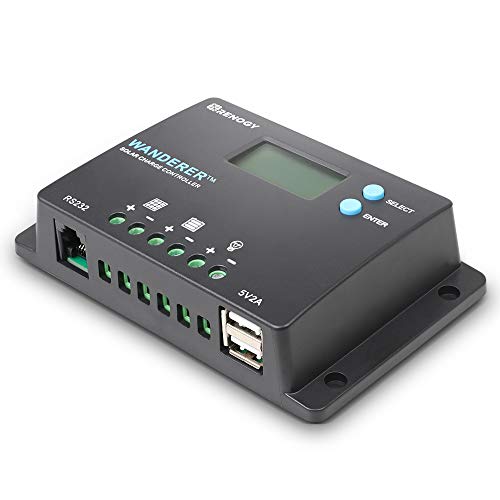
Renogy’s Wanderer 10A PWM controller features a four-stage charging profile (Bulk/Boost/Float/Equalization) designed to extend battery life across AGM, Gel, Flooded, and Lithium configurations. It emphasizes smart load management and system protection against overcharge and reverse polarity. The negative-ground design and compact form factor make it popular for RVs, boats, and small off-grid installations, with an LCD status display that helps users monitor charging progress and stage transitions.
Depvko [Upgraded] 30A Solar Charge Controller

This upgraded Depvko PWM controller is designed for 12V and 24V systems with a three-stage PWM charging process. It includes dual USB ports for mobile device charging and supports a variety of lead-acid batteries (Open, AGM, Gel). The controller memorizes user-set parameters to avoid reconfiguration after battery replacement and includes protections against overcurrent, short circuits, poor connections, and incorrect polarity. It’s suitable for outdoor installations requiring reliable control and a compact footprint.
SUNAPEX Solar Charge Controller 12V 20A

SUNAPEX’s 20A PWM controller focuses on 12V battery systems and is designed to be compatible with various 12V batteries, including lead-acid types such as AGM and Gel. The unit features a user-friendly LCD screen and LED indicators to monitor status and charging stages. It emphasizes safe operation, with protections against reverse polarity and overcharge while delivering straightforward setup for off-grid solar projects where space is limited and reliability matters.
MPPT Solar Charge Controller 12V 10A By SUNAPEX

This MPPT option by SUNAPEX targets 12V systems with a compact 10A maximum output. It supports a broad range of 12V battery chemistries, including lead-acid variants and LiFePo4, offering wide compatibility in a small package. It provides real-time status monitoring via its LCD and indicators, helping users tailor charging modes to their battery type while avoiding overcharging and reverse current drain when the panel isn’t producing power.
Victron Energy SmartSolar MPPT 30A Controller

The Victron SmartSolar MPPT 30A controller uses advanced MPPT technology to extract maximum power from solar panels. It supports Bluetooth for wireless monitoring and configuration, enabling users to fine-tune charging algorithms to optimize battery longevity and performance. Its design emphasizes rapid tracking and synchronization capabilities, allowing multiple controllers to operate in concert to manage larger systems with consistent charging stages across panels and batteries.
Victron Energy SmartSolar MPPT 15A Controller

Victron’s 15A MPPT option offers similar benefits in a smaller package, suitable for mid-sized solar arrays. It emphasizes fast MPPT tracking and robust protection features to prevent overcharging and electrical faults while maintaining battery health. Bluetooth connectivity provides convenient remote monitoring and configuration via a mobile app, making it a solid choice for portable or fixed installations seeking scalable power management.
Buying Guide: Key Considerations For Choosing A Solar Charge Controller
- Battery chemistry compatibility: Confirm whether the controller supports lead-acid variants (open, AGM, GEL) or lithium chemistries, and ensure the voltage range matches your battery bank (12V or 24V is most common).
- Technology: PWM controllers are often simpler and cheaper, best for smaller systems, while MPPT controllers optimize power harvest in variable conditions and larger setups. MPPT can significantly improve efficiency in shaded or hot environments.
- Current rating and expansion: Choose a controller with a continuously rated current at or above your system’s peak current. If you plan to expand panels later, consider a higher-current model or a future-proof architecture.
- Protection features: Look for protections against reverse polarity, overcharge, short circuits, and temperature effects. Some models include auto-equalization, load control, and USB charging for auxiliary devices.
- Display and monitoring: An LCD or app connectivity (Bluetooth) makes it easier to monitor charging stages, battery health, and system performance in real time.
- Physical fit and installation: Consider size, mounting options (DIN rail, wall), IP rating for outdoor use, and compatibility with your enclosure or cabinet space.
- Future integration: If you anticipate syncing multiple controllers or integrating in a larger system, MPPT units with monitoring networks and synchronization capabilities offer smoother system-wide optimization.
- Budget vs. value: While PWM controllers are budget-friendly, MPPT models deliver more energy, especially in challenging conditions. Weigh long-term gains against upfront costs for your specific setup.
- Warranty and support: Prioritize brands with solid customer support, clear warranties, and readily available replacement parts to reduce long-term risk.
Each of the five highlighted products offers distinct advantages for American homeowners, RV enthusiasts, boaters, and off-grid planners. By aligning battery chemistry, system voltage, and energy goals with these options, you can choose a controller that protects batteries, improves efficiency, and fits your installation footprint.