Best Solar Inverter Charger Controllers for Home Off-Grid Power
Answering the core buyer intent: these solar inverter charger controllers blend energy storage with power conversion to supply reliable AC from a 24V or 12V solar setup. They’re best for off-grid cabins, RVs, boats, and small homes seeking a simplified, all-in-one solution or flexible charging options. Below, five top picks are explained with who they’re best for, why they were chosen, and practical cautions. A quick summary table helps compare key points at a glance.
| Product | Battery Type Support | Key Feature | Best For |
|---|---|---|---|
| SUMRY Solar Inverter Charger (SRGFTS) | AGM, Lithium, Lead-Acid | 3600W inverter with built-in 120A MPPT | High-demand off-grid use with PV priority |
| Renogy Wanderer Li 30A | Li-Ion, AGM, Gel, Flooded | 4-stage PWM with lithium optimization | Compact RV or small system with lithium |
| [Upgraded] 30A Solar Charge Controller | Lead-acid (OPEN/AGM/GEL) | Dual USB output, 3-stage PWM | Budget-lead-acid setups needing USB passthrough |
| VEVOR Hybrid Solar Inverter | Lead-Acid, Lithium | 100A MPPT, 3000W inverter | Versatile off-grid with strong MPPT |
| SUNGOLDPOWER 5000W Hybrid Inverter | Any 48V system | 80A MPPT, all-in-one with AC priority | High-capacity off-grid with 4 charging modes |
SUMRY Solar Inverter Charger, 3600W Hybrid Controller

Best for high-demand off-grid needs, this all-in-one unit combines a 3600W inverter, a 120A MPPT solar charger, and a 100A AC battery charger. It supports PV input up to 4200W and accepts a wide 60V-500V DC range, making it suitable for larger solar arrays. The unit provides a pure sine wave output of 110V/120VAC, ensuring compatibility with many household appliances and sensitive electronics. It can operate with or without a battery, though optimal efficiency is achieved with a battery connected. Best for homeowners who want a single, integrated solution that reduces system complexity and cabling.
Who it’s best for: homes or cabins with sizable solar capacity and a need for robust power conversion, especially when battery storage is planned or already in place. Limitation: operation without a battery will draw power directly from PV, potentially consuming grid power if PV voltage drops; plan battery inclusion to maximize solar usage.
Renogy Wanderer Li 30A 12V PWM Controller

Best for lithium and mixed-battery setups in compact spaces, this 30A PWM controller is designed to optimize charging for lithium, AGM, gel, and flooded batteries. It features a 4-stage charging profile with bulk, boost, float, and equalization, plus safeguards against reverse polarity, overcharging, and short circuits. It’s compact, with IP32-rated protection for outdoor installations. It’s a strong choice for RVs, boats, and small off-grid systems that prioritize battery longevity and simple monitoring via LED indicators.
Who it’s best for: users with lithium or mixed-battery systems seeking a durable, space-saving PWM controller. Limitation: not suitable for higher-voltage systems beyond 12V, and performance may be limited compared to higher-end MPPT controllers in very sunny locations.
[Upgraded] 30A Solar Charge Controller
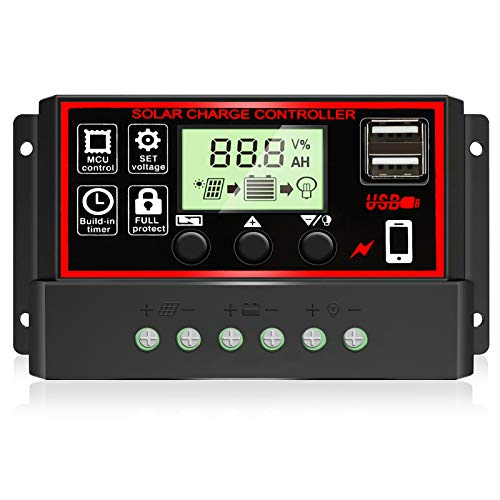
Best for budget-conscious setups focused on lead-acid batteries, this controller offers a three-stage PWM charging profile and dual USB output for charging devices. It includes multiple protection features, including overcurrent, short circuit, low voltage, and overcharge protections, helping extend battery life in simple solar arrays. Choose this if you’re building a straightforward system and need reliable basic regulation with USB passthrough for on-site devices.
Who it’s best for: users with lead-acid batteries needing a low-cost, reliable PWM regulator. Limitation: open, AGM, or GEL lead-acid only; does not support lithium chemistry or high-voltage configurations.
VEVOR Hybrid Solar Inverter, 3000W

Best for versatile off-grid systems needing a robust MPPT and inverter in a single unit, this 3000W pure sine wave inverter offers built-in MPPT up to 100A, with a wide DC input range (60V-500V) to accommodate various solar configurations. It supports 24V battery systems and is optimized for lithium and lead-acid chemistries. The product suits remote cabins or workshops where reliability and compatibility with different battery chemistries are important.
Who it’s best for: off-grid users who want a single, adaptable solution for both navigation of solar charging and reliable AC output. Limitation: the exact compatibility with high-availability lithium packs should be confirmed for your specific battery setup.
SUNGOLDPOWER UL1741 5000W Hybrid Inverter

Best for high-capacity off-grid needs, this 5000W all-in-one hybrid inverter handles 48V systems with up to 80A MPPT charging and 40A AC battery charging. It supports multiple charging modes (AC Priority, Solar Priority, Only Solar, Hybrid) and four output modes to tailor the power flow between PV, grid, and inverter. The unit is UL1741 listed and suitable for larger homes or workshops with heavy electrical demand. It’s a strong pick when flexible energy sourcing is essential.
Who it’s best for: households or cabins with substantial energy needs and a preference for flexible charging modes. Limitation: parallel operation is not supported, so you’ll need separate units for very large installations or to plan around the maximum 5000W output.
Victron Energy SmartSolar MPPT With Bluetooth

Best for intelligent, future-ready solar management, this MPPT controller optimizes energy capture and battery longevity. Its smart features include fast optimum power point tracking and synchronized charging across multiple controllers, which makes it ideal for larger off-grid systems seeking coordinated energy management. It’s particularly effective when paired with other Victron devices in a single ecosystem for a seamless monitoring experience.
Who it’s best for: tech-forward off-grid setups requiring precise control and scalability. Limitation: higher upfront cost and need for compatible Victron ecosystem components to maximize benefits.
Renogy BT-2 Bluetooth Monitoring Module

Best for real-time system insight, this Bluetooth module connects Renogy RS485-compatible devices to the Renogy DC Home App. It enables live data monitoring and easier control of battery charge states, helping users optimize performance and battery health. It’s a practical add-on if you’re building a Renogy ecosystem for off-grid monitoring.
Who it’s best for: users who want to monitor and manage a Renogy system remotely. Limitation: requires a Renogy-compatible RS485 setup; may have a learning curve for new users.
Buying Guide: Key Purchase Considerations
- System voltage and battery chemistry: Confirm your system voltage (12V, 24V, 48V) and whether you use lead-acid, AGM, GEL, or lithium batteries. This determines compatible controllers and inverters.
- Inverter size vs. load profile: Match the inverter wattage to your typical loads (refrigerators, power tools, or electronics) and consider peak surge requirements.
- MPPT vs PWM: MPPT controllers harvest more power in variable conditions but tend to cost more. PWM is simpler and cost-effective for smaller systems and stable sun exposure.
- Charge algorithms and battery care: Look for controllers with multi-stage charging (bulk, boost, float, equalization) and safeguards against overcharge, short circuits, and reverse polarity.
- Expandability and monitoring: If you plan to scale, consider ecosystems (Victron or Renogy) that offer multi-controller synchronization or Bluetooth/APP monitoring for real-time insights.
- Installation environment: Check IP ratings and weatherproofing for outdoor installations. Ensure adequate ventilation for devices with high heat output.
- Safety and certifications: Seek UL/ETL-listed inverters and controllers when possible; certifications help ensure compliance with electrical standards.
Frequently Asked Questions
- What is a solar inverter charger controller?
It is a combined device that converts DC power from solar panels to AC power for home loads while managing battery charging and power flow between PV, battery, and grid or load.
- Do I need MPPT or PWM for my system?
MPPT controllers extract more energy from panels, especially in hot or shaded conditions, and are better for larger or variable-sun systems. PWM controllers are simpler and cheaper, suitable for smaller, stable setups.
- Can I run appliances directly from PV panels without a battery?
Some all-in-one inverters can run loads directly from PV under strict conditions, but it’s generally more reliable to use a battery for energy storage and to smooth PV fluctuations.
- What battery types should I choose for longevity?
Lithium (LiFePO4) generally offers longer cycle life and better depth of discharge than many lead-acid options, but the best choice depends on budget and maintenance willingness.
- How do I plan for off-grid expansion?
Pick a controller or inverter that supports multiple devices in your ecosystem, and verify compatibility for future additions like additional battery packs or solar panels.
- Is parallel operation necessary for large systems?
Some units do not support parallel operation. For very large installations, you may need multiple units designed for parallel use or a higher-capacity single unit.