Best Solar Inverter Battery Charger Solutions for Home and Off-Grid Power
Answering your search for reliable solar inverter battery chargers, this guide highlights top options that balance efficiency, capacity, and versatility. Most suitable buyers include off-grid homeowners, RV enthusiasts, and small businesses seeking flexible solar energy integration. The top picks cover battery-less operation, MPPT charging, and multi-unit parallel capabilities to scale power as needed.
Summary of chosen products:
| Product | Key Strengths | Best For |
|---|---|---|
| SUMRY Hybrid Solar Inverter 4000W | Pure sine wave, 140A MPPT, high efficiency | Battery-less or AGM/Lithium setups |
| SUMRY Solar Inverter Charger 3600W | All-in-one inverter, 120A MPPT, battery optional | Home energy systems with or without battery |
| Aninerel 12000W Solar Hybrid Inverter | Dual MPPT, 12kW output, parallel up to 6 units | Large off-grid or workshop systems |
| Ampinvt 5000W Solar Inverter | 100A MPPT, multiple charging modes | Flexible battery chemistries |
| ECO-WORTHY 10000W DC 48V Inverter | Dual MPPT, up to 200A charging, parallel capable | High-capacity off-grid systems |
Click any product heading to view the Amazon listing and full specifications for quick comparison. The following sections describe each option in detail, including who it’s best for and potential limitations.
SUMRY Hybrid Inverter 4000W With LCD

Best for: users who want a compact, powerful hybrid for battery-less or AGM/Lithium setups. This unit offers a pure sine wave output of 4000W with an 8000W peak. The built-in 140A MPPT controller supports PV input up to 5600W at 350VDC, delivering high efficiency (up to 98%). The glass top and large LCD provide clear real-time data. Caution: verify your load adds up within the inverter’s continuous and peak outputs to avoid overload.
SUMRY Solar Inverter Charger 3600W

Best for: homeowners needing a versatile all-in-one unit with 3600W continuous power and 120A MPPT charging. It supports PV input up to 60–500VDC and 4200W PV input. The device can run with or without a battery, using PV power to feed loads if grid is not connected, or while charging from PV to reduce grid consumption. Limitation: battery-less operation requires sufficient PV input and appropriate load timing.
Aninerel 12000W Hybrid Inverter

Best for: large off-grid or mixed-use environments needing scalable power. With 12,000W continuous output and 24,000W peak, it supports two MPPT controllers (up to 500VDC PV input) and 220A charging. Parallel operation up to six units enables up to 72kW. It works with 48V AGM, GEL, Lead-acid, Li-ion, and LiFePO4 batteries and can operate without a battery for direct PV-to-load use. Caution: parallel setups require careful system design and wiring.
Ampinvt 5000W Solar Inverter
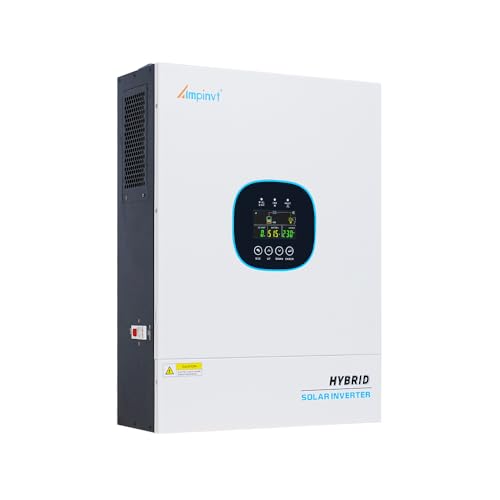
Best for: buyers seeking a compact, all-in-one inverter with 100A MPPT and multiple charging modes (Only Solar, Mains Priority, Solar Priority, and Mains & Solar hybrid). It supports 48V lead-acid and LiFePO4 batteries and outputs 120/240Vac in single- or split-phase formats. Limitation: ensure PV input remains within the configured MPPT range to maximize charging efficiency.
ECO-WORTHY 10000W 48V Inverter Charger

Best for: high-capacity off-grid systems requiring dual MPPT controllers and substantial battery charging (up to 200A). This 48V system provides 120V/240V outputs and supports parallel operation up to six units, ideal for cabins or backup setups. Caution: off-grid only; it cannot feed back to the utility grid.
Buying Guide
What should you consider when choosing a solar inverter charger?
- System voltage and battery type: Ensure the inverter supports your battery chemistry (AGM, Gel, Li-ion, LiFePO4) and the system voltage you use (24V, 48V, etc.).
- MPPT capacity: Higher MPPT current improves charging efficiency in varying sun conditions. Look for units with dual MPPTs for better energy harvest.
- Output power and waveform: Choose a pure sine wave inverter for sensitive electronics and motors. Check continuous (rated) and peak (surge) Power.
- Grid interaction and battery-less operation: If you want to run loads directly from PV, verify battery-less operation conditions and PV input requirements.
- Parallel capability: For upgrades, ensure the unit supports reliable parallel connections to scale power safely.
- Protection features: Overload, short circuit, and reverse polarity protections extend system life and safety.
Frequently Asked Questions
- What is the difference between a solar inverter and an inverter charger? Inverter chargers combine an inverter, charger, and MPPT controller in one unit, enabling PV charging and AC input charging with battery management.
- Can I run an off-grid system without batteries? Some units support PV-to-load operation without batteries, but performance depends on PV input and load timing.
- Is parallel operation safe? Parallel connections increase total power and surge capacity, but require proper electrical design, breakers, and accurate load planning.
- What is MPPT and why does it matter? MPPT (maximum power point tracking) optimizes solar panel energy extraction, especially under changing light conditions, improving charging efficiency.
- Which system voltage should I choose? 24V is common for smaller setups; 48V systems reduce current and improve efficiency for larger installations.
- Do these units support lithium and lead-acid batteries? Most listed models work with AGM, Gel, Lead-acid, and LiFePO4 chemistries; verify compatibility for your exact battery type.