Best Solar Panel Cost Guide: Compare Top Options for Your Budget
If you’re shopping for solar panel solutions, this guide clarifies costs by product type and use case. It targets homeowners, RV travelers, boaters, and outdoor enthusiasts who want reliable solar kits without breaking the bank. Below is a quick side-by-side of five suitable options, followed by in-depth product notes and practical buying tips.
| Product | Brand | Best For | Notes |
|---|---|---|---|
| Solar Panel Coating | Anti Dust | BLOOMX | Maintenance-conscious homeowners | Enhances sunlight penetration; long-term protection |
| SOLPERK Solar Panel Kit 20W | SOLPERK | Small setups, boats, RVs | Includes MPPT controller; weatherproof |
| DOKIO 100W Portable Foldable Kit | DOKIO | Camping, emergencies | Foldable; separate controller |
| 200W Portable Solar Panel – TWELSEAVAN | TWELSEAVAN | Power stations, travel | ETFE construction; USB-C/PD |
| HQST 200W Ultra-Light | HQST | Off-grid, camping | Lightweight; N-Type cells |
Prices vary by wattage, build quality, and included hardware. In general, portable panels with higher efficiency and robust frames command higher upfront costs but can lower total ownership through faster charging and longer lifespans. The five products below are selected for clear cost-to-performance signals across common use cases.
Solar Panel Coating By BLOOMX

Product overview: BLOOMX offers a ceramic coating that claims to maximize sunlight penetration and reduce dust and dirt buildup on panels. The coating provides anti-abrasion and hydrophobic properties, with protection claims up to five years and a 10H hardness rating. This option is best suited for homeowners or commercial sites seeking lower maintenance costs and better long-term panel longevity. A potential limitation is the coating’s dependence on proper surface preparation for maximum effectiveness.
Who it’s best for: Homeowners or small businesses wanting to reduce cleaning frequency and protect panels from environmental grime. It is less about increasing watts and more about preserving efficiency over time. Choose this if you want a maintenance-friendly add-on rather than a high-wanting-instant-output solution.
Key takeaway for costs: This product aims to cut cleaning costs and extend panel life, which can lower operating expenses over time, offsetting a higher upfront application cost.
SOLPERK 20W Solar Panel Kit
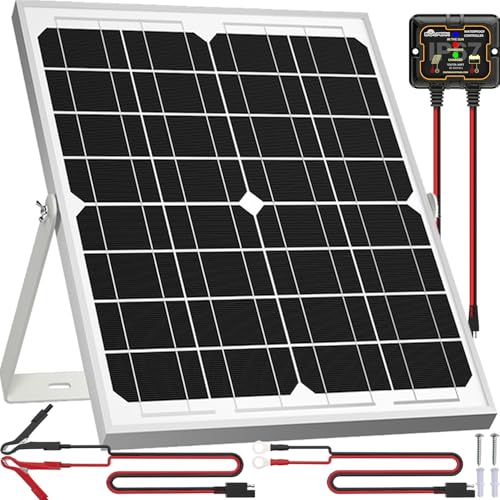
Product overview: SOLPERK’s 20W kit includes a 12V system with a smart MPPT controller and adjustable mounting. The panel uses monocrystalline A+ cells, with a quoted efficiency range of 21%–30%. It is designed for charging and maintaining batteries in trailers, boats, RVs, and other mobile setups. The kit emphasizes weather resistance with a corrosion-resistant frame and waterproof construction. It also notes a robust wind and snow load rating, offering durability in harsh environments.
Who it’s best for: Small vehicle or boat owners who need reliable off-grid power with an added charge controller. It’s ideal for on-the-go charging and maintaining 12V systems when permanent installation isn’t practical.
Limitations to consider: The efficiency range is broad; actual performance varies with sun and temperature. The included controller is a key factor in safe, efficient charging but may require future upgrades for higher power applications.
DOKIO 100W Portable Foldable Kit

Product overview: The DOKIO kit emphasizes travel-friendly portability. Weighing around 5.3–6 pounds, it folds compactly for RVs, tents, and emergency power. It includes a separate controller and dual USB outputs, enabling charging of 12V systems while keeping the controller accessible for safety checks. The kit is practical for temporary or supplemental solar needs rather than heavy daily use.
Who it’s best for: Backpackers, campers, or emergency planners needing a lightweight, easy-to-transport solar option. It’s a good match when space and weight are critical considerations.
Limitations to consider: The 100W rating corresponds to peak conditions; performance can drop in low sun. The separate controller adds a component to manage and maintain, which may be less convenient for some users than a built-in controller.
TWELSEAVAN 200W Portable Panel

Product overview: This 200W panel features high-efficiency A+ monocrystalline cells and an ETFE laminated surface for improved light transmission. It ships with a 5-in-1 MC4 connector and multiple adapters to fit popular power stations. It adds PD-enabled USB-C and QC3.0 ports for simultaneous device charging, making it versatile for camping, RVs, and power stations. The panel’s rugged build aims to withstand outdoor use while delivering substantial charging capacity.
Who it’s best for: Users needing substantial portable power for power stations or larger off-grid setups. It balances high wattage with broad compatibility for multiple devices and power stations.
Limitations to consider: Higher upfront cost and bulk compared to smaller 20–100W panels. Weighs more, which can affect portability for tight storage spaces.
HQST 200W Ultra-Light Portable Panel
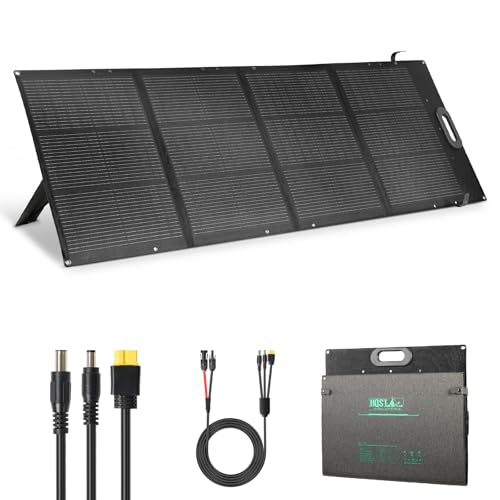
Product overview: The HQST panel uses next-gen 16BB N-Type cells for up to 25% efficiency. It emphasizes light weight and a compact fold for easy transport. The included 4.9 ft 3-in-1 adapter cable supports a wide range of power stations, enhancing compatibility with popular systems. This panel is designed to deliver more energy in a lighter form, facilitating off-grid use in camping and emergency scenarios.
Who it’s best for: Outdoor enthusiasts who need higher efficiency in a lighter package and broad compatibility with portable power stations. It suits frequent travelers and campers seeking dependable performance with easier handling.
Limitations to consider: N-Type cells are efficient but can be sensitive to high temperatures; performance may vary with climate. It may require careful stowage to prevent damage in transit.
Buying Guide: How To Choose The Right Solar Panel For Your Budget
- Wattage needs: Determine daily energy use and select a panel that can reliably meet or exceed peak requirements. Higher wattage means more upfront cost but faster charging and less panel area needed.
- Portability vs. permanence: For travel and camping, portable foldable panels offer flexibility. Fixed installations prioritize durability and long-term cost efficiency.
- Controller type: Built-in MPPT controllers save space and simplify wiring. Separate controllers can allow upgrades but add setup steps and potential points of failure.
- Durability and build quality: Look for weather-resistant frames, UV-resistant coatings, and robust connectors. ETFE or tempered glass surfaces often outperform standard PET films for longevity.
- Efficiency and technology: Monocrystalline cells deliver higher efficiency than polycrystalline under similar conditions. In limited space, higher efficiency provides more power per square foot.
- Weight and portability: Lighter panels are easier to transport but may trade durability. Consider how often you’ll move or rehang the panel.
- Compatibility with power stations: Check connector types and included adapters. Ensure compatibility with your existing power station or battery system.
- Maintenance needs: Some products offer anti-dust or anti-soiling coatings, which can reduce cleaning frequency and maintenance costs over time.
Frequently Asked Questions
- What affects solar panel cost the most? Wattage, panel efficiency, build quality, and included hardware such as controllers and mounting equipment.
- Is a built-in MPPT controller worth it? Yes, it optimizes charging by adjusting voltage and current to maximize efficiency and reduce power loss.
- Are portable solar panels durable for outdoor use? Many are designed for outdoor use with weatherproof frames, but always verify wind and snow load ratings for your environment.
- Can coatings reduce maintenance costs? Anti-dust or hydrophobic coatings can lower cleaning frequency, potentially lowering long-term costs.
- How do I choose the right panel for an off-grid power station? Match the wattage to your station’s input range, ensure compatible connectors, and consider whether you need a separate controller or a built-in option.
- Do higher-priced panels always provide better value? Not always. Compare wattage, efficiency, durability, and total lifecycle costs to determine true value for your use case.