Best Solar Electric Power System Solutions for Off‑Grid and Home Use
This buyer’s guide highlights five solar electric power system options from Amazon, each suited to different needs—from portable power for camping to full home/off‑grid installations. If you need reliable off‑grid charging for devices and small appliances, start with a portable solar generator. For complete home backup, consider modular solar kits that scale with your energy needs. This guide explains who each product is best for, why it stands out, and practical considerations to help you choose.
Product Summary
The following table compares the five highlighted products, focusing on best-use scenarios, key capabilities, and notable limitations.
| Product | Best For | Power/Storage | Notes |
|---|---|---|---|
| Portable Solar Generator, 300W Portable Power Station (ZeroKor) | Outdoor enthusiasts and RVs | 300W AC, 280Wh battery, multiple outputs | Includes 60W solar panel; watch appliance wattage |
| ECO WORTHY 10KW Complete Off-Grid System (10kW system) | Full-home backup and off‑grid living | Up to 10kW continuous, 16.1 kWh storage | Supports up to six parallel units for scale |
| ECO WORTHY 10KW 9.36KWH Kit (12pcs 195W Panels) | Mid-to-large homes needing robust 110/120V/240V support | 9.36 kWh daily target, 5,000W inverter | High-efficiency panels, plug-and-play design |
| ECO WORTHY 9.36KWH 2340W Kit (12x195W Panels) | Energy storage with reliable off-grid power | 9.36 kWh daily target, 5,000W inverter | Excellent panel efficiency and durability |
ZeroKor 300W Portable Solar Generator With 60W Panel

The ZeroKor portable solar generator is best for campers, RV owners, and ne-ed-on-the-go users needing a compact, all‑in‑one charging solution. It includes a 60W foldable solar panel and a 280Wh battery with multiple outputs, including 2x 300W AC outlets and USB ports. This unit supports rapid charging of phones, tablets, and small laptops and is suitable for off‑grid tent camping or short outdoor trips. A caution: using devices over 300W may strain the unit or cause damage, such as high‑watt tools or appliances with heat loads like hair dryers or coffee makers. The built‑in SOS flashlight adds safety in remote environments. Best for: casual outdoor trips, light electronic needs, and as a backup power source for small devices.
ECO WORTHY 10KW Off-Grid System With 2950W Panels

This all‑in‑one home solar solution is designed for homeowners who want a scalable, high‑capacity setup. It delivers up to 10kW continuous power with 120V/240V support, and includes a 48V 314Ah LiFePO4 battery delivering 16.1 kWh of storage. It uses a 7‑inch display and supports monitoring via Bluetooth/Wi‑Fi. The system is compatible with multiple inverters and can be expanded by paralleling units. Best for: complete home backup, cabins, sheds, or farms needing reliable, multi‑unit scalability. Caution: parallel expansion requires proper system sizing and wiring considerations to maintain safety margins.
ECO WORTHY 10KW 9.36KWH Kit With 12x195W Panels

This kit targets homeowners seeking robust off‑grid capability with reliable 9.36 kWh daily output. It features 12 panels totaling 2340W and a 5000W 48V inverter with a 12V DC solar charger option. The panel technology emphasizes high efficiency (up to 25%), weather durability, and a plug‑and‑play experience. Best for: larger off‑grid homes, workshops, or remote properties where steady 110/120V or 240V power is essential. Limitation: higher upfront cost and more complex installation than portable kits.
ECO WORTHY 9.36KWH 2340W Kit With 5000W Inverter
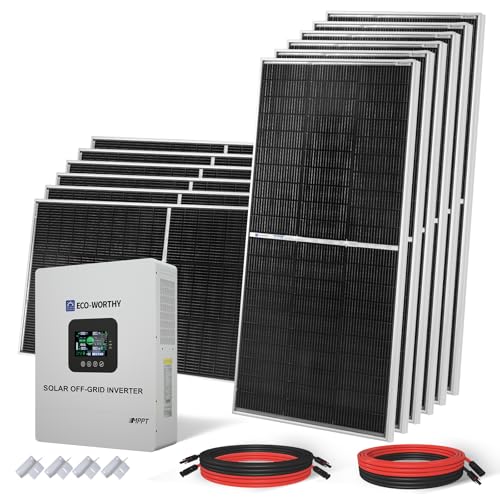
This kit provides a balanced mix of efficiency and capacity for off‑grid living. The 12×195W panels offer solid daily energy, while the 5000W all‑in‑one inverter supports a broad range of household devices. The system emphasizes real‑world reliability with improved heavy‑duty components, including robust wiring and mounting hardware. Best for: off‑grid homes needing dependable 110/120V or 240V power and straightforward expansion. Caution: system size may require professional installation and permits depending on local regulations.
Buying Guide: Key Considerations For Solar Power System Purchases
- Energy needs: Estimate daily watt-hour requirements for essential devices. Start with a baseline and scale with panel and storage capacity.
- System type: Portable kits suit travel and temporary setups; fixed home kits suit continuous power and expansion.
- Battery chemistry: LiFePO4 is common for safety and longevity; consider cycle life and depth of discharge.
- Inverter capacity: Match inverter rating to peak appliance loads; avoid undersizing to prevent tripping or damage.
- Expandability: If future power growth is expected, choose systems that allow parallel connections or easy panel additions.
- Monitoring and control: Look for built‑in monitoring via mobile apps or PC to track performance and health.
- Durability and warranties: Check weather resistance, mounting hardware, and warranty terms for long‑term reliability.
- Install considerations: For high‑wattage systems, electrical permits and professional installation may be advisable.
FAQ
- What is the difference between portable and off‑grid home solar systems? Portable systems are compact, designed for on‑the‑go charging, and typically have built‑in battery storage. Off‑grid home systems are larger, with higher capacity for continuous power and multi‑load appliances.
- Is 280Wh storage enough for camping needs? For basic devices like phones and a few small gadgets, yes. For larger loads, plan for higher storage or supplementary charging sources.
- Can multiple ECO‑WORTHY kits be combined? Yes, several ECO‑WORTHY kits support parallel expansion, but proper configuration and safety checks are essential.
- Do these systems support full home power? Larger ECO‑WORTHY setups are designed for high‑capacity use but may require professional design and permitting for full home installations.
- What maintenance is needed for solar panels? Regular cleaning, inspection for loose connections, and monitoring of inverter/charger performance help sustain efficiency.
- Are LiFePO4 batteries safer? LiFePO4 batteries offer strong thermal stability and longer life, making them a common choice for off‑grid storage.