Best Solar Dump Load Controllers for Hybrid Wind and Solar Systems
Facing the need to safely manage wind and solar charging with a dump load is key for reliable off-grid power. This guide highlights five top solar dump load controllers, each suited to different system sizes and battery voltages. Ideal buyers include homeowners building wind-solar hybrids, boat owners seeking stable off-grid power, and street-light operators needing dependable MPPT control. The table below summarizes the five products to help you compare capacity, voltage range, and primary use at a glance.
| Product | Voltage Range | Hybrid Capacity | Dump Load Type | Best For |
|---|---|---|---|---|
| VNATWGOO 15000W Wind Solar Hybrid Charge Controller | 24V/48V Auto | Up to 15000W total input | External dump load resistor with PWM | Large off-grid homes, ships, or street lights needing strong charging support |
| VQP 2000W Wind Solar Hybrid Charge Controller | 12V/24V | Up to 2000W total input | External dump load with PWM | Small to mid-sized off-grid systems and lighting projects |
| Pikasola 1400W Off Grid Hybrid Controller | 12V/24V | Up to 1400W total input | Dump-load resistance with MPPT/ PWM | Compact wind-solar hybrids for homes or boats |
| Himopuer 6000W-12000W MPPT Hybrid Controller | 12V/24V/48V | Up to 12000W (12000W model) | External unloading device with MPPT/PWM | Mid-to-large scale off-grid deployments |
| RoyceBee 20000W Hybrid MPPT Controller | 12V/24V/48V | Up to 20000W total input | External dump load with MPPT/PWM | High-capacity wind-solar installations |
Below are five product-focused sections to help you compare features, intended use, and potential caveats. Each item notes who the product is best for, why it was selected, and a practical limitation to consider.
VNATWGOO 15000W Hybrid Controller

The VNATWGOO unit supports wind and solar inputs with a 24V/48V auto configuration. It uses MPPT boosting to maintain charging efficiency at low wind speeds and integrates a stepless discharge function via an external dump-load resistor. Best for large off-grid systems, including homes or boats that require high input capacity and flexible battery types, including lithium. Limitation: configuration relies on proper external dump-resistor setup which may require careful wiring and protection planning.
VQP 2000W Wind Solar Hybrid Controller
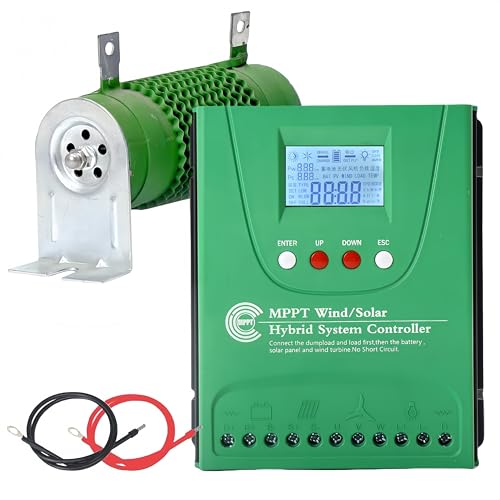
This compact unit is designed for 12V/24V battery setups with up to 2000W total input from wind and solar. It uses boosted MPPT for wind charging and PWM for solar charging. It’s a solid choice for budget-minded, small to mid-sized off-grid systems, or for lighting setups on boats and properties. Caution: not ideal for very high-wattage wind turbines or expansive solar arrays beyond its 2000W rating.
PIKASOLA 1400W Hybrid Controller

The Pikasola unit supports 12V/24V and up to 1400W combined wind and solar input, with MPPT boosting and a dump-load resistor. It’s well-suited for small homes, boats, or street-light projects where space and budget are limited. Best for gentle wind sites or modest solar arrays. Limitation: smaller capacity means less headroom for high wind events or expanding systems.
Himopuer 6000W-12000W MPPT Hybrid Controller

The Himopuer model supports 12/24/48V systems with a broad 6000W to 12000W input range. It combines MPPT and PWM charging with an LCD that displays wind, solar, batteries, loads, and power generation metrics. It’s appropriate for mid-to-large off-grid installations where real-time monitoring is valued. Consideration: ensure your wiring and overcurrent protections are matched to the higher input capacity to avoid safety issues.
RoyceBee 20000W Hybrid Controller

The RoyceBee unit offers a high-capacity 12/24/48V option with up to 20000W of hybrid input. It uses booster MPPT for wind charging and PWM charging for solar, plus an external dump-load path. Best for large, performance-driven wind-solar installations on homes, ships, or public lighting networks. Limitation: the power level necessitates careful system design, advanced protections, and proper thermal management to sustain long-duration operation.
Buying Guide
Choosing the right solar dump load controller involves matching system size, voltage, and redundancy to your goals. Consider the following questions to guide your decision:
- What is your system voltage? Most hybrid controllers support 12V, 24V, and 48V; choose one that aligns with your battery bank.
- What is the maximum wind and solar input you plan to harvest? Larger systems need higher wattage ratings and robust dump-load options.
- Do you need real-time monitoring? Controllers with LCD displays or LED readouts offer clearer visibility into wind, solar, and load status.
- Is an external dump-load resistor necessary for your layout? Some setups require an external dump path to safely dissipate excess energy.
- Will you expand the project in the future? Select a controller with scalable input ranges and compatible battery chemistries, including lithium.
Key Comparison Points
- Voltage compatibility: Ensure the controller supports your battery bank (12V, 24V, or 48V).
- Input capacity: Verify total wind and solar input ratings match or exceed your planned system size.
- Dump-load method: External dump-load resistor vs. internal dissipation options can affect wiring and layout.
- Monitoring features: LCD displays provide quick status checks; some units include data logging or day/night metrics.
- Physical considerations: larger controllers may require adequate enclosure and ventilation for heat management.
FAQ
- What is a dump-load controller? It manages surplus energy by diverting excess power to a load, preventing overcharging of batteries.
- Do all hybrid controllers support lithium batteries? Many do, but confirm battery compatibility before purchase.
- Can I use these controllers off-grid for home lighting? Yes, especially models with higher wattage and robust dump-load options.
- Is MPPT necessary for wind energy? MPPT boosts charging efficiency at low wind speeds, making it advantageous for mixed wind-solar setups.
- Should I hire an electrician for installation? For high-wattage systems and custom dump-load wiring, professional installation is recommended.