Best Solar Controller With Inverter for Home Power Systems
If you’re shopping for a solar controller with an integrated inverter, you want a unit that combines reliable PV charging with clean, safe AC power for your home or off-grid setup. This guide highlights five capable models and explains who each is best for, along with practical buying tips. Whether you need a compact backup solution, a high-capacity off-grid inverter, or a flexible battery‑less option, these picks align with typical buyer needs such as budget-friendly reliability, parallel expansion, or battery compatibility.
Summary of chosen products
| Product | Type | Best For | Key Benefit |
|---|---|---|---|
| SUMRY Hybrid Solar Inverter, 4000W | Hybrid Inverter with MPPT | Mid‑to‑large off-grid loads | High 140A MPPT and 98% efficiency |
| SUMRY Solar Inverter Charger, 3600W | Inverter Charger with MPPT | Battery-supported or battery-less setups | Flexible PV input, pure sine wave |
| POWLAND 4000W Hybrid Inverter | Hybrid Inverter with MPPT | Battery-compatible with strong display | Glass LCD, 98% efficiency |
| Ampinvt 5000W Solar Inverter | High‑power Inverter with MPPT | Scalable or parallel systems | 2 MPPT, expandability |
| Aninerel 12000W Solar Hybrid Inverter | Large-capacity Inverter | Commercial or larger off-grid needs | Dual MPPT, parallel up to 6 units |
SUMRY Hybrid Solar Inverter, 4000W

The SUMRY 4000W model combines a pure sine wave inverter with a built-in 140A MPPT charge controller. It supports battery-less operation or AGM/Lithium battery configurations, making it a flexible option for both off-grid cabins and backup power setups. The tempered glass top and 6.25-inch LCD offer easy real-time monitoring of input, output, and battery status. Best for households needing robust AC power with solid PV charging capacity. Caution: Verify load totals to ensure the 4000W continuous rating covers simultaneous devices.
SUMRY Solar Inverter Charger, 3600W

This all-in-one unit packs 3600W continuous power and a 120A MPPT controller with 100A AC battery charging. Its wide PV input range (60V–500VDC) supports substantial solar arrays, while the pure sine wave output ensures compatibility with most household appliances. Suitable for users who want an inverter that can work with various battery chemistries or operate with PV power even when a battery is not connected (with the right PV conditions). Limitations include the need for careful battery matching and grid considerations when operating without a battery.
BELTTT 2000W Pure Sine Wave Inverter

This 2000W continuous inverter delivers up to 4000W peak, suitable for larger loads at a lower price point. It uses a pure sine wave, reducing wear on sensitive electronics. An intelligent LCD display shows input/output voltages, battery status, and load conditions for quick troubleshooting. Best for smaller off-grid cabins or RV setups where a reliable, affordable inverter is needed. Caution: Ensure your battery bank and PV input are sized to consistently meet the 2000W continuous rating.
POWLAND 4000W Hybrid Solar Inverter

POWLAND offers a 4000W continuous, 8000W surge hybrid inverter with a 140A MPPT controller and a 98% efficiency rating. Its glass LCD provides real-time monitoring and supports battery-less operation in sunny conditions. Best for users seeking strong charging performance and a polished display in a mid-to-large system. Caution: Battery compatibility should be verified for non-battery operation in your specific setup.
Ampinvt 5000W Solar Inverter
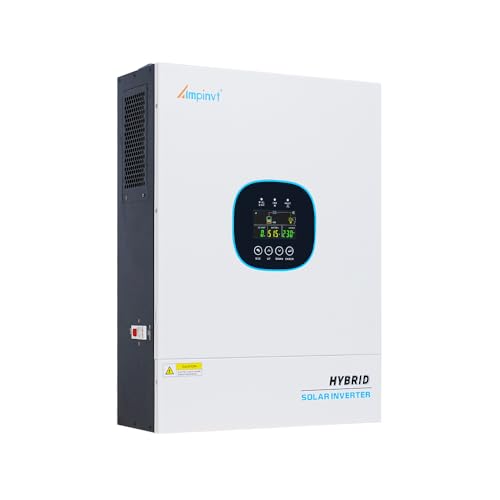
This high-powered unit combines an inverter, MPPT solar charger, and AC auto-transfer switch, with two MPPT controllers and up to 100A PV charging. It supports up to 5500W PV input and allows parallel expansion for larger systems. Best for scalable off-grid homes or workshops needing significant power and modular growth. Limitation: Parallel configuration requires proper system design to avoid mismatched phases and loads.
Aninerel 12000W Solar Hybrid Inverter

Aninerel’s 12000W hybrid inverter targets larger, more capable setups, offering a single-phase 120V/240V output with dual MPPT controllers and parallel expansion up to six units for very high power demands. Best for commercial off-grid applications or sizable residential builds that require scalable, robust power. Limitation: System complexity increases with parallel setups; professional design and protection strategies are essential.
Buying Guide
Key considerations when choosing a solar controller with inverter
- Power capacity vs. load demand: Match continuous watts and surge capability to the appliances you plan to run. Higher wattage handles more devices simultaneously but may cost more.
- MPPT charging: A higher MPPT current and voltage range improves solar harvesting in varying weather and shading conditions. Look for models with 100A+ MPPT when expanding arrays.
- Battery compatibility: Confirm support for AGM, Gel, Lead‑Acid, Li‑ion, and LiFePO4 batteries. Battery-less modes can save cost but rely on PV power availability.
- Display and monitoring: A clear LCD or glass cover display helps track real-time data like PV input, battery status, and load. A touch-enabled interface is a plus for quick adjustments.
- Expandability: If you plan to grow your system, choose units that support parallel operation with multiple inverters or MPPT controllers.
- System configuration: Decide between battery-backed vs. battery-less operation, grid-tied options, and whether you want automatic transfer switching (for backup power).
Frequently Asked Questions
- What is the difference between a hybrid inverter and a pure inverter?
Answer: A hybrid inverter combines solar charging with an AC inverter and often MPPT charging, enabling battery charging and sometimes battery-less operation, whereas a pure inverter only converts DC to AC power. - Do I need a battery for these inverters?
Answer: Some models support battery-less operation using solar power directly, but adding a battery expands runtime and reliability for essential loads. - What size does my PV array need to be for a 4000W inverter?
Answer: It depends on your MPPT input and sun conditions. Look for a PV input around 4–6 kW or more to maximize charging efficiency in bright conditions. - Can multiple inverters be used in parallel?
Answer: Yes, many models support parallel operation to increase total output, but proper wiring, protection, and system design are required. - Are these inverters safe for sensitive electronics?
Answer: Yes, all listed units provide pure sine wave output, which reduces risk of damage to sensitive devices. - What maintenance is required?
Answer: Regular inspection of cables, fuses, and battery health; ensure proper ventilation and avoid overloading the unit.