Best Solar Controller for RV: Top PWM and MPPT Choices
Choosing the right solar controller is essential for reliable off-grid RV power. This guide reviews five top options, covering PWM and MPPT technologies, battery compatibility, and ease of installation. Each product section includes a quick overview, key features, and practical considerations to help you compare at a glance.
| Product | Battery Types | Controller Type | Max Solar Power | RV Fit |
|---|---|---|---|---|
| Go Power Go Power! GP-PWM-30-UL | Lithium, Wet, AGM, Gel | PWM Digital Regulator | 570 W | Yes |
| Renogy Adventurer 30A (Flush Mount) | Lithium, AGM, Gel, Flooded | PWM | 900 W (approx. typical with 30A at 12V) | Yes |
| Victron Energy SmartSolar MPPT 50A | 12V/24V Systems, Li, AGM, Gel | MPPT | High efficiency (varies by setup) | Yes |
| Renogy Wanderer Li 30A | Li, AGM, Gel, Flooded | PWM | Up to 30 A rated | Yes |
| BougeRV Li 30A PWM | LFP, Li, Traditional 12V/24V | PWM | 30 A (rated) | Yes |
The following sections provide detailed information on each option. Each product highlights compatibility, installation considerations, and how its features align with typical RV living off the grid.
Go Power GP-PWM-30-UL Solar Controller Review
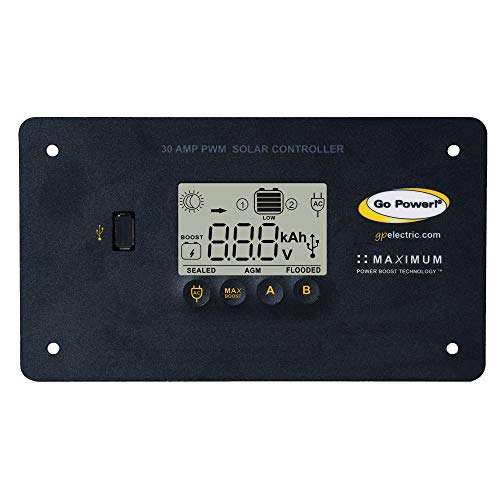
The GP-PWM-30-UL is a 30A PWM digital regulator designed for RV use, with broad battery compatibility including Lithium, wet cell, AGM, and gel types. It supports full four-stage charging—Bulk, Absorption, Float, and an Equalization option for wet cell batteries. This regulator can handle up to 570 watts of solar input, making it suitable for mid-sized RV solar setups. It provides a straightforward, reliable option for travelers who prioritize proven PWM charging and simple integration into existing 12V systems.
Key considerations include ease of installation and compatibility with various battery chemistries. PWM regulators are typically simplest to configure and very robust in harsh outdoor environments, though MPPT options can extract more energy in shaded or variable light conditions. For RVs with modest solar arrays, the GP-PWM-30-UL remains a solid, budget-friendly choice.
Renogy Adventurer 30A PWM Charger

The Renogy Adventurer 30A PWM controller is designed for compact RV installations with a flush-mount design. It supports 12V/24V systems and is compatible with sealed, gel, flooded, and Lithium batteries. The controller offers Bulk, Boost, Float, and Equalization charging phases to extend battery life. Its negative-ground design enhances safety when grounding the solar system, which aligns well with typical RV electrical layouts. The flush-mount option helps maintain a clean, low-profile dashboard or cabinet appearance in mobile living spaces.
Designed for seamless RV integration, this model includes a clear interface for monitoring charging progress and status. While PWM is generally more affordable than MPPT, it can be effective when solar exposure is relatively consistent and panels are sized to meet modest energy needs.
Victron Energy SmartSolar MPPT 50A Controller

The Victron SmartSolar MPPT 50A controller optimizes power conversion with rapid MPPT tracking and intelligent charge algorithms. It’s designed to maximize energy output from solar arrays, adjusting in real time to shade and changing sun angles. This model supports synchronization with multiple SmartSolar controllers, enabling system-wide energy optimization and consistent battery longevity. Bluetooth connectivity allows remote monitoring and configuration via mobile apps, which is helpful for RV owners who want to fine-tune charging on the go and monitor performance from inside the coach.
MPPT controllers like Victron excel in scenarios with variable light, higher solar input, or larger arrays. They tend to deliver better efficiency and faster charging than PWM, particularly in mobile environments where sunlight can change quickly as you travel. Consider space for installation and the need for compatible wiring and fuse protection when planning an RV solar upgrade.
Victron Energy SmartSolar MPPT 75V, 15A Controller

Another Victron option targets smaller 12V/24V systems with MPPT precision, delivering reliable performance with advanced synchronization features. While the 15A rating is lower than the 50A model, this unit remains suitable for smaller RV setups or for integrating with a multi-controller system that balances several solar arrays. The Bluetooth interface and robust protection features help protect both panels and batteries in rugged travel conditions.
When sizing an MPPT controller, consider the total panel wattage, voltage, and the battery bank’s chemistry. MPPT controllers can extract more energy from higher voltage panels, which matters if your RV system uses longer cable runs or higher voltage arrays to reduce losses. Always verify compatibility with your battery type and temperature compensation settings for optimal results.
Renogy Wanderer Li 30A PWM Controller

The Renogy Wanderer Li 30A PWM controller is crafted for RVs with flexibility in battery type and a focus on safety. It supports Lithium, AGM, Gel, and Flooded batteries and includes a four-stage charging profile: Bulk, Boost, Float, and Equalization. The LCD and indicator LEDs provide clear status updates, while a compact footprint helps fit into tight RV compartments. This unit’s negative-ground design aligns with many RV electrical systems, enhancing safety during grounding.
Wanderer Li emphasizes compact compatibility and a decent energy management strategy for moderate solar setups. PWM technology remains a budget-friendly way to reliably manage charging for RVs with smaller solar arrays or when upgrading an existing system incrementally.
BougeRV Li 30A PWM Solar Controller

The BougeRV Li 30A PWM controller offers a backlit display with a USB port and a robust set of battery compatibility modes for 12V/24V systems. It clearly indicates PV and battery status, updating every few seconds for real-time monitoring. It includes explicit icons for various Lithium chemistries (LFP, Li, LTO) and supports jump-starting a lithium battery if needed. The controller is designed to handle diverse battery types including SLD, GEL, AGM, and Li-based chemistries, making it a flexible choice for RVs using mixed battery configurations.
Consider this model if you value a bright, easy-to-read interface and explicit lithium battery support. PWM regulation remains straightforward and reliable, especially for RV owners who want a practical, mid-range controller with flexible battery compatibility and onboard diagnostics.
Buying Guide: What to Look For In An RV Solar Controller
- Controller type: PWM vs MPPT. PWM is typically simpler and cheaper, adequate for smaller systems. MPPT can squeeze more energy from larger or higher voltage arrays, especially in variable light conditions.
- Battery chemistry compatibility. Ensure the unit supports your battery types (Lithium, AGM, Gel, Flooded). Some models offer flexible “Li” presets for LiFePO4 or other Li chemistries.
- System voltage and current rating. Match the controller to your RV’s system voltage (12V/24V) and solar array wattage. Oversizing a controller is common but unnecessary if your setup is modest.
- Grounding and safety features. Negative-ground compatibility is common in RVs. Look for protection against overcharge, over-discharge, short circuits, and reverse polarity.
- User interface and monitoring. LCDs, backlit displays, Bluetooth apps, and remote monitoring help optimize charging while on the road.
- Physical fit and installation. Consider flush-mount or surface-mount designs for tight RV spaces, as well as waterproof or IP-rated enclosures for outdoor panels.
- Expansion potential. If you anticipate adding panels or batteries, choose a controller that supports higher power or multiple controllers with synchronization features.
- Warranty and support. A solid warranty, accessible customer support, and documented installation guides reduce long-term risk.
Choosing the right RV solar controller involves balancing system size, battery chemistry, and how you use power on the road. MPPT controllers offer higher efficiency for larger or shaded setups, while PWM models provide dependable, budget-friendly performance for compact rigs. Consider future expansion, climate, and how much monitoring you want while traveling to make the best long-term choice.