Best Solar Charge Controller With Generator Input for Off-Grid Power
The right solar charge controller with generator input can simplify remote power systems by managing solar charging while integrating generator sessions. This guide highlights five top options suited for RVs, off-grid homes, boats, and mobile power stations. Each product section explains who it’s best for, why it was selected, and a practical limitation to consider.
Quick comparison table of chosen products:
| Product | Best For | Key Benefit | Limitations |
|---|---|---|---|
| POWLAND 120A MPPT Solar Charge Controller | Large systems; multi-volt setups | Very high current with auto-sensing 12–96V | Moderate install complexity |
| EcoSolLi 120A MPPT Solar Charge Controller | High-output DIY solar arrays | Excellent MPPT efficiency up to 98% | Panels must align with MPPT limits |
| Renogy Rover Lite 60A MPPT | Home RV and workshop systems | Wide voltage range; strong temperature performance | Limited to 60A current |
| Renogy Rover 40A MPPT | Compact off-grid installs | Solid autonomy for smaller systems | Lower amperage than others |
| Victron SmartSolar MPPT | Linked systems; Bluetooth monitoring | Smart syncing and optimal power tracking | Higher price; requires compatible setup |
POWLAND 120A MPPT Solar Charge Controller

Best for: Large, mixed-voltage solar systems needing automatic voltage detection and high current. This controller supports 12V to 96V auto-sensing with up to 120A charging capacity. It employs advanced MPPT for up to 98% efficiency and robust three-stage charging suitable for LiFePO4, AGM, GEL, and flooded lead-acid batteries.
Why selected: The universal voltage range reduces wiring complexity in multi-battery setups. The high efficiency and comprehensive protections help maximize energy harvest while protecting batteries.
Caution: Actual performance depends on panel and wiring quality; ensure proper heat management in hot environments.
EcoSolLi 120A MPPT Solar Charge Controller
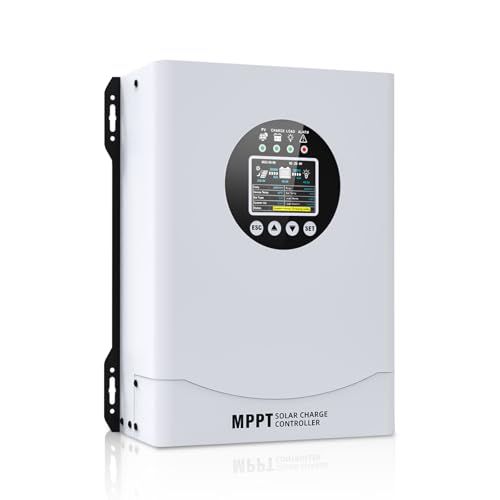
Best for: High-output solar setups with up to 96V systems and large panel arrays. It emphasizes MPPT efficiency (up to 98%) and broad protection, including lithium battery activation for certain chemistries.
Why selected: It provides a strong balance of high current, broad voltage compatibility, and multi-protection features that suit off-grid camps or mobile workshops.
Caution: Data notes repeated feature details; verify exact protection profiles for your battery type before use.
Renogy Rover Lite 60A MPPT

Best for: RVs, off-grid cabins, and workshops needing reliable 60A control across 12V–48V systems. It handles harsh temperatures and emphasizes self-cooling for continuous operation.
Why selected: Renogy’s Rover Lite combines solid temperature tolerance with versatile battery compatibility. It supports a wide range of systems and is a common choice for durable, DIY off-grid builds.
Caution: While capable, it may not match higher-current controllers for very large solar arrays.
Renogy Rover 40A MPPT

Best for: Smaller off-grid systems or budget-conscious setups where 40A capacity is sufficient. It supports 12V/24V systems and multiple battery chemistries.
Why selected: A compact, more affordable option with reliable MPPT performance for moderate solar arrays and diverse battery types.
Caution: Lower amperage means slower charging for larger battery banks or high-wattage requirements.
Victron Energy SmartSolar MPPT

Best for: System-integrated networks and Bluetooth-enabled monitoring with synchronized charging across multiple controllers. Suitable for users prioritizing smart control and battery longevity.
Why selected: Victron’s SmartSolar is designed for advanced systems with monitoring and multi-panel configurations. The Bluetooth feature supports remote diagnostics and system optimization.
Caution: The feature-rich approach can be more complex to configure; ensure compatibility with existing Victron components if expanding the system.
Buying Guide
What size and voltage range should you choose?
- Match the controller to your battery system voltage (12V, 24V, 48V, etc.) and the total PV array wattage to avoid overloading the device.
- Consider MPPT efficiency and how much energy you want to recover under partial shading or variable conditions.
How important are protections and battery compatibility?
- Look for protections such as reverse polarity, overvoltage, overcurrent, and temperature compensation—especially if you use LiFePO4, AGM, GEL, or flooded lead-acid batteries.
- Verify that the controller supports your battery chemistry and charging profile (bulk/absorption/float, lithium recovery, etc.).
Should you prefer a model with smart features?
- Bluetooth or network synchronization can simplify monitoring and coordination across multiple controllers, but may add setup complexity.
- Smart features are helpful if you plan to scale the system or want easy remote diagnostics.
Installation and maintenance tips
- Follow wiring diagrams precisely and use appropriately rated cables to minimize losses and heat.
- Ensure proper ventilation and mounting away from extreme heat or moisture.
- Keep firmware or software updated if the model supports updates via mobile apps or USB.
Frequently Asked Questions
- What is an MPPT charge controller?
It uses maximum power point tracking to optimize energy harvest from solar panels by adjusting charging voltage to match the battery’s needs.
- Can I connect a generator to a solar charge controller?
Some controllers support generator input via AC or DC interconnects, but always follow the manufacturer’s guidance for safe operation and transfer switching.
- What is the difference between 12V and 48V systems?
Higher voltages reduce current for the same power, improving efficiency and reducing conductor losses in larger systems.
- Do I need a separate battery management system with LiFePO4?
Some controllers provide sufficient protection, but many LiFePO4 setups benefit from a dedicated BMS for cell balancing and safety.
- Is Bluetooth monitoring essential?
Not essential for basic setups, but helpful for troubleshooting and optimizing performance in more complex installations.
- How do I choose between a 60A and a 120A controller?
Choose based on your total PV wattage, battery capacity, and future expansion plans; higher amperage accommodates larger arrays and faster charging.