Best Solar Charge Controllers for Marine Use in 2026
Answering the question: the best solar charge controllers for marine setups are those that reliably maximize panel output, protect batteries in challenging salt-air environments, and offer easy compatibility with common boat battery types. This guide highlights five marine-friendly charge controllers that fit different boat sizes, electrical systems, and user needs. It targets boaters seeking MPPT efficiency, PWM simplicity, and robust waterproof design. The following products are chosen for their balance of performance, protection features, and practical use on decks, in cabins, or mounted near the dinghy. A quick summary table follows to help you compare at a glance.
| Product | Best For | Key Benefit |
|---|---|---|
| Victron Energy SmartSolar MPPT | Mid-sized boats with 12/24V systems | Superior MPPT efficiency and synchronized charging |
| Renogy Voyager 20A | RVs, boats, and trailers needing robust protection | IP67 waterproofing and 4-stage charging |
| Renogy Wanderer 10A | Small boats and compact mains | Negative-ground design with compact form |
| ZOUPW 30A PWM | Large solar arrays on boats | Higher current with adjustable LCD |
| SOLPERK 10A PWM | Budget-minded marine systems | Waterproof, smart protection, easy indicators |
Notes: This selection emphasizes marine suitability—water resistance, compatibility with common battery types (AGM, Gel, Flooded, LiFePO4), and straightforward installation on a boat. Each option balances cost with reliability, ensuring that sailors can choose according to their battery bank size and panel array while maintaining safe charging practices.
Victron Energy SmartSolar MPPT Solar Charge Controller

Brand: Victron Energy. Features include smart solar charging that converts sunlight into usable energy while prioritizing battery longevity, a fast optimum power point tracking (MPPT) to maximize output, and synchronized charging across multiple controllers. Best for vessels with diverse sunlight exposure on a single system or extended voyages where system-wide energy optimization matters.
Who it’s best for: boaters needing high efficiency and the ability to coordinate multiple controllers for a larger or multi-zone system. Why selected: MPPT efficiency and synchronization can improve overall energy harvest on boats with unusual sun angles or shaded deck areas.
Caution: Some installations may require compatible busbars or a dedicated control interface; ensure your battery bank can support synchronized charging across multiple devices.
Renogy Voyager 20A 12V/24V PWM

Brand: Renogy. Features 4-stage PWM charging (Bulk, Absorption, Float, Equalization), IP67 waterproof rating, and multiple protections against reverse polarity, overcharge, short-circuit, reverse current, overload, and over-discharge. Best for medium to larger boats where a rugged, straightforward regulator is preferred and panel shade is common.
Who it’s best for: boaters seeking a rugged, protected PWM option with simple LCD readouts. Why selected: The Voyager’s IP67 rating and comprehensive protections suit outdoor marine environments; it’s a reliable option for steady charging in varied sea conditions.
Caution: PWM controllers generally harvest less energy than MPPT in partial shade; consider MPPT if your panels experience frequent shading.
Renogy Wanderer 10A PWM 12/24V
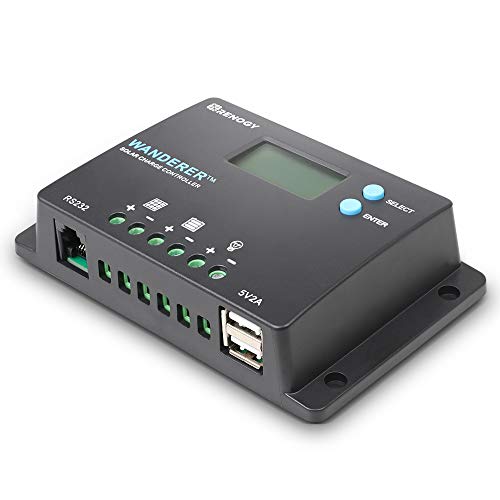
Brand: Renogy. Features a smart 4-stage charging algorithm focused on extending battery life, a negative-ground design, and an LCD for easy status viewing. Best for small boats or limited space where a compact, low-profile controller is needed.
Who it’s best for: small craft or retrofits where limited space requires a compact unit. Why selected: It provides robust protection and a proven track record in marine applications while maintaining a compact footprint.
Caution: Negative ground design can require careful wiring compatibility with existing boat electrical systems; verify battery type support before installation.
ZOUPW 30A PWM Solar Charge Controller

Brand: ZOUPW. Design features include a 32-bit chip for faster sampling and stable operation, a large LCD display for easy parameter adjustment, and compatibility with AGM, Gel, and LiFePO4 batteries. Best for boats with larger panel arrays needing reliable monitoring and adjustable charging parameters.
Who it’s best for: boaters who want a higher current PWM option with adjustable settings and clear monitoring. Why selected: The 32-bit control and LCD make it easier to tailor charging for different battery chemistries on a marine installation.
Caution: Requires correct polarity connection; no polarity converter is included, so miswiring can damage equipment.
SOLPERK 10A Waterproof PWM Controller

Brand: SOLPERK. Features IP67 waterproof rating, 12V or 24V operation, max power up to 150W (12V) or 300W (24V), three indicator LEDs, and intelligent 3-stage PWM charging. Best for budget-conscious sailors who still need a robust outdoor unit.
Who it’s best for: boaters seeking a cost-effective, weatherproof regulator with easy-to-read indicators. Why selected: Waterproofing and simple protection features provide reliable performance in wet decks and exposed mounting locations.
Caution: PWM efficiency is typically lower than MPPT; this unit is best paired with well-mimensioned panels to ensure adequate charging in varied conditions.
Buying Guide
What type of system do you have?
Choose MPPT controllers for boats with larger or partially shaded solar arrays where maximizing power is critical. PWM controllers are often enough for smaller boats or simple setups with steady sun.
How much solar and how many batteries?
For larger battery banks or multiple battery types, consider controllers that support 12/24V operation and offer protections against overcharge and reverse current. MPPT units tend to be more efficient in variable conditions while PWM units provide straightforward reliability for basic systems.
Waterproofing and mounting considerations?
Marine environments demand IP-rated devices. Look for IP67 or better and ensure the controller can be mounted away from direct spray or splashes, with proper ventilation.
Battery compatibility?
Verify battery chemistries such as AGM, Gel, Flooded, or LiFePO4. Some controllers advertise multi-chemistry support; confirm the charging profile matches your battery type to avoid degradation.
Ease of use and monitoring?
LCD displays and LED indicators simplify setup and ongoing monitoring. MPPT models with Bluetooth or app compatibility can help troubleshoot energy flow without accessing compartments.
Installation considerations?
Ensure correct polarity and compatible wiring gauges. Some models require additional accessories (sensors, busbars, or distribution blocks) for a clean marine installation.
Safety and longevity?
Protection features like reverse polarity, overcharge, short-circuit, and temperature compensation contribute to longer battery life and safer operation on a moving vessel.
FAQ
- What is the difference between MPPT and PWM for marine usage? MPPT controllers extract more energy from panels by tracking the maximum power point, especially under varied light or shading. PWM controllers are simpler, cheaper, and good for smaller systems with steady sun.
- Why is waterproofing important in marine charge controllers? Saltwater and spray can damage electronics; IP-rated models resist moisture and corrosion, extending controller life.
- Can I use multiple charge controllers on one boat? Yes, but ensure they can synchronize or operate independently without conflicting charge profiles. Victron’s synchronization feature is an example of how this can be managed.
- Do these controllers support LiFePO4 batteries? Some do; verify the supported battery chemistries and charge parameters before wiring. Always match the controller’s program to the battery type.
- Is a higher amperage controller always better? Not necessarily. Choose amperage based on panel output and desired charging speed without exceeding battery or wiring ratings.
- What maintenance is required? Regularly inspect connections for corrosion, clean dust or salt spray from heat sinks, and verify that fuses and wiring remain intact after rough seas.