Best Solar Centrifugal Water Pumps for Quiet, Efficient Circulation
Answering the demand for affordable, solar-ready water circulation, these pumps are ideal for small fountains, ponds, fish tanks, and hydroponics. The top picks below are best suited for DIY solar setups, off-grid projects, and low-noise operation. They favor buyers who need reliable submersible pumps with low power consumption and easy integration with solar panels or battery storage. The table summarizes core specs to help compare options quickly.
| Product | Voltage | Flow (L/H) | Lift (m) | Best For |
|---|---|---|---|---|
| GENEDEY DC 12V Brushless 800L/H | 12V | 800 | 5 | Small ponds, aquariums |
| ZAOJIAO DC 12V Brushless 800L/H | 12V | 800 | 4 | Fountains, solar ponds |
| GENEDEY DC 24V 800L/H | 24V | 800 | 5 | Solar panels with higher voltage |
| Hilitand Brushless DC12V 800L/H | 12V | 800 | ~4 | Aquariums, hydroponics |
| GENEDEY DC 12V 800L/H (Same family) | 12V | 800 | 5 | Fish tanks, fountains |
GENEDEY DC 12V Brushless Magnetic Drive Centrifugal Submersible Water Pump

This 12V pump offers quiet operation and compact size, designed for solar-powered water circulation in small tanks, ponds, or fountains. It uses a brushless magnetic drive for efficiency and longevity, with a waterproof IP68 rating to resist submersion. The ceramic shaft adds wear resistance for longer service life.
Best for: Small aquariums, garden ponds, or solar-powered fountain setups that require low-noise pumping and reliable submersion.
Why selected: High efficiency, low power consumption, and robust waterproofing suit off-grid solar applications where downtime is costly.
Limitation: Non-self-priming; requires submersion to operate and may need priming if mounted above water level.
ZAOJIAO DC 12V Brushless Water Pump 1/2” 800L/H

This centrifugal submersible pump is non-self-priming and designed for submersion, suitable for fountains, pools, and hydroponic systems. The 1/2″ male outlet makes hose connections straightforward, with easy detachment for cleaning. It provides up to 800 L/H and a 4 m lift, operating in 0–60 °C environments.
Best for: Solar-powered fountains or ponds where a compact, easy-to-connect pump is preferred.
Why selected: Simple hose compatibility and a reasonable flow/lift balance for small water features.
Limitation: It is not self-priming, so proper submersion is required to maintain prime and prevent air pockets.
GENEDEY DC 12V Brushless Magnetic Drive Centrifugal Submersible Water Pump (Second Model)

This second 12V option mirrors the first in quiet operation and efficiency, with reinforced waterproofing and ceramic shaft technology for extended life. It is designed for quiet, continuous circulation in smaller water features or solar-assisted systems.
Best for: Redundant or alternative 12V solar setups where a similar performance profile is desired.
Why selected: Consistent 800 L/H flow with strong anti-interference design, suitable for replicable solar builds.
Limitation: Like other submersible pumps, it requires correct submersion or appropriate priming to avoid air intake issues.
GENEDEY DC 24V 1/2″ Brushless Pump For Solar Circulation

This 24V model is designed for solar-powered systems where higher voltage is advantageous, especially when pairing with solar panels that deliver 24V. It maintains a quiet operation and a robust waterproof rating, with a ceramic shaft for durability and long service life.
Best for: Solar installations using 24V arrays or battery banks, and larger micro-water features needing steadier pressure.
Why selected: Offers similar performance at a higher voltage, enabling flexibility in solar design and wiring efficiency.
Limitation: Requires compatible 24V solar supply or controller; not a plug-and-play 12V system.
Hilitand Brushless DC12V 20W Submersible Pump
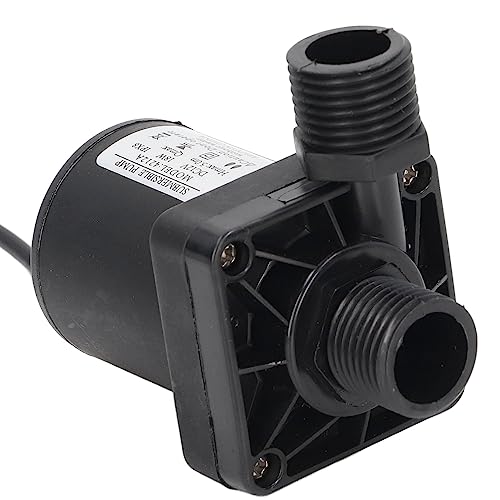
This compact 12V pump uses a 20W motor to deliver up to 800 L/H, with IPX8-grade protection for water contact. It is ideal for small aquaponics, fountains, hydroponics, and cooling loops. The design emphasizes efficiency and ease of installation in tight spaces.
Best for: Tiny solar-powered setups or hidden installations where power efficiency matters most.
Why selected: A balance of compact size, efficiency, and waterproof protection that suits portable solar projects.
Limitation: Might require careful mounting to ensure submersion remains uninterrupted and priming stays consistent.
Buying Guide
Key considerations for choosing a solar centrifugal water pump:
- Voltage compatibility: Match the pump voltage to your solar array or battery. 12V models work well with small solar setups; 24V may suit higher-energy systems.
- Flow versus lift: For small ponds and fountains, 600–800 L/H with 4–5 m lift is typical. If you need to move water farther or higher, prioritize higher lift.
- Submersion and priming: Non-self-priming pumps require full submersion and proper priming to avoid air pockets. Submersible installation is common in solar applications.
- Durability and seal: Look for IP waterproofing and ceramic shafts for wear resistance in long-term use, especially in outdoor settings.
- Noise level: Brushless magnetic drives generally offer quiet operation. If noise is a priority, check decibel ratings and mounting logistics.
- Connection and maintenance: Check outlet size (often 1/2″), hose compatibility, and ease of cleaning or detaching for service.
Frequently Asked Questions
- Can these pumps run directly off a solar panel? They can, when matched to a suitable solar panel and controller or battery, respecting voltage and power limits.
- Are these pumps suitable for outdoor ponds? Yes, many are designed for submersion with IP68 ratings, but ensure proper mounting and protection from the elements.
- What maintenance is required? Regular cleaning of the inlet, checking hoses, and ensuring the shaft remains free of debris helps maintain performance.
- Which is best for a small fountain? Pumps with 800 L/H flow and 4–5 m lift typically provide adequate circulation without excessive energy use.
- Do these pumps require priming? Non-self-priming models require submersion and careful initial priming to prevent air lock.
- Is a higher voltage pump always better? Not necessarily; choose based on your solar system’s voltage, available current, and wiring efficiency.