Best Solar Battery Charge Controllers for Off-Grid Power and RV Use
Choosing the right solar battery charge controller is essential for protecting your investment and maximizing system efficiency. This guide highlights five top-rated controllers, across PWM and MPPT technologies, suitable for 12V and 24V systems. Each product section includes key features, compatibility notes, and practical considerations to help you match a controller to your battery type and solar setup. Whether you need reliable PWM performance for RVs or advanced MPPT power tracking for larger off-grid arrays, these options cover common needs and climates.
Summary of selected products:
- Renogy Wanderer 10A PWM: Negative ground, LCD display, multi-battery compatibility including Li-ion.
- Renogy Wanderer Li 30A PWM: Lithium-friendly with robust protections and compact design.
- Victron Energy SmartSolar MPPT (75V, 15A): Bluetooth-enabled MPPT with synchronized charging capability.
- SOLPERK 8A PWM with IP67: Waterproof, LED status indicators, multiple protections.
- Depvko [Upgraded] 30A PWM: Dual USB output, wide battery compatibility, auto-memory of settings.
Renogy Wanderer 10A PWM Negative Ground Controller
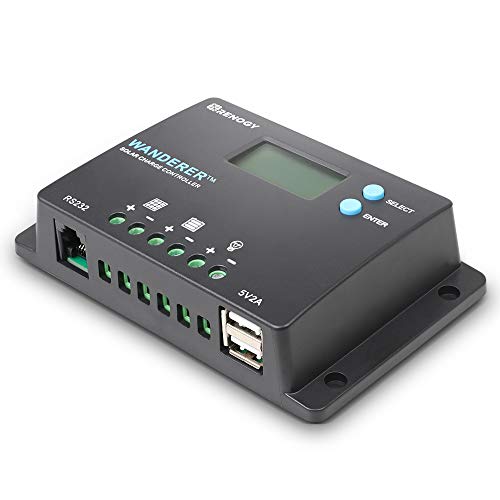
Renogy’s Wanderer 10A PWM controller uses a four-stage charging process—Bulk, Boost, Float, and Equalization—to optimize both battery life and solar efficiency. It supports AGM, Gel, Flooded, and Lithium batteries, and its negative-ground design is often favored for RVs and marine installations. The LCD interface provides real-time data and error codes for quick diagnostics. Built for outdoor use, the Wanderer combines compact dimensions with robust protection against overcharge, overload, or reverse polarity, helping extend the life of your battery bank.
Key considerations: This model is best for smaller solar arrays where PWM control is sufficient. It’s ideal if your system already uses lead-acid or certain LiFePO4 chemistries and you need reliable, simple management with a clear LCD readout. Negative-ground compatibility is a practical concern for specific vehicle or boat electrical systems.
Renogy Wanderer Li 30A PWM Controller

This 12V universal PWM controller from Renogy is designed to flexibly charge Li-ion, AGM, Gel, and Flooded batteries. It provides four-charge stages (Bulk, Boost, Float, Equalization) and offers a straightforward way to switch battery types while monitoring charging stages via LEDs. The Wanderer Li 30A emphasizes durability in RV or marine settings, with a compact form factor and IP32-rated waterproofing for lighter outdoor exposure. It balances performance with an approachable interface for users upgrading to lithium or mixed chemistries.
Key considerations: Suitable for mid-sized installations that require lithium compatibility without stepping up to MPPT. If you’re transitioning to lithium or want a controller that can handle multiple battery chemistries, this model provides a practical upgrade path without adding complexity or cost associated with MPPT features.
Victron Energy SmartSolar MPPT Solar Charge Controller

The Victron SmartSolar MPPT controller uses advanced maximum power point tracking to maximize energy harvest, even when panels operate in partial shade. It supports 12V and 24V systems and can synchronize multiple controllers to act as a single system, ensuring balanced charging across modules and batteries. Bluetooth connectivity enables remote monitoring and parameter adjustment via a compatible app, offering detailed insights into charging curves and historical performance. This model is a strong choice for larger off-grid setups or installations requiring precise energy optimization.
Key considerations: MPPT controllers provide superior efficiency in variable light conditions and higher system voltages. If you have a sizable solar array or aim to maximize energy capture in less-than-ideal conditions, this Victron option is highly suitable, especially when expansion or system integration matters.
SOLPERK 8A PWM With IP67 Waterproofing

SOLPERK’s 8A PWM controller emphasizes rugged outdoor use with IP67 waterproof protection. Its LED indicators provide simple status updates for charging, and the controller integrates essential protections, including reverse current, overcharging, short circuits, and high/low voltage limits. The device is suitable for 12V lead-acid systems and is a practical choice for RVs, boats, or outdoor installations where weather resistance is a priority. The compact unit is easy to mount and operate, making it a reliable budget-friendly option for smaller arrays.
Key considerations: This model keeps things straightforward with essential protections and clear status indicators. It’s best when a compact, weatherproof PWM controller is needed without the complexities or higher cost of MPPT systems.
Depvko [Upgraded] 30A PWM Solar Controller
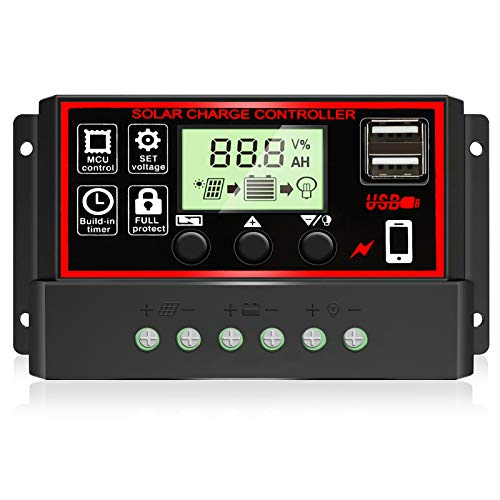
This upgraded 30A PWM controller supports 12V and 24V systems with a dual USB output (5V/2.5A max) for charging mobile devices. It memorizes user-set parameters, allowing automatic resume after battery depletion and features three-stage PWM charging for lead-acid batteries (OPEN, AGM, GEL). It warns against use with non-lead-acid chemistries, and automatic shutdown occurs if battery voltage falls below 8V to protect battery life. The robust 30A capacity makes it suitable for mid-to-large loads in RVs or small off-grid setups.
Key considerations: A practical option for users who need USB charging alongside PWM control. If your battery bank remains primarily lead-acid and you want a flexible, memory-enabled controller, this model offers reliable performance without MPPT complexity.
Buying Guide: Key Purchase Considerations
When choosing a solar battery charge controller, weigh these factors to fit your system and usage:
- Battery chemistry compatibility: Ensure support for AGM, Gel, Flooded, Lithium, or LiFePO4 as needed. Lithium-compatible models may require specific settings or firmware.
- System voltage and current rating: Match the controller to your panel array’s voltage and the battery bank’s amp-hour rating. Larger systems benefit from MPPT for higher efficiency.
- PWM vs MPPT: PWM controllers are simple and cost-effective for smaller systems and lead-acid batteries. MPPT controllers harvest more energy, particularly in cooler climates or partially shaded conditions.
- Protection features: Look for over-charge, over-discharge, reverse polarity, short-circuit, and temperature protection. Waterproof or IP-rated enclosures are important for outdoor installations.
- Monitoring and interfaces: LCD displays and LED indicators help with quick diagnostics. Bluetooth or app-based monitoring is valuable for remote system oversight.
- Physical design and installation: Consider size, mounting options, and negative-ground vs positive-ground configurations. Outdoor exposure requires weatherproofing and robust materials.
- Expandability and synchronization: For larger systems, MPPT controllers that can synchronize with others can simplify management and optimize overall performance.
In summary, PWM controllers like the Wanderer and SOLPERK models provide solid, economical control for smaller systems or lead-acid chemistries. MPPT options, such as Victron SmartSolar, deliver higher efficiency for larger arrays and mixed environments. When selecting a controller, prioritize battery compatibility, system voltage, and environmental exposure to ensure reliable, long-term operation.