Best Soft Start Kits for Residential Air Conditioners: Reduce Surges and Extend Lifespan
Choosing a soft start kit can protect your AC system, especially in homes with unstable power, generators, or solar setups. The following picks are among the most capable options for residential use, RVs, and small commercial installations. Each product helps reduce startup current, minimize voltage fluctuations, and extend compressor life while remaining easy to install. Below you’ll find practical guidance and a concise buying guide to help compare features, compatibility, and installation considerations.
| Product | Brand | Approximate Capacity | Key Benefit |
|---|---|---|---|
| MICRO-AIR EasyStart FLEX 398 | MICRO-AIR | Up to 6 Tons | Generates smooth starts; works with generators and inverters |
| Eshcol AC Soft Start Kit (1.75-3.5 Ton) | eshcol | 1.75 – 3.5 Ton | Wide voltage compatibility; robust protection features |
| Hyper Engineering Soft Starter SS1B16-32SN | Hyper Engineering | 5-7 Ton | Delays starts to prevent overload; generator friendly |
| AIRGO Soft Starter | AIRGO | 4-7 to 7+ Ton range | Wide compatibility; generator and solar friendly |
| SoftStart Home – Soft Starter for A/C | SoftStartRV By NetworkRV | Up to 6 Tons | 15-minute install; off-grid readiness |
MICRO-AIR EasyStart FLEX 398

The MICRO-AIR EasyStart FLEX 398 is designed for residential units up to 6 tons (72,000 BTUs). It provides a controlled, gentle startup that reduces mechanical stress and extends the life of the air conditioning system. The kit includes everything needed for straightforward installation, making it viable for home, RV, and commercial applications. It also claims compatibility with generators and inverters, helping to lower startup current by up to 75%, which can be critical in locations with limited or unstable power sources. This flexibility makes it a strong option for homes near unreliable grids or those using off-grid power.
Eshcol AC Soft Start Kit (1.75-3.5 Ton)

This soft start kit from eshcol covers 1.75 to 3.5-ton residential air conditioners and operates on 110V-240V. It’s designed for homes, RVs, marine environments, and settings with unstable power, offering a smooth startup and reduced current draw. The kit is compatible with non-Bluetooth MICRO-AIR units and can help prevent tripping breakers by soft-starting the compressor. Built-in protections address reverse motor scenarios, low voltage, and overcurrent events, backed by a flame-retardant ABS enclosure for durability.
Hyper Engineering Soft Starter SS1B16-32SN

The Hyper Engineering SS1B16-32SN targets 5-7 ton HVAC systems, offering a robust solution for emergencies or outages when a generator is in use. It reduces locked rotor amperage and inrush current up to 70% at startup, helping to minimize light flicker and startup noise. The device also protects the compressor or motor from stalling at low voltages and includes a delay function to limit the number of starts per hour, making it suitable for mission-critical or off-grid installations where power reliability is a concern.
AIRGO Soft Starter for ACs & Heat Pumps

The AIRGO soft starter is designed for both air conditioners and heat pumps, reducing startup surge and protecting against reverse motor scenarios. It’s compatible with generator setups, stored energy systems, and solar power, making it a versatile option for various power conditions. This kit emphasizes a gentle ramp-up to minimize electrical stress and is particularly useful in environments where power quality is inconsistent or frequently interrupted, ensuring reliable operation across seasons.
SoftStart Home – Soft Starter for A/C
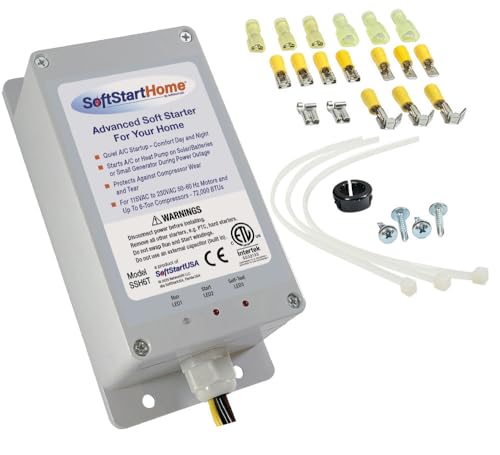
SoftStart Home offers a compact, user-friendly soft starter for air conditioners and heat pumps up to 6 tons. It emphasizes a 70% reduction in startup current, supporting off-grid operations with generators, RVs, and solar systems. The device is marketed to extend compressor life by reducing startup heat buildup and mechanical stress, making it a practical option for homeowners seeking improved reliability without complex installation requirements.
Buying Guide: Key Purchase Considerations
- System size and compatibility: Match the kit to your AC unit’s tonnage and voltage (110V-240V is common). Larger systems (4-7 tons) may require higher-capacity starters with robust protection features.
- Power source considerations: If you rely on generators, inverters, or solar, prioritize kits explicitly designed for off-grid or weak-grid conditions to achieve meaningful current reductions.
- Protection features: Look for reverse motor protection, overcurrent protection, low-voltage protection, and anti-stall features. These protect compressors during voltage fluctuations.
- Installation effort: Some kits include comprehensive installation kits. Assess whether you need professional help or a DIY-friendly option with clear instructions.
- Noise and startup behavior: A softer startup reduces audible noise and prevents tripping breakers, enhancing comfort in residential settings.
- Durability and enclosure: Durable housings (flame-retardant, dust-proof ABS) extend longevity, particularly in harsher environments or garages.
- Brand and support: Consider brands with clear documentation, warranty coverage, and compatibility notes for various AC brands.
- Future upgrades: If you anticipate adding more off-grid capabilities or solar, choose modules noted to work well with generators or stored-energy systems.
Usage Considerations and Comparative Insights
Soft start kits improve reliability for homes with marginal electrical infrastructure or frequent power fluctuations. When selecting a kit, verify that the unit supports your air conditioner’s tonnage and compressor type (single-stage vs. two-stage). Some kits also offer compatibility with heat pumps, expanding usefulness across year-round comfort systems. For RVs and marine applications, portability and installation ease can be decisive factors. In generator-heavy environments, prioritize models that advertise significant startup current reductions and robust protection against voltage drops. While price varies, the long-term savings on reduced wear and fewer service calls can justify the investment.
Installation Tips and Best Practices
- Follow the manufacturer’s wiring diagram precisely to avoid miswiring that could bypass safety features.
- Ensure the breaker and wiring gauge match the kit’s requirements to prevent nuisance trips.
- Test the system under load after installation to confirm a smoother startup without voltage drops.
- Maintain clear labeling of installed soft starters for future service calls or upgrades.
- Keep documentation handy for warranty considerations and compatibility notes with future equipment replacements.
By selecting a suitable soft start kit and installing it correctly, homeowners can mitigate voltage-related startup issues, extend compressor life, and maintain more stable indoor comfort. The options listed here provide a range of capacities and installation complexities to fit different home setups and power environments.