Best Interconnected Smoke and Carbon Monoxide Detectors for Home Safety
Looking for reliable interconnected smoke and carbon monoxide detectors? This guide highlights five top options ideal for different homes and needs. The focus is on devices that alert all alarms in a system when one detects danger, helping you and your family react quickly. Best for multi-room homes, renters, seniors, and households seeking long-life batteries or easy setup. The following picks cover hardwired, wireless, and battery-powered interconnectivity.
| Product | Interconnection | Power | Best For |
|---|---|---|---|
| X-Sense Interconnected Smoke and Carbon Monoxide Detector 10-Year Battery (6-Pack) | Interconnected | 10-year sealed battery | Large homes or multi-level layouts; maintenance-free for a decade |
| First Alert Combination Smoke & CO Alarm, Interconnect Hardwire Detector with Battery Backup (SMICO100-AC) | Hardwired interconnect | Hardwired with battery backup | New builds or renovations needing reliable home-wide interconnection |
| X-Sense Wireless Combination Smoke & CO Detector (XP0H-WN, 3-Pack) | Wireless interconnection | 10-year non-replaceable battery | Renters or multi-unit homes; easy placement without rewiring |
| X-Sense Smoke & CO Detector Combo 10-Year Battery, Wireless Interconnected (SC01-W, 6-Pack) | Wireless interconnection | 10-year sealed battery | Homes seeking long-life, wireless reliability with simple expansion |
| Kidde Smoke & CO Detector, Hardwired with AA Battery Backup (3 Pack) | Hardwired interconnect | 120V with AA backup | Preserving traditional hardwired systems with backup protection |
X-Sense Interconnected Smoke and Carbon Monoxide Detector 10-Year Battery (6-Pack)

This detector uses a 10-year sealed lithium battery, enabling maintenance-free protection for up to a decade. It combines smoke and CO sensing in a single unit and is UL 217 and UL 2034 certified. All alarms in the interconnected network sound together, giving everyone in the home a timely warning. Best for large homes or multi-story layouts where maintenance convenience matters. A potential limitation is the non-hardwired design, which relies on battery-only power and wireless linking between units.
First Alert Combination Smoke & Carbon Monoxide Alarm, Interconnect Hardwire Detector with Battery Backup (SMICO100-AC)

This model emphasizes early warning with precision detection technologies and a straightforward Quick Connect Plug for easy installation without rewiring. It is designed to minimize nuisance alarms caused by cooking while still providing reliable interconnection across all compatible units. Choose this if you want a robust hardwired solution with a dependable battery backup for power outages. A potential drawback is the higher initial setup effort if you’re replacing an older system.
X-Sense Wireless Combination Smoke and Carbon Monoxide Detector XP0H-WN (3-Pack)

XP0H-WN provides wireless interconnection among up to 18 X-Sense Link+ devices and uses a 10-year non-replaceable battery. It features remote testing and silencing options (sold separately) to avoid ladder climbs, making it a practical option for homes with seniors or multi-floor layouts. Best for: homes that prefer wireless expansion without a rebuild. Limitation to note: it does not include Wi-Fi connectivity, which means remote monitoring is not possible through a smart hub.
X-Sense Smoke and Carbon Monoxide Detector Combo 10-Year Battery, Wireless Interconnected (SC01-W, 6-Pack)

SC01-W combines smoke and CO detection with a 10-year sealed battery and wireless interconnection. It ensures all alarms react in sync for faster evacuation. It’s well-suited for homes needing long-life wireless coverage and simple expansion. A possible drawback is that the interconnection relies on radio signals rather than a wired backbone, which may affect reliability in environments with heavy interference.
Kidde Smoke and Carbon Monoxide Detector, Hardwired with AA Battery Backup (3 Pack)
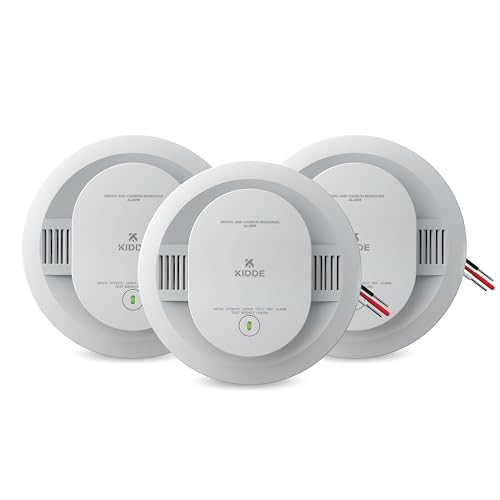
This hardwired option provides dual sensing for both smoke and CO with an 85 dB alarm and visible LED indicators. It interconnects across the home and includes a backup power option via AA batteries for outages. It’s a solid choice for homes with existing 120V wiring that want extended protection. Caution: warranty details and ongoing maintenance should be checked based on the installation environment and local codes.
Buying Guide
What interconnect type best fits your home?
- Hardwired interconnect: Best for new builds or homes undergoing renovation where a wired backbone is feasible. Pros include consistent power and reliable interconnection during outages. Cons include installation complexity.
- Wireless interconnection: Ideal for rentals or retrofits where rewiring is impractical. Pros include easier installation and flexible placement; cons may involve radio interference or battery dependence.
- Battery-powered with long life: Great for maintenance-free operation over many years. Pros include minimal upkeep; cons include reliance on battery health and potential gaps if a device is removed or relocated.
What should you consider when choosing?
- Sensor combination: 2-in-1 smoke and CO detectors offer convenient protection in one unit. If you only need one sensor type in certain areas, consider single-purpose devices paired with others.
- Battery life: Ten-year sealed batteries reduce maintenance, but ensure you know replacement timing if not sealed.
- Interconnect capacity: Some models support dozens of linked units; confirm the exact number if you have a large home.
- Certification: Look for UL 217 for smoke and UL 2034 for CO detectors to ensure standards compliance.
FAQ
- Q: Do interconnected detectors require a central hub? A: Not always. Some models use hardwired interconnect or wireless radio links, while others may offer optional hubs for remote monitoring.
- Q: Can I mix brands in an interconnect system? A: Often possible with standard interconnect signals, but compatibility varies. Stick to models that clearly state universal interconnection or consult a professional.
- Q: How long do the batteries last on 10-year detectors? A: The sealed lithium batteries typically last up to 10 years, with each unit indicating end-of-life timing.
- Q: Do these detectors require regular testing? A: Yes; regular testing ensures sensors and interconnections function correctly. Remote testing options may be available on some models.
- Q: Are these detectors suitable for kitchens or garages? A: Many models include nuisance alarm reduction features, but placement should follow manufacturer guidelines to minimize false alarms in cooking areas.