Best 300 Watt Solar Panel Options for Off‑Grid Power and RV Living
Answering the question “which 300 watt solar panel is right for me?” this guide highlights five high‑efficiency 300W panels suited for RVs, boats, campsites, and off‑grid homes. These selections emphasize reliability, portability, and strong performance across various environments. Best for compact roof space, best for marine setups, best for flexible mounting, and best overall value are considered. The buyer types most likely to benefit include full‑time RV travelers, weekend campers, boat owners seeking steady shore power, and off‑grid installers maximizing small roof area.
Summary of chosen products
| Product | Best For | Key Strength | Limitations |
|---|---|---|---|
| 300 Watt Solar Panel N-Type 18BB 12V (Mndstek) | RVs and rooftops with limited space | High efficiency up to 24.6% | New tech may require compatible mounting |
| 300 Watt Solar Panel 10BB N-Type 300w (Mndstek) | Marinas and mobile setups | 25% efficiency with half-cut cells | Busbar-Less design can affect wiring choices |
| Bifacial 300W Solar Panel 25% (Mndstek) | Long evenings and reflective surfaces | Front and back energy capture up to 30% | Double-sided performance depends on reflectivity |
| 300 watt Flexible Panel Bendable (Mndstek) | Curved roofs and irregular surfaces | 0.11 inch ultra-thin profile | Premium flexibility may affect mounting security |
| DOKIO 300W Foldable Kit | Portable camping and emergencies | Foldable with standalone PWM controller | Wired in with separate controller requirement |
300 Watt Solar Panel N-Type 18BB 12V 300W — High Efficiency Monocrystalline

This 300W panel uses 18BB cells with up to 24.6% conversion efficiency. It is constructed with n-type technology and high‑quality materials to optimize performance while saving space. Best for buyers prioritizing compact footprint and strong daytime output for RVs, boats, or small roofs. Caution: verify mounting hardware compatibility with your roof profile and ensure adequate ventilation for heat dissipation.
300 Watt Solar Panel 10BB N-Type 300w — 25% Efficiency

This panel features 10BB concealed busbars and half‑cut cells for improved light absorption, delivering up to 25% efficiency. It uses upgraded N‑type technology to reduce surface recombination and improve temperature performance, making it well suited for RV rooftops or back‑of‑house solar installations. Best for users who want higher efficiency with better low‑light response. Limitations: ensure compatible frame and hardware for your mounting plan; busbar‑less design may require careful wiring practices.
Bifacial 300W Solar Panel 25% — Front & Back Energy
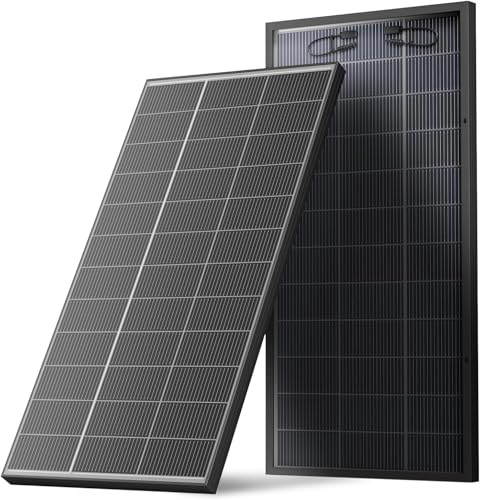
This bifacial panel captures light on the front and reflected light on the back, boosting energy harvest by up to 30% in optimal conditions. It uses N‑Type cells with 18BB busbars for efficiency. Best for RVs, off‑grid homes, and marine use where reflective surfaces (water, snow, roofs) are common. Caution: performance gain depends on mounting angle and reflective environment; ensure adequate shading control.
300 Watt Flexible Solar Panel Bendable — Ultra-Thin 23.5%

An ultra-thin, flexible panel with 23.5% efficiency and ETFE coating. It bends up to 270° for curved roofs, boats, or vans and is designed for irregular surfaces with a lightweight build. Best for mobile and curved installations where rigid panels won’t fit. Limitation: flexible panels may have lower impact resistance than rigid options and require careful mounting to resist bending strain.
Flexible Solar Panel 2-Pack 150W — Off‑Grid Flexibility

Two 150W flexible panels, totaling 300W, with up to 240° bending and lightweight construction. Targeted for RVs, boats, and cabins with irregular or curved surfaces. Best for flexible layout and space-constrained roofs. Caution: ensure electrical wiring and mounting hardware can handle two panels as a combined setup rather than a single rigid frame.
DOKIO 300W Foldable Solar Panel Kit — Portable Power

Foldable kit with a separate PWM controller for safe charging of 12V systems. It folds to compact dimensions for easy transport and includes a long 9.85 ft cable. Best for campers and emergency setups where portability matters. Limitation: separate controller adds an additional component to manage during use and storage.
DOKIO 300W Portable Foldable Kit — Standalone Controller

This kit emphasizes portability with a foldable design and a standalone PWM controller for safe charging. Best for travelers who need a compact, all‑in‑one power solution that can be deployed quickly. Caution: ensure compatibility between the controller and battery system to avoid under‑ or overcharging.
Buying Guide: What To Consider When Picking a 300W Panel
- Application environment: Roof space, boat decks, or portable setups all influence panel choice. Rigid panels offer durability, while flexible panels fit curved shapes better.
- Cell technology: N-type cells and 18BB/10BB busbars improve efficiency and temperature performance. Consider bifacial designs only if reflective surfaces are present.
- Mounting and installation: Check compatibility with existing racks, frames, or adhesives. Pre-drilled holes and mounting hardware simplify installation for RVs and boats.
- Durability: Weather resistance (IP ratings), tempered glass, and frame materials affect long‑term performance in harsh environments.
- Portability vs. output: Foldable kits and flexible panels excel in travel; fixed roof panels maximize steady daytime power for steady systems.
Frequently Asked Questions
- What makes a 300W panel suitable for off‑grid use? – It provides a balance of output, space efficiency, and portability for remote locations with limited roof or deck space.
- Are bifacial panels worth it for a boat or RV? – They can boost energy capture, especially on reflective surfaces; effectiveness depends on installation angle and surroundings.
- Do I need a specific controller for 300W panels? – A charge controller or a PWM controller is recommended to regulate charging and protect batteries; some kits include controllers, others do not.
- Can flexible panels handle marine conditions? – Flexible panels resist impact and conform to curved surfaces, but verify water sealing and mounting strength for marine use.
- How do I compare efficiency across panels? – Look for cell type (N‑type vs PERC), busbar count (18BB vs 10BB), and bifacial capabilities to estimate real‑world output.
- Is 300W enough for full RV camping power? – It depends on energy demand; for high consumption, pairing with a battery bank and possibly additional panels is common.