Best Small Wind Power Generators for DIY Energy
Small wind power generators offer hands-on insight into renewable energy, useful for classrooms, hobbyists, and off-grid setups. This guide highlights five accessible options that balance educational value, durability, and performance for American readers interested in compact wind energy projects.
Summary of Selected Products
| Product | Brand | Power (approx.) | Notable Feature | URL |
|---|---|---|---|---|
| Wind Power V4.0 STEM Kit | Thames & Kosmos | Manual 3 ft turbine | Single-piece blade for durability | Link |
| Enrienn 1200W Wind Turbine | Enrienn | Up to 1200W | MPPT controller for stable output | Link |
| OSKOPWRC 800W Kit | OSKOPWRC | 800W rated | All-weather fiberglass nylon blades | Link |
| 4M Green Science Windmill Kit | 4M | LED-lit windmill (kit) | Educational science kit | Link |
| SWONVI Micro Wind Turbines | SWONVI | 0.55 W per unit | DIY assembly for hands-on learning | Link |
The following sections explore five top picks in detail, focusing on how each model supports learning, experimentation, and practical small-scale power generation.
Thames & Kosmos Wind Power V4.0 Kit
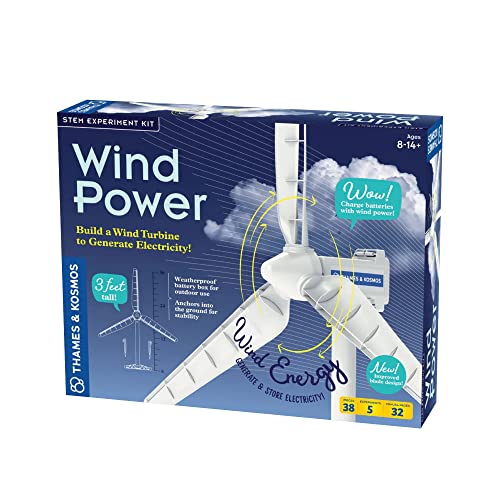
- Real, working 3-foot tall wind turbine suitable for outdoor use.
- Single-piece blade construction designed for durability and better aerodynamics.
- Generates electricity to charge a battery and power a small model car, illustrating practical energy conversion.
The kit emphasizes wind energy concepts through hands-on assembly and testing. It provides a tangible demonstration of how wind speed affects power output and how turbines convert kinetic energy into usable electrical energy for small devices. This makes it a strong educational tool for classrooms, science fairs, and home experiments alike.
Small Wind Turbine Generator Micro DC Motor (DIY Kit)

- Compact design with a 17.5 cm blade diameter and 11 blades per propeller.
- Requires external wind or a powered blower to generate electricity; suitable for controlled experiments.
- DC motor-based generator with variable output dependent on wind intensity and airflow angle.
Ideal for demonstrating the relationship between wind speed, turbine blade design, and voltage generation, this kit supports physics and engineering explorations, though it relies on an external wind source for operation, making it a good fit for lab benches and classroom demonstrations.
Enrienn 1200W Wind Turbine with MPPT

- High-efficiency 5-blade design for improved wind energy capture.
- 4.27 ft rotor diameter with MPPT controller to optimize energy conversion across wind speeds.
- Durable PBT blades and housing with corrosion and sand resistance for year‑round use.
This model targets more serious off-grid or steady renewable energy setups, offering scalable power for modest loads. The MPPT controller automatically adapts blade angles to changing winds, helping maximize output while maintaining system stability and protection against high winds.
OSKOPWRC 800W Wind Turbine Kit

- 6-blade, durable construction designed for home, RV, or off-grid use.
- Low start-up wind speed (1.0 m/s) and rated wind speed (11 m/s) support energy generation in light winds.
- Weather-resistant fiberglass nylon blades and protective die-cast housing for longevity.
OSKOPWRC offers a robust option for individuals seeking a resilient wind turbine with practical output for smaller utilities or backup power. Its design prioritizes reliability in varied outdoor conditions while remaining accessible to hobbyists and educators evaluating wind energy concepts.
4M Green Science Windmill Kit

- 5-inch windmill generator with LED light, powered by wind energy.
- Includes materials and a recycled bottle for a complete build experience.
- Educational pamphlet provides renewable energy facts and context.
This compact kit is ideal for younger learners and beginners exploring the fundamentals of wind power, energy conversion, and simple circuitry. It combines a hands-on build with an immediate visual result—an LED powered by wind energy—supporting foundational STEM learning.
SWONVI Micro Wind Turbines (2-Pack)

- Two compact 0.1–5.5 V micro wind turbines with 4 vanes each.
- Requires assembly and is designed for DIY learning and demonstrations.
- Suitable for classroom demos and small-scale wind power projects.
These micro turbines offer a simple, scalable way to illustrate wind power concepts in a classroom or hobby setting. Since they require assembly, they encourage problem-solving and hands-on experimentation while remaining accessible for younger learners.
Buying Guide: Key Purchase Considerations for Small Wind Power Generators
Purpose and scale
Consider whether you want a classroom demonstration, a DIY project for learning, or a small off-grid power source. Some kits focus on educational assembly and basic LED outputs, while others target higher power output and real energy generation.
Wind conditions and placement
Outdoor models require stable mounting and weather resistance, whereas indoor kits emphasize airflow or fans for testing. Start-up wind speed, blade design, and rotor diameter influence achievable power at given wind speeds.
Durability and materials
Durable blades and weather-resistant housings extend life in outdoor settings. Materials like fiberglass nylon and high-grade plastics resist corrosion and abrasion in challenging climates.
Power management and electronics
MPPT controllers or simple direct-output designs affect how efficiently energy is captured and stored. Consider whether you need battery charging, voltage regulation, or compatibility with specific storage systems.
Educational value
LED indicators, pamphlets, and guided experiments add learning value. Kits with clear explanations help users understand wind energy concepts, turbine dynamics, and electrical output relationships.
Assembly and ease of use
Some products arrive pre-assembled or with minimal setup, while others require careful construction. If teaching or learning with kids, choose options that balance challenge with achievable outcomes and safety considerations.
Budget and availability
Prices vary by power, durability, and included components. If possible, select a mix of introductory and mid-range options to build a layered understanding of wind energy and practical applications.