Best Small Propane Powered Generators for Home Backup
If you need portable, reliable power from propane, these small, dual-fuel generators offer clean power and quiet operation for camping, tailgating, or emergency home backup. This guide highlights five solid options, explains who each is best for, and explains why propane support can be an advantage when gasoline isn’t available. The top picks are selected for portability, runtime, noise level, and ease of use, helping you quickly identify the right fit for your needs.
| Product | Fuel Type | Peak / Rated Watts | Run Time |
|---|---|---|---|
| Westinghouse 4650 Peak / 3600 Rated (Gas) | Gas & Propane | 4650 / 3600 (Gas); 4650 / 3240 (Propane) | Up to 14 Hrs per Tank |
| PowerSmart 3800 Dual Fuel | Gas & Propane | 3800 starting / 3300 running (Gas); 3500 starting / 3100 running (Propane) | Up to 10–25 Hrs |
| WEN DF280iX 2800-Watt | Gas & Propane | 2800 surge / 2250 rated (Gas); 2800 surge / 2000 rated (Propane) | Variable depending on fuel |
| WEN DF360iX 3600-Watt | Gas & Propane | 3600 surge / 2900 rated (Gas); 3500 surge / 2600 rated (Propane) | Quiet operation profile |
| ERAYAK 4500W Dual-Fuel | Gas & Propane | 4500 peak / 3500 rated (Gas); 4050 peak / 3150 rated (Propane) | Extended runtime with dual fuel |
Below are the five highlighted models, each selected for portability, safety features, and fuel flexibility. Use this guide to compare their strengths, limitations, and the best use cases for your situation.
Westinghouse 4650 Dual Fuel Generator
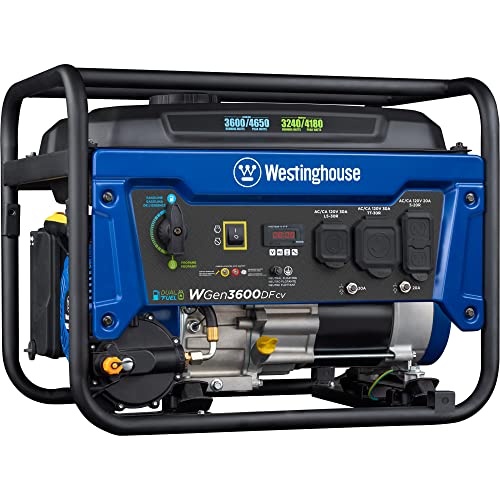
The Westinghouse model delivers 4650 peak watts with 3600 running watts on gasoline and 3240 running watts on propane. It includes a 4-gallon fuel tank with gauge and multiple outlets (120V duplex, TT-30 RV, and L5-30). Best for: homeowners needing RV-ready power and flexibility between gas and propane. Caution: run time varies with load and fuel type, so plan fuel accordingly.
PowerSmart 3800 Dual Fuel Inverter
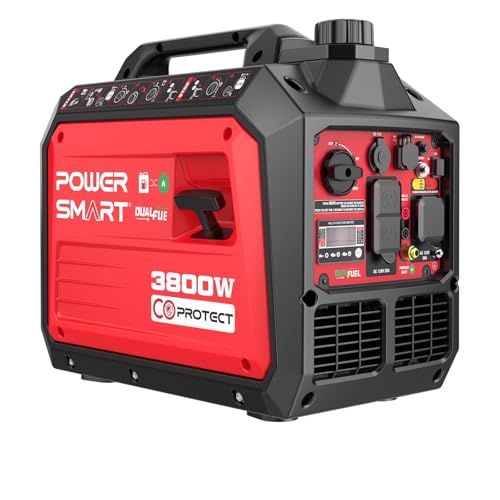
PowerSmart offers 3800 starting watts with 3300 running watts on gasoline and 3500 starting watts with 3100 running watts on propane. It emphasizes quiet operation (65 dBA at 23 feet) and a Pure Sine Wave output safe for sensitive electronics. Best for: quiet camping, small home backup, and RV use where low noise matters. Caution: may be less power for heavy-load tasks compared with larger units.
WEN DF280iX 2800-Watt Dual Fuel

The WEN DF280iX runs on gasoline (2250- and 2900-rated) or propane (2000- and 2800-surge ratings). It provides clean power suitable for electronics and includes a CO watchdog feature for safety. Best for: budget-conscious buyers needing essential dual-fuel functionality and CO protection. Caution: lower power ceiling means limited simultaneous appliance use at higher loads.
WEN DF360iX 3600-Watt Dual Fuel

With 3600 surge watts and 2900 running watts on gasoline, plus 3500 surge and 2600 running watts on propane, the DF360iX is noted for quiet operation and clean power. It also relies on a CO watchdog for safety. Best for: portable backup with a balance of power and quiet performance. Caution: higher fuel consumption at peak output than smaller models.
Westinghouse 6500 Watt Dual Fuel Backup

Although larger, this model demonstrates the full potential of dual-fuel capability with significant output (gasoline: 6500 peak / 5300 running; propane: 5800 peak / 4800 running). It includes multiple outlets and a wheel kit for mobility. Best for: larger homes or job sites needing substantial power with dual-fuel flexibility. Caution: heavier and less portable than smaller units.
Buying Guide: How To Choose A Small Propane Powered Generator
- What will you power? List essential devices (fridge, lights, sump pump) and total wattage to ensure the unit meets demand.
- Do you need dual-fuel capability? If you anticipate propane availability or fuel cost concerns, a dual-fuel model offers flexibility.
- How important is noise? If you’ll use the generator near neighbors or camping sites, choose models with quiet operation and inverter technology for clean power.
- Portability and storage: Check weight, handle design, and whether a wheel kit is included or optional.
- Safety features: Look for CO sensors, automatic shutoffs, and rubber outlet covers for weather protection.
- Run time and fuel capacity: Compare fuel tank size and efficiency to estimate how long the unit can run between refuels.
- Outlet configuration: Ensure the model has the correct outlets for your needs (RV, household, USB charging).
Frequently Asked Questions
- What is the advantage of propane over gasoline for a portable generator?
Propane offers cleaner storage, longer shelf life, and readily available fuel in some situations. It can be easier to keep on hand for emergencies.
- Are dual-fuel generators more reliable for home backup?
Yes, dual-fuel models provide flexibility to switch between fuel sources, potentially avoiding outages caused by a limited gasoline supply.
- Do inverter generators provide clean power for electronics?
Yes, inverter models typically produce a pure sine wave with low total harmonic distortion, making them safe for sensitive devices.
- What factors affect run time the most?
Load level, fuel type, and tank size drive run time. Heavier loads consume fuel more quickly and reduce overall runtime.
- Is CO monitoring necessary for portable generators?
CO sensors are a valuable safety feature to automatically shut down the unit if dangerous levels are detected, especially for indoor or semi-indoor use.
- Which model is best for RV use?
Look for an RV-ready outlet (TT-30R) and parallel capability if you plan to pair units for more power. The Westinghouse and some WEN models offer RV-ready configurations.