Best Small 3 Phase Generator Picks for DIY Projects
Looking for compact three-phase generators suitable for education, hobby kits, and small-scale experiments? This guide highlights five practical options, focusing on hand-held or tabletop units that can help learners understand three-phase generation, motors, and power electronics. Each pick targets a specific buyer: students and teachers, hobbyists building models, or professionals validating small-scale setups. The table below compares key attributes to aid quick decisions.
| Product | Best For | Voltage Range | Output (A) |
|---|---|---|---|
| CrocSee Micro 3 Phase AC Mini Hand Brushless Motor Generator | Students and teaching labs | 3–24V | 0.1–1 |
| ECSiNG 2PCS 3-24V 3 Phase Micro Hand Brushless Generator | DIY makers and hobbyists | 3–24V | Varies by setup |
| 3 Phase Permanent Magnet Generator AVAN-300W | Educational demonstrations and small wind/water projects | Low rpm, 3-phase | Not specified |
| 3-Phase Permanent Magnet Generator (Generic) | Wind/water turbine experiments | Low rpm, 3-phase | Not specified |
| Acxico 3 Phase Micro Mini Wind Hand Generator | Classroom demonstrations and students | 3–24V | 0.1–1 |
CrocSee Micro 3 Phase AC Mini Hand Brushless Generator
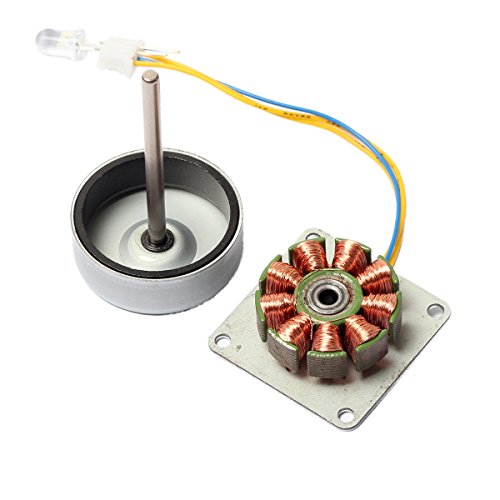
The CrocSee Micro 3 Phase AC Mini Hand Brushless Generator is designed for educational use and small experiments. It outputs 3–24V with a current range of 0.1–1A, suitable for teaching devices and basic demonstrations. Best for classrooms, science fairs, and hobbyists exploring how three-phase generation works in a compact package. Caution: performance depends on the load and wiring integrity; verify safe operating conditions before experiments.
ECSiNG 2PCS 3-24V 3 Phase Micro Hand Generator

The ECSiNG set provides two compact 3-phase micro hand brushless generators, operable in a 3–24V range. Its three-phase AC design aims for smooth operation with minimal maintenance. It suits model building, teaching labs, and DIY experiments where multiple units help demonstrate phase relationships and power outputs. Choose this if you need a pair for comparative experiments; avoid if you require higher current capabilities without upgrades.
3 Phase Permanent Magnet Generator AVAN-300W

The AVAN-300W three-phase permanent magnet generator emphasizes low-speed operation with a gearless design. It uses a die-cast aluminum shell for durability and resistance to the elements. This unit is best for demonstrating how low rpm alternators convert mechanical to electrical energy in wind or hydro setups. It is better for longer demonstrations than quick experiments; note elevated complexity if used with non-matched rectification or storage gear.
3-Phase Generator, Low RPM Permanent Magnet Model

This 3-phase permanent magnet generator targets wind and water integration. It emphasizes a low-start torque design and durable die-cast aluminum housing with corrosion resistance. It is best for demonstrations tied to renewable energy concepts and gearless efficiency. Use this when you want a simple, robust setup; be cautious about peak voltage behavior and the need for additional drive and rectification equipment.
Acxico 3 Phase Micro Mini Wind Generator

The Acxico 3 Phase Micro Mini Wind Generator is suitable for classroom demonstrations and basic wind-energy experiments. It handles 3–24V output with 0.1–1A current. It’s best for quick setup tests and model-building projects where students observe three-phase generation. A limitation is that higher loads or more demanding tests may require supplementary power conditioning equipment and connectors.
Buying Guide
What should you consider when selecting a small 3 phase generator?
- Voltage and current range: Ensure the unit offers the voltage window and current your experiment or model requires. A 3–24V range covers many educational setups.
- Phase design and maintenance: Brushless, three-phase designs reduce maintenance and improve reliability for teaching labs.
- Durability and housing: Die-cast aluminum shells provide durability in windy or outdoor demonstrations; consider enclosure ratings if used outdoors.
- Drive and integration needs: Some units require a drive source, rectifier, or storage battery. Plan for compatible components in your project.
- Number of units: If you need to compare phases or repeat experiments, consider sets that include multiple generators.
- Safety and wiring: Keep safety in mind with high-current or high-voltage setups. Use proper shielding and connectors designed for three-phase wiring.
Practical buying questions
- Is a brushless 3-phase generator better for beginners? Yes, due to lower maintenance and smoother operation in classroom demos.
- Do I need a rectifier with these generators? Some models require external rectification to provide DC for storage or testing equipment.
- Can these units power small models directly? Many support up to 24V and 1A, suitable for light loads in educational projects.
- Should I buy a pair or more? If your goal is comparative experiments or multi-phase demonstrations, buying multiple units is helpful.
- Are these suitable for wind or water turbine projects? Some models are designed for wind/water integration, but verify voltage and interface needs first.
FAQ
- What is a 3-phase generator best used for in education? Demonstrating phase difference, power conversion, and multi-phase system behavior.
- Can these generators run directly on batteries? Some models operate in a DC-DC range; check the voltage and current specs for compatibility.
- Do these units require special safety equipment? Basic electrical safety gear and proper insulation are advised for all learning setups.
- What separates brushless from brushed models? Brushless designs typically offer longer life and less maintenance in continuous use.
- Are these suitable for hobbyist wind projects? Yes, especially low-rpm, permanent-magnet variants designed for wind/water applications.