Best Small 240-Volt Generators for Home Backup and Campers
Answer: For reliable 240V portable power in a compact footprint, choose a dual‑fuel generator with a 120/240V output, easy electric start, and safe power for essential electronics. The following options are suitable for small homes, RVs, and camping setups, balancing size, fuel flexibility, and transfer-switch readiness. Each product is best for a specific use case—from tight urban spaces to RV upgrades—so you can pick the right fit. The table below highlights key attributes to compare at a glance.
| Product | Best For | Fuel Type | Output (Surge / Running) | Key Benefit |
|---|---|---|---|---|
| WEN DF475T | Small homes and emergency backup | Gasoline / Propane | 4750 / 3800 W (gas) ; 4350 / 3500 W (propane) | Easy 120V/240V transfer switch readiness |
| WEN DF680iX | RV owners and vehicle charging | Gasoline / Propane | 6800 / 5100 W (gas) ; 6000 / 4500 W (propane) | CO watchdog and 240V for Level 2 charging support |
| PowerSmart 7000W | Home backup with sensitive electronics | Gasoline / Propane | 7000 / 6000 W | Clean power (<3% THD) for electronics |
| WEN DF8000X | Mid‑sized home backup | Gasoline / Propane | 8000 / 6500 W (gas) ; 7200 / 5850 W (propane) | Electric start and robust 340cc engine |
| ComJoy 5500W | Camping and portable power | Gasoline | 5500 / 5000 W | 7‑port charging hub and RV-ready outlets |
WEN DF475T: 4,750‑Watt Dual Fuel Portable Generator

The WEN DF475T offers a dual‑fuel option with 4750 surge watts and 3800 running watts on gasoline, plus 4350 surge and 3500 running watts on propane. It also switches to 120V or 240V with a simple dial, making it suitable for transfer switches and basic home backup. The 224cc OHV engine provides reliable starts with electric start via a key. This model is best for small homes, workshops, and campers who prioritize compact size and flexible fuel choice. Caution: propane runs at lower power output than gasoline; plan loads accordingly.
WEN DF680iX: 6,800‑Watt Dual Fuel Inverter

The DF680iX provides 6,800 surge watts and 5,100 running watts on gasoline, with propane at 6,000 surge and 4,500 running. It features a bonded‑neutral 240V configuration to support low‑power Level 2 EV charging and a CO watchdog sensor for safety. This model is best for RV enthusiasts and light EV backup, offering flexible fuel and 240V output for more demanding loads. Limitation: heavier than ultra‑compact models, which may affect portability in tight spaces.
PowerSmart 7000W Open Frame Inverter

The PowerSmart 7000W model is a robust open‑frame generator with 7,000 surge and 6,000 running watts. It offers 120/240V dual voltage and a 322cc engine for endurance. It can power sensitive electronics with Clean Power (<3% THD) and requires a brief warm‑up before heavy loads to stabilize the engine and inverter. Best for homes needing more power for appliances and workshop tools. Caution: open‑frame design can be noisier than enclosed units, so consider location and sound considerations.
WEN DF8000X: 8,000‑Watt Dual Fuel Portable Generator

The DF8000X delivers 8,000 surge watts and 6,500 running watts on gasoline, with 7,200 surge and 5,850 running on propane. It includes electric start and CO watchdog for safety. Its 340cc engine and transfer‑switch readiness make it a strong option for mid‑sized homes and RV setups that require more dependable 240V power. Best for upgrading from smaller units when you need higher peak power. Limitation: higher weight and footprint than the smallest models.
WEN DF1100T: 11,000‑Watt Dual Fuel Portable Generator
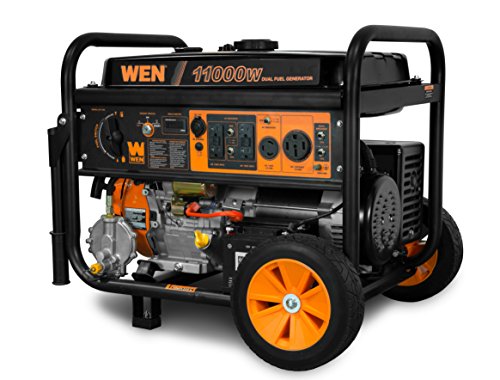
The DF1100T provides 11,000 surge watts and 8,300 running watts on gasoline, with 9,500 surge and 7,500 running on propane. It supports 120V/240V output and uses a 457cc engine with electric start. This model is best for whole‑house backup in larger homes or high‑demand scenarios where a higher 240V capacity is required. Caution: considerably larger and heavier; ensure proper space and handling ability.
Buying Guide: Key Purchase Considerations
- Output needs: Do you require 120V/240V capability for a transfer switch and whole‑home backup, or is RV/portable use sufficient?
- Fuel flexibility: Is dual‑fuel (gasoline/propane) important for longer outages or variable fuel access?
- Power quality: How critical is clean power for electronics? Look for inverter technology and low THD ratings.
- Startup and runtime: Do you prefer electric start for quick power or recoil start as a backup? Consider tank size for runtime.
- Portability vs. power: Open‑frame designs can be louder and bulkier; enclosed units may be quieter but heavier.
- Safety features: CO shutdown sensors, bonded neutrals on 240V, and rubber‑covered outlets help protect users and equipment.
- Transfer‑switch readiness: If you want whole‑house backup, verify compatibility with standard transfer switches and outlet types (L14‑30R, 14‑50R, etc.).
Frequently Asked Questions
- What does “dual fuel” mean in these generators?
– It means the unit can run on both gasoline and propane, providing flexibility during fuel shortages or outages. - Is 120V/240V output necessary for every home?
– Not always. If you only need portable power for basic appliances or an RV, 120V may suffice, but 240V enables larger loads and transfer‑switch readiness. - What is THD and why does it matter?
– THD stands for Total Harmonic Distortion. Lower THD (<3%) is safer for sensitive electronics like computers and chargers. - Should I choose an open frame or an enclosed model?
– Open frames are typically lighter and easier to service but louder; enclosed models are quieter and better for campgrounds and neighborhoods. - Do all these generators include electric start?
– Most listed models offer electric start, with some providing a backup recoil option. Check each product’s features for exact startup method. - Do these units require regular maintenance?
– Yes. Regular oil changes, air filter checks, and a battery/or charging system check for electric start help maintain reliability.