Best Single Phase Transformer Manufacturer Options for Your Project
Looking for a reliable single phase transformer manufacturer to meet your electrical needs? This guide highlights five practical, widely available options and explains who each product is best for. It focuses on compact power transformers, buck-boost units, current transformers, and industrial control transformers. The aim is to help buyers compare configurations, safety notes, and suitability for specific applications—from lighting and audio runs to commercial control panels and industrial setups.
| Product | Best For | Key Benefit |
|---|---|---|
| Acme Electric T181050 Buck-Boost Transformer | Small- to mid-load commercial projects | Versatile, cost-efficient voltage adjustment |
| 1 Phase Buck and Boost Step-Down Transformer (Larson Electronics) | Customizable industrial or lab needs | Multiple secondary options and decent ampacity |
| EHSOLZXBE 100/5a MES Current Transformer | Measurement and metering panels | Precise current sensing for control systems |
| weideer 24V 10VA Power Transformer | Low-power lighting and audio gear | Compact, simple AC-to-AC conversion |
| SolaHD HS1F1BS Non-Ventilated Automation Transformer | Automation and control panels | Encapsulated design with solid mount and safety |
Acme Electric T181050 Buck-Boost Transformer

Best for: Small to mid-range equipment where a flexible voltage adjustment is needed. This unit is easily configured for many applications and can provide a lower-cost solution by boosting or bucking voltages as required. Suitable for environments where space and budget constraints exist while maintaining reliable output.
Why selected: It combines straightforward configurability with a compact form, offering a 12/24V secondary on a 120 x 240V primary. The 250 VA rating suits control panels, lighting, or small machinery that require voltage adjustment rather than full isolation.
Limitations: Check your load profile—if steady, high-amperage demand is expected, this unit’s VA rating may limit performance. Ensure compatibility with your specific voltage swing and duty cycle.
1 Phase Buck and Boost Step-Down Transformer

Best for: Industrial or laboratory setups needing multiple secondary options. This transformer supports several amperage choices (26.6, 35.4, or 60 amps) at 240V primary, making it flexible for varying equipment loads.
Why selected: The product line emphasizes customization, enabling users to tailor performance to specific needs. The stated cautions highlight safety and disposal policies, indicating the importance of following manufacturer guidelines for transformer handling.
Limitations: Some configurations or options may require direct inquiry for exact specifications. Returns and post-purchase handling policies should be reviewed before purchase.
EHSOLZXBE 100/5a MES Current Transformer

Best for: Measurement and metering panels requiring precise current sensing. This transformer is designed to convert high current to a measurable 5A secondary, ideal for monitoring and protection schemes in control rooms and switchgear areas.
Why selected: Its single-phase format aligns with common control architectures, and the 100/5A ratio is widely used for utility-grade monitoring equipment. It’s a straightforward, compact option for data logging and protective relays.
Limitations: It is a sensing device, not a power transformer. Ensure the application matches a current transformer’s role, avoiding direct power delivery to loads from this unit.
weideer 110V Input to 24V Output Power Transformer
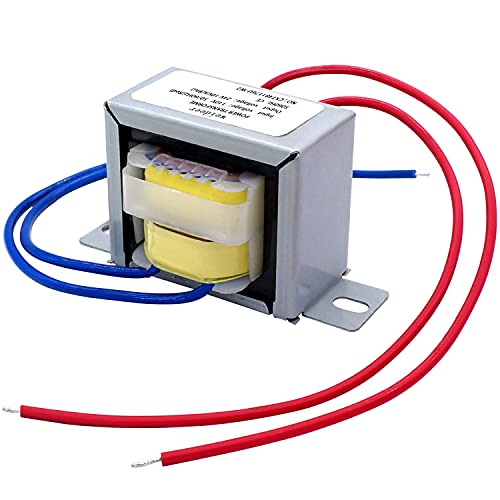
Best for: Small lighting, audio equipment, or compact power supplies where only a low-power AC-to-AC conversion is needed. The unit is designed for 110V input and 24V, 10 VA output, making it a good fit for low-demand devices.
Why selected: Its ultra-compact dimensions and simple wiring make it a practical choice for hobbyist projects or enclosure-mounted power sections where space is limited. The 10 VA rating means it’s best for low-power applications.
Limitations: The maximum power is limited to 10W; avoid using it for higher-power devices or longer duty cycles.
SolaHD HS1F1BS Non-Ventilated Automation Transformer

Best for: Automation and control panels requiring a compact, encapsulated, non-ventilated design. This unit supports robust performance with a 1 kVA rating suitable for mixed control loads.
Why selected: The encapsulated construction enhances safety and durability in enclosed wiring compartments. Its form factor suits compact cabinetry and industrial automation environments, with practical mounting and wiring accessibility.
Limitations: Non-ventilated design may require attention to heat in high-load applications; ensure the thermal profile matches your control panel design.
Buying Guide
What to consider when choosing a single-phase transformer
Voltage requirements: Match primary and secondary voltages to your equipment. Consider buck-boost capability if your load experiences voltage drift.
Power rating: VA or kVA rating should cover the expected load with a safety margin. For control panels, 0.05–1 kVA is common; for small equipment, 10–250 VA may suffice.
Type and design: Open core vs encapsulated, ventilated vs non-ventilated. Encapsulated units are safer in confined spaces; open-core models can be easier to modify.
Applications: Consider whether you need a transformer for voltage adjustment, current sensing, or isolation. Current transformers are for metering, not power delivery.
Safety and compliance: Review manufacturer cautions, installation guidance, and any disposal or safety policies related to each unit.
Workflows and installation tips
- Plan for space: Measure cabinet depth, height, and clearance around wiring terminations.
- Wiring access: Check conduit knockouts and lead wire lengths to ensure proper routing in panels.
- Thermal management: Ensure adequate heat dissipation for higher-load units or non-ventilated designs.
- Compatibility checks: Verify frequency (50/60 Hz) and phase (single-phase) alignment with your site specifications.
Frequently asked questions
- What is a single-phase transformer best used for?
A: It converts voltage levels for equipment, provides voltage adjustments (buck/boost), or supplies low-power loads in control systems. - How do I choose the right VA rating?
A: Estimate the total load current and multiply by the voltage to obtain VA. Add a safety margin of 20–25% for startup surges. - What’s the difference between a current transformer and a power transformer?
A: A current transformer (CT) measures current and scales it to a safe level for meters or relays; a power transformer delivers usable AC power to equipment. - Are encapsulated transformers safer in control panels?
A: Yes, encapsulated designs offer better protection from dust and moisture and easier enclosure mounting. - Can I mix frequency options with a single-phase transformer?
A: Only if the unit is rated for 50/60 Hz; confirm frequency compatibility before installation.