Best Single Phase to Three Phase Converters for Home Workshops and Small Shops
Choosing a reliable single-phase to three-phase converter is essential when you need to power three-phase tools from a standard 120/240V outlet. The right converter delivers stable voltage, protects motor windings, and minimizes electrical noise. This guide reviews five commonly used models that balance performance, ease of use, and safety. Each entry provides practical insights into inputs, outputs, protections, and installation considerations to help you compare options for your CNC machines, spindles, or industrial tools.
| Product | Brand | Output | Input |
|---|---|---|---|
| DPS Single Phase to 3 Phase Converter, 7.5HP | Generic | Up to 3 phase (7.5HP) | 200-240V |
| XCFDP 2.2KW VFD, 220V | XCFDP | Single to 3 phase (2.2KW) | 220V |
| DPS 2HP Single to 3 Phase | DPS | Up to 3A motor (2HP) | 200-240V |
| LyteSolar 7.5HP Digital Phase Shifter | LyteSolar | Single to three-phase power | 220-240V |
| QNK 7.5KW 10HP VFD Converter | QNK | Single to 3-phase (up to 10HP) | 220V |
DPS Single Phase to 3 Phase Converter, 7.5HP

The DPS 7.5HP model is designed to run a 3-phase motor from single-phase power. It emphasizes a straightforward connection between DPS and motor, compact size, and light weight for easier installation in limited spaces. The unit is UL-listed, which adds a layer of safety assurance for electrical compliance. When selecting this converter, ensure your motor’s rated horsepower and the drive’s input/output specifications align with your project requirements.
XCFDP AC 220V/2.2KW VFD, 220V

This single-phase input, three-phase output VFD from XCFDP delivers 2.2KW (3HP) at 220V with a compact footprint. It features multiple protections such as over-current, over-voltage, overload, and short-circuit safeguards. The control panel is removable for easier wiring, and the device includes a 20 cm control cable. It’s designed for spindle motors and other small machinery, offering reliable speed control with RS-485 compatible communication in some configurations. Note the product may vary slightly in branding across production runs.
DPS 2HP My-PS-2 Single to 3 Phase Converter

This DPS unit is sized for smaller motors up to about 2HP (roughly 1.5 kW) and notes one-motor-only usage. It emphasizes ease of connection between the DPS converter and the motor, and a compact, light-wt profile. Applications include small drill presses, fans, and compact CNC spindles where space and simplicity matter. Verify your motor’s current draw and horsepower to avoid overloading the converter.
LyteSolar 7.5HP Digital Phase Shifter
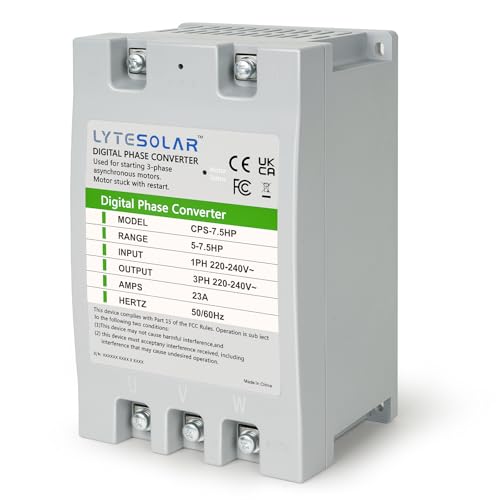
LyteSolar’s 7.5HP digital phase shifter offers precise conversion for 220-240V systems with a compact form factor. Its design emphasizes efficiency and high performance, reducing wiring complexity and enabling a straightforward installation in space-constrained workshops. The unit’s compact dimensions (about 9.8″ x 5.9″ x 5.3″) and light weight make it suitable for home garages, studios, and small fabrication shops. Consider potential needs for enclosure, cooling, and long-term reliability in your shop environment.
QNK 7.5KW 10HP VFD Converter

The QNK 7.5KW (10HP) VFD converter handles 1-phase or 3-phase input with 3-phase output up to 220V. It targets CNC spindles and speed-controlled tools with a wide output range up to 2,000 Hz. The unit emphasizes low-noise operation and low electromagnetic interference, thanks to PWM control and a carefully designed power stage. It supports RS485 communication and Modbus-based control, making it compatible with many automation setups. Users should confirm wiring, cooling, and enclosure needs for continuous operation at higher frequencies.
Buying Guide: Key Considerations For Single-Phase To Three-Phase Converters
When selecting a converter, consider motor size, application type, and the electrical environment of your workspace. Below are essential factors and how they impact performance and reliability.
- Horsepower and current rating: Match the converter to your motor’s horsepower (HP) and current draw. Oversizing provides headroom but increases cost and size, while undersizing risks overheating and nuisance trips.
- Input and output voltage: Commonly 200-240V input, producing 200-240V three-phase output. Ensure your equipment and supply line voltage align with the model’s specifications and local electrical standards.
- Protection features: Look for overload, short-circuit, over-current, and over-voltage protections. Additional protections like anti-paint or thermal safeguards can improve longevity in industrial environments.
- Control interface and connectivity: PWM-based VFDs often offer RS-485/Modbus communication, remote speed control, or remote start/stop. Decide if you need integrated control panels or external interfaces for automation.
- Cooling and enclosure: Most units require adequate ventilation. In tight spaces, choose a compact design with a robust heat sink and consider an enclosure to protect components from dust and moisture.
- Noise and EMI: Some converters are designed for low-noise operation, which is important in environments with sensitive electronics or where audible noise is a concern.
- Maintenance and serviceability: Check for easily replaceable components, spare parts availability, and clear installation guidelines to minimize downtime.
- Warranty and safety certification: UL-listed or equivalent safety certifications provide assurance of electrical safety and build quality for American installations.
Practical usage notes: verify motor compatibility, especially when using high-frequency operation. Some models support up to 2,000 Hz, which is important for high-speed spindles. Always follow the manufacturer’s wiring diagrams, use appropriate fusing, and ensure proper grounding to prevent electrical hazards.