Best Single-Mode Outdoor Fiber Cables for Harsh Environments
Finding a durable, reliable single-mode outdoor fiber cable is essential for outdoor networks, FTTH deployments, or backbone links in challenging environments. This guide highlights five suitable options, explains who they’re best for, and identifies key strengths and limitations. The featured cables emphasize outdoor armor, low-friction LSZH jackets for easy installation, and uniboot LC connectors to save space in dense cabinets. Suitable buyers include data centers needing rugged links, telecom installers, and outdoor network engineers seeking long-distance, high-density cabling solutions.
| Product | Best For | Key Feature |
|---|---|---|
| High-density racks and outdoor runs | ||
Bangun 100 Meters Uniboot LC to LC Outdoor Armored Fiber Patch Cable

Best for high-density indoor-to-outdoor deployments where space savings matter. This OS2-compatible patch cord uses an ultra-low-friction LSZH jacket with μ<0.2, easing installation and conduit density. The built-in stainless armor adds crush and rodent protection, while Uniboot LC connectors save space and simplify patching in dense panels. Note that armor adds stiffness, which can affect bent paths in very tight conduits.
FLYPROFiber OD-5mm OS2 LC to LC Outdoor Armored Patch Cable

Better for rugged industrial environments where pulling through harsh paths is common. The Industrial TPU jacket provides high abrasion resistance and UV protection, paired with dual armor (metal steel and stainless mesh) to shield the inner fiber. Uniboot LC connectors compress cable footprint in high-density areas. Choose this if you expect outdoor-to-indoor transitions with heavy outdoor exposure; avoid if you require maximum flexibility in very tight conduits.
YUTIANHOME 500ft/150m LC to LC Armored Outdoor Cable

Best for long outdoor backbones requiring reliable outdoor armor. Features a built-in helical steel armor for additional crush and rodent protection, OS2 compatibility, and ultra-low friction LSZH jacket for easier installation. The 3.0 mm diameter and minimum bend radius help manage conduit layouts. For very tight spaces, consider alternatives with greater bend flexibility; this option prioritizes durability over extreme flexibility.
ERSTICKT 100M/328FT Armored LC to LC Patch Cable

Choose this for outdoor networks that need robust protection across long runs. It uses a rugged 5.0 mm TPU jacket with steel tube plus stainless mesh armor for excellent resistance to water, UV, and crushing. The Uniboot LC connectors support dense cabling, and its OS2/OS1 compatibility broadens compatibility with various transceivers. Limitations include higher stiffness due to armor, which may affect routing in restricted conduits.
RamboCables 330ft/100m OS2 LC to LC Outdoor Armored Cable
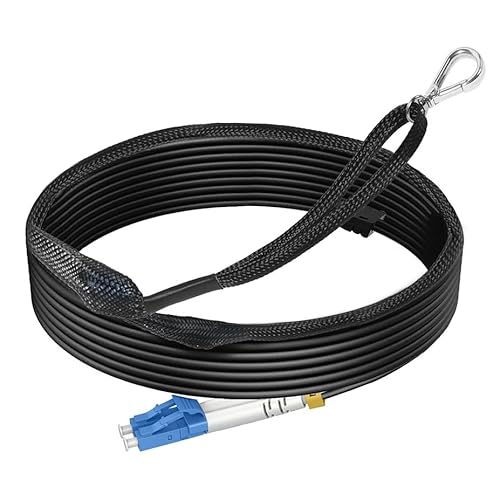
Best for telecom builds and campus backbones needing reliable, long outdoor runs. This 10G/40G/100G-capable OS2 duplex with TPU armor, a pulling eye kit, and direct burial suitability supports robust outdoor deployments. The included pulling eye aids conduit installation by protecting connectors. A limitation is that it may be bulkier to route in tight indoor spaces or smaller conduits.
Buying Guide
Outdoor single-mode fiber cables blend durability, ease of installation, and high-bandwidth capability. When choosing, consider armor type, jacket material, connector style, and the environment where the cable will run.
Key considerations
- Armor and protection: Steel armor, stainless mesh, or TPU jackets boost durability in concrete conduits, roads, or outdoor runs.
- Jacket material: LSZH jackets reduce toxic smoke in a fire and offer low-friction pull characteristics for easier installation.
- Connector design: Uniboot LC connectors save space in dense patch panels and improve routing in tight cabinets.
- Distance and bandwidth needs: OS2 single-mode fibers support long distances and high data rates; ensure transceiver compatibility (SFP+/QSFP+ ports, etc.).
- Bend radius and diameter: Larger armor may reduce flexibility. Plan conduit layout to minimize tight bends.
- Direct burial vs. conduit: Some cables are designed for direct burial; others require protective conduits or enclosures.
Product selection tips
- For high-density indoor-outdoor networks, prioritize Uniboot LC and armor that resists crushing and rodent damage (Bangun, ERSTICKT, RamboCables).
- For harsh outdoor sites with weather exposure, choose cables with TPU jackets and dual armor (FLYPROFiber, YUTIANHOME variants).
- For long-haul outdoor backbone links, look for armored cables with robust shielding and low-friction LSZH jackets to ease installation in conduits (YUTIANHOME, ERSTICKT, RamboCables).
FAQ
- What is a single-mode outdoor fiber cable used for?
It supports long-distance, high-bandwidth networks in outdoor environments, including FTTH backbones and campus deployments. - Why choose armored jackets?
Armored jackets protect against crush, moisture, UV exposure, and rodent damage in outdoor or harsh industrial settings. - What is Uniboot LC, and why is it useful?
Uniboot LC connectors group two fibers in a single housing, saving space and simplifying management in dense patch panels. - Are OS1 and OS2 compatible with the same transceivers?
OS1/OS2 compatibility depends on the transceiver and link budget; confirm with your equipment vendor to ensure proper performance. - How do I route armored fiber cables indoors?
Plan for gentle bends, use appropriate conduits, and avoid pulling through extremely tight bends to minimize attenuation. - Can these cables be buried directly?
Some armored cables are rated for direct burial; verify the model’s direct burial suitability and local installation codes before deploying.