Best Single Axis Tracking Solar Systems for Power Boost
Answering the search intent for buyers seeking single axis solar tracking, this guide highlights practical options that can boost energy capture while staying user-friendly. Best for small farms, yards, and DIY installations, these single-axis trackers align panels toward the sun to improve daily output. The featured products cover easy setups, versatile panel compatibility, and robust performance under common weather conditions. Read on to compare models and find the right fit for your energy goals.
Summary of chosen products:
| Product | Brand | Best For | Why Selected |
|---|---|---|---|
| ECO-WORTHY Solar Panel Single Axis Tracking System | ECO-WORTHY | Yard/Farm/Field | Simple single-axis design, up to 30% power boost, adjustable for multiple panel sizes |
| BINGOX Dual-Axis Solar Tracker Controller Kit | BINGOX | Off-grid, RV, DIY | Auto sun tracking with wind protection, LCD and remote control |
| Aitoserlea Single Axis Sun Tracking Controller | Aitoserlea | Direct sun tracking projects | Patented four-quadrant light-sensing design for precise tracking |
| GODIYMODULES Solar Tracking Module | GODIYMODULES | Compact solar projects | Low-voltage single-axis tracking module for light-source alignment |
| Hyuduo Solar Tracking Module | Hyuduo | Educational or hobbyist builds | Dual-port sensor approach with practical tracking mechanics |
ECO-WORTHY Solar Panel Single Axis Tracking System

This single-axis system is designed to maximize power generation by keeping panels oriented toward the sun throughout the day. It supports various panel sizes and configurations, making it suitable for yards, farms, and fields. The included controller helps automate movement, reducing manual adjustments.
Best for: Small to mid-size installations where a straightforward, hands-off sun tracking solution is desired. It’s a solid choice for customers who want a noticeable daily energy gain without the complexity of dual-axis systems.
Limitations: The system’s power increase is described as at least 30% versus fixed mounts, but actual gains depend on mounting geometry and local sun exposure. Ensure panel widths fit the supported ranges for the number of panels you plan to mount.
BINGOX Dual-Axis Solar Tracker Controller Kit
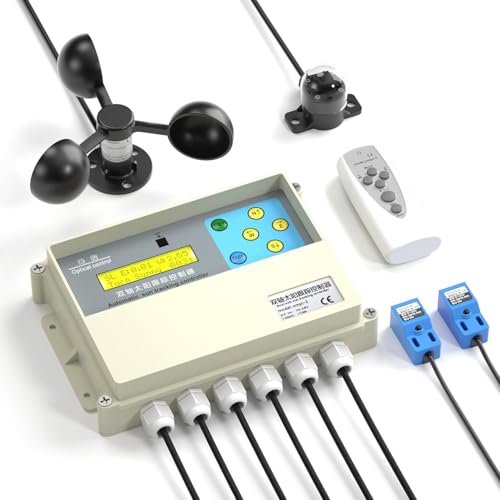
Although this kit features dual-axis tracking, its inclusion here highlights its robust automation, wind protection, and clear setup guidance. The auto sun tracking aligns panels in both east–west and north–south directions, offering higher precision for maximizing daylight energy capture.
Best for: Off-grid or DIY systems where high automation and flexibility are priorities. The wind sensor and remote control provide practical protection and ease of use in variable climates.
Caution: Dual-axis tracking can be more complex to install and may require more space and wiring than single-axis options. Verify compatibility with your existing mounting and power setup.
Aitoserlea Single Axis Sun Tracking Controller

This controller specializes in single-axis tracking with a light-sensing system that analyzes signals to drive the motor platform toward the sun. It is designed for biaxial or uniaxial setups and uses a patent-based four-quadrant light sensor arrangement to improve accuracy.
Best for: Projects needing a compact, focused single-axis controller with a sophisticated light-sensing approach. Choose this if you want precise daylight tracking in a lightweight package.
Limitation: The description emphasizes sensor-driven tracking, so ensure your motor actuation and power supply are compatible with the controller’s voltage and control signals.
GODIYMODULES Solar Tracking Module

This single-axis tracking module presents a compact, light-source-focused approach. The design details explain a balance-based control strategy: a shielded photosensitive resistor forms a shadow pattern that the system uses to align to the sun.
Best for: Small, integrated tracking modules in educational builds or compact installations where a simple, low-voltage solution is desired. It’s a good fit for experiments or demonstrations of solar tracking concepts.
Limitation: The module operates at a modest DC voltage range; verify your power supply and motor compatibility before integration into larger arrays.
Hyuduo Solar Automatic Tracking Module

The Hyuduo tracking module offers a two-port sensing approach and a straightforward control concept for single-axis tracking. It supports automatic tracking and can be used in simple, educational projects or hobbyist builds where a hands-on learning experience is valued.
Best for: Beginners or hobbyists who want a clear, demonstrable single-axis tracking setup that demonstrates the basics of sun tracking without heavy engineering requirements.
Limitation: This module is geared toward learning and small-scale experiments; scale and exposure should be matched to its power handling capabilities.
Buying Guide: Key Considerations for Single Axis Solar Trackers
- Power boost expectations: How much daily or peak energy do you want to gain, and how does this align with your panel size and mounting area?
- Panel compatibility: What are your panel widths and frame dimensions, and how many panels do you plan to mount on the tracker?
- Automation vs. manual controls: Do you prefer fully automatic sun tracking, or is some manual adjustment acceptable?
- Weather resilience: Does the tracker include wind protection, auto-leveling, or weather-aware features for your climate?
- Ease of installation: Are you installing a DIY kit or integrating into an existing array? Consider wiring complexity and required tools.
- Control interface: Is there an LCD display, remote control, or app compatibility for monitoring and adjusting settings?
- Voltage and motor compatibility: Confirm the tracker’s operating voltage and motor type to avoid mismatches with your solar array.
- Maintenance and after-sales support: Look for clear guidance on troubleshooting and replacement parts if needed.
Frequently Asked Questions
- What is the main benefit of a single axis solar tracker?
It maintains panels toward the sun along one axis, typically east–west, increasing daily energy capture compared with fixed mounts. - Can single-axis trackers work with different panel sizes?
Yes. Many models are designed to accommodate several panel widths, but verify the maximum number of panels and their combined width for your installation. - Do single-axis trackers require wind protection?
Some do, especially larger setups. Look for auto-leveling features or wind sensors to protect the system in strong winds. - Are these trackers suitable for off-grid installations?
Yes, several options target off-grid, RV, or farm setups, with standalone controllers and remote capabilities. - What maintenance is typical for solar tracking kits?
Regular checks of mechanical linkage, sensors, and wiring; ensure solar trackers are kept clean and free of debris that could hinder movement. - Is dual-axis worth it if I only need a single-axis solution?
Dual-axis systems offer higher theoretical gains but come with higher cost and complexity. Choose based on your space, budget, and desired automation level.