Best Short Circuit Finder Tool for Automotive Electrical Troubleshooting
Answering the need for quick, accurate fault locating in 6–42V systems, these short circuit finder tools help forewarned buyers identify open Circuits, shorts, and broken wires. They’re ideal for automotive technicians, DIY enthusiasts, and professional electricians working on cars, trucks, trailers, boats, and home wiring. This guide highlights five top options, explains who each is best for, and compares their strengths and limitations in practical terms.
| Product | Best For | Why It Stands Out |
|---|---|---|
| UT-LNTELA EM415Pro | Car diagnostics & DIY repairs | Wide 6–42V range; flexible 7″ probe; quick locating of open/shorts |
| VSTM Wire Tracer | Professional electricians & autotech | All-in-one tester; strong signal; adjustable sensitivity |
| Ansbell Automotive Tracer | Beginners to pros | Clear color signals; user-friendly guidance; strong accuracy |
| AWBLIN Wire Tracer | DIYers & techs needing clear feedback | Tone and light indicators; low-battery alert; non-damaging tracing |
| VDIAGTOOL V210 | Heavy-duty or multi-vehicle use | Open/short finder with 7″ probe; flexible signaling |
UT-LNTELA EM415Pro Automotive Circuit Breaker Finder

The EM415Pro is designed to locate circuits quickly using transmitter signals and an audible receiver. It’s tailored for 6–42V DC systems, making it suitable for modern vehicles and standard car repairs. Best for: automotive technicians who need a reliable, straightforward tool to trace open wires, shorts, and circuit breakers without removing insulation. Caution: performance may vary in highly shielded wiring or environments with heavy electrical noise.
VSTM Wire Tracer Automotive Electrical Finder

VSTM offers an all-in-one DC 6–42V circuit tester that locates breakers, traces broken wires, detects current leaks, and tests continuity. It uses a high-sensitivity transmitter/receiver with bright LEDs and beeps, plus a low-battery indicator. Best for: professional electricians and auto technicians who need precise fault localization across complex wiring. Caution: signal strength and accuracy can vary with wiring complexity; use the adjustable sensitivity to minimize false positives.
Ansbell Automotive Circuit Tracer & Short Open Finder

Ansbell provides a beginner-friendly yet capable tool for locating shorts, broken wires, and bad connections. It uses color-coded signals (green for open, red for short) and adjustable sensitivity to handle real-world wiring. Best for: new technicians or DIYers who want clear, intuitive guidance and reliable performance in typical automotive wiring. Caution: not always ideal for highly multi-branch or marine wiring without careful step-by-step tracing.
AWBLIN Wire Tracer Open & Short Finder
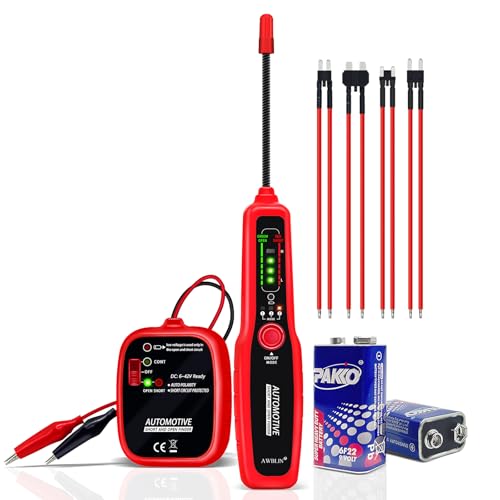
AWBLIN emphasizes clear feedback with sound and LED indicators, plus a battery alert. The device traces wires behind panels without insulation damage and helps identify open circuits and shorts with a straightforward three-mode receiver. Best for: DIYers and technicians who value simple, dependable feedback in everyday wiring tasks. Caution: signal clarity can degrade in extremely noisy electrical environments; ensure proper transmitter orientation for best results.
CrysGuard Automotive Circuit Tracer & Wire Tracker EM415Pro

This model combines accuracy in detecting shorts and opens with non-invasive wire tracing. It’s suitable for diagnosing electrical issues in cars, motorcycles, trailers, RVs, and boats. Best for: users who need reliable fault finding across diverse DC 6–42V systems and want clear, signal-based guidance including a probe for challenging paths. Caution: signal strength may vary; adjust the probe position to locate precise breakpoints.
VDIAGTOOL V210 Wire Tracer Electrical Tester

The V210 is built for open/short finding with a 7″ flexible probe. It highlights open and short circuit conditions via LEDs and an audible buzzer, with adjustable receiver signal strength. Best for: technicians dealing with complex wiring layouts where a long probe helps locate faults behind panels. Caution: sound level varies with signal and environment; adjust testing steps to confirm exact fault points.
Buying Guide
What to consider when choosing a short circuit finder tool:
- Voltage range: Most automotive tools cover 6–42V DC. Ensure compatibility with your vehicle or installation.
- Probe length and flexibility: A longer, flexible probe helps trace wires behind dashboards and inside harnesses without removal.
- Indication method: Look for clear LED indicators, tones, or both. Dual feedback reduces misreads in noisy environments.
- Sensitivity controls: Adjustable sensitivity helps adapt to complex wiring and prevents false positives.
- Portability and ease of use: Handheld, intuitive controls, and visual cues speed up diagnostics.
- Durability and build: Ergonomic design and sturdy housings improve reliability in workshop conditions.
Practical questions to ask before buying
- Will this tool trace wires behind walls or inside panels without insulation damage?
- Can it pinpoint both open circuits and shorts reliably in multi-branch systems?
- Is there a low-battery alert to prevent mid-test shutdowns?
- Does the tool offer a clear open vs. short indication with adjustable sensitivity?
Usage tips for best results
- Test in a known-good section of the circuit to validate signal strength before tracing suspect areas.
- Start with the highest sensitivity setting when tracing long, hidden runs, then reduce as you approach the fault.
- Always verify suspected points with a secondary check or method to avoid misidentifying a load or switch as the fault.
FAQ
- What voltage range do these tools support? All listed devices target 6–42V DC systems common in cars, trailers, boats, and similar equipment.
- Can these tools locate open circuits and shorts at the same time? Yes, most models identify both, using LEDs, tones, or a combination for clear differentiation.
- Do I need to remove insulation to trace wires? Many models offer non-invasive tracing that follows cables behind panels or under carpets without insulation damage.
- What indicates a weak signal or battery issue? Look for a low-battery indicator or a fading audio/visual signal and adjust or replace batteries as needed.
- Is a long probe always better? A longer flexible probe is helpful for hard-to-reach paths, but ensure the receiver can still clearly detect the transmitted signal.