Best Server Room Temperature Control Solutions for Data Centers and IT Closets
Find reliable, scalable temperature control for server rooms, data closets, and critical IT spaces. This guide highlights five networked and standalone monitors and controllers that help keep equipment within safe operating ranges, with clear guidance on who each device suits best. Expect real-time alerts, remote access, and automated responses to protect sensitive gear from heat, humidity, and power events.
| Product | Brand | Best For | Key Benefit |
|---|---|---|---|
| GuardFlow Ethernet Server Room Temp Monitor | GuardFlow | Data centers, server rooms, network closets | Swiss-precision sensing with multiple alert channels |
| TRIPP LITE LX Platform SNMP Models | TRIPP LITE | Remote access for cooling units | 24/7 off-site control and monitoring |
| ALAZUR Cellular Temperature Monitor (4G) | ALAZUR | Remote locations without WiFi | Cellular independence with long-term alerts |
| Inkbird ITC-308 Digital Controller | Inkbird | Simple dual-stage heating/cooling control | Easy setup and dual-relay versatility |
| DEWENWILS Digital Temperature Controller | DEWENWILS | High-power cooling/heating control | Wide range, clear VA display, robust safeguards |
| ALAZUR Cellular Temperature Monitor (4G) – Other Model | ALAZUR | Remote server rooms and vacation sites | Similar cellular model with app-based monitoring |
GuardFlow Ethernet Server Room Temp Monitor

The GuardFlow model is designed for critical environments such as data centers, network closets, and industrial spaces. It features a Swiss-grade external probe with ±0.2 °C and ±2 %RH typical accuracy, delivering real-time temperature, humidity, and dew point data. This makes it ideal for IT rooms where precise environmental control is required to protect servers, storage devices, and switches.
Best for: IT managers needing high-precision monitoring with multi-channel alerts. The product supports email, SNMP, and MQTT, with a built-in web interface and a local 3.5-inch color display for quick on-site checks. The onboard relay output enables automated control of fans or AC units based on set thresholds.
Limitations: As a professional-grade monitor, it may require network configuration and integration planning for multi-device deployments. It is not a consumer-grade, plug-and-play option for small home setups.
TRIPP LITE LX Platform SNMP Select Models

TRIPP LITE’s LX Platform is recommended for 24/7 off-site access and control of cooling units. The LX interface provides remote monitoring capabilities, while the onboard E2MT module supports ambient temperature monitoring. This option is best for facilities that require consistent remote visibility and control over cooling equipment from any location.
Best for: Facilities needing reliable, continuous remote control of cooling assets with SNMP-enabled alerts and simple integration into network management workflows.
Limitations: It emphasizes cooling unit control; ensure compatibility with existing cooling hardware and SNMP management systems before purchase.
ALAZUR Cellular Temperature Monitor for RV Pet Safety

This model uses cellular connectivity with a built-in SIM card, enabling remote access without WiFi. It ships with two years of cellular service and provides real-time alerts via app, SMS, and email. Swiss-grade sensors deliver measurements every 30 seconds for timely awareness of changing conditions in remote server rooms, vacation homes, or other non-WiFi locations.
Best for: Server rooms in remote locations or sites where WiFi coverage is unreliable but continuous monitoring is required. The cellular approach reduces signal drop risk and supports unlimited emergency contacts.
Limitations: After the included two-year cellular plan ends, ongoing service requires renewal, which should be budgeted as an ongoing cost.
Inkbird ITC-308 Digital Temperature Controller

The Inkbird ITC-308 offers a straightforward dual-relay setup for heating and cooling, with °C/°F display support and a dual-display window showing measured and set temperatures. It is a practical choice for laboratories, greenhouses, or server spaces that require a simple thermostat-based control loop rather than networked monitoring.
Best for: Small server rooms or lab environments needing dependable, offline temperature control with easy setup and clear display.
Limitations: Lacks built-in remote alerts or cloud connectivity; no humidity monitoring included, so consider a separate sensor if humidity control matters.
DEWENWILS Digital Temperature Controller
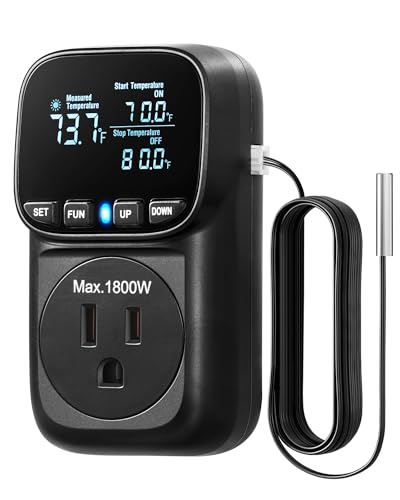
The DEWENWILS model is a robust plug-in thermostat with a 15A/1800W capacity and a wide -40℉ to 210℉ range. Its VA display provides bright, easily readable readings in challenging environments. This device supports both heating and cooling modes with cyclic timing and countdown features, making it suitable for greenhouses, incubators, or server rooms that require precise, high-power control.
Best for: Environments needing strong power handling and a clear, easy-to-read interface, especially when precise timing and dual-mode control are important.
Limitations: It is a plug-in controller rather than a full network monitor; it does not inherently provide remote alerts or centralized monitoring without additional hardware or software.
Buying Guide: Key Considerations for Server Room Temperature Control
- Monitoring vs. control: Decide whether you need only temperature control (thermostat) or a full monitoring system with alerts and remote access.
- Connectivity: Evaluate whether wired Ethernet, SNMP integration, or cellular connectivity best fits your site’s network reliability and remote access needs.
- Sensor accuracy: For data centers, prioritize devices with high-precision environmental sensing and calibrated external probes.
- Alerts and automation: Consider whether email, SNMP traps, MQTT, SMS, or app alerts are required, and whether the device can trigger relays to control cooling or dehumidification equipment.
- Scalability: If you manage multiple rooms, look for devices that support multi-channel alerts, web interfaces, and easy central management.
- Power handling: For high-power environments, verify that the controller’s relays and outputs can safely drive cooling or heating equipment without overheating.
FAQ
- What is the advantage of a networked temperature monitor for a server room?
- Do I need humidity monitoring in addition to temperature?
- Is cellular connectivity reliable for server room monitoring?
- Can I manage all devices from a single interface?
- What is the role of a dual-relay controller in a server room?
A networked monitor provides real-time sensing, remote alerts, and automated responses that can save time and prevent downtime in data centers and IT closets.
Humidity control helps protect equipment from condensation or static-related issues; many devices include humidity sensing or work with separate humidity sensors.
Cellular monitoring can be advantageous when WiFi or wired networks are unavailable or unstable; ensure coverage and consider data plan costs in long-term planning.
Yes, many SNMP-enabled or cloud-connected devices support centralized dashboards, enabling easier management across multiple rooms or sites.
Dual relays allow simultaneous control of heating and cooling devices, maintaining tighter environmental conditions and enabling automated responses to set thresholds.