Best Server Room Environment Monitoring Systems for Proactive Uptime
Looking for a reliable server room environment monitoring system? This guide highlights five top options designed for data centers, IT closets, and enterprise facilities. Each product is evaluated for accuracy, alerting, and ease of integration to help you choose the right fit for your environment. Ideal buyers include IT managers, facilities engineers, and data center operators seeking real-time protection against temperature, humidity, leaks, and power events.
Summary of selected products:
- Room Alert 3S Environment Monitor — compact, affordable, with instant alerts
- GuardFlow Ethernet Server Room Temperature Monitor — professional-grade sensors with multi-channel alerts
- NECTO Necto Cellular Temperature Monitor — cellular connectivity with 2 years of service included
- Room Alert 12SR Foundation Bundle — comprehensive, enterprise-ready with external sensors
- Room Alert 32S — expansive, supports many environmental factors for larger facilities
Room Alert 3S Environment Monitor

Best for compact spaces and budget-conscious setups, the Room Alert 3S monitors temperature and two additional environmental factors. It provides real-time email, text, and push notifications, enabling immediate action from on-site staff or off-site IT teams. Ideal for small server rooms or network closets where space is at a premium and rapid response is essential. A limitation is its smaller sensor footprint, which may suit smaller rooms but could miss large-area variations.
Who it’s best for: small offices, single-rack closets, or start-up data rooms needing quick, affordable monitoring with straightforward alerts. Why chosen: compact design, easy setup, and flexible alerting options help keep critical equipment within safe ranges without complex configurations.
GuardFlow Ethernet Server Room Temperature Monitor

Best for professional data centers and IT rooms requiring precise, multi-parameter monitoring. GuardFlow delivers high-accuracy temperature and humidity measurements with a Swiss-grade external probe, plus dew point tracking. The 3.5-inch color display enables on-site visibility without a PC, and the device supports threshold configuration, web access, and several alert channels (SMTP, SNMP, MQTT). The onboard relay output enables automated responses such as fans or dehumidifiers. Limitation: direct physical access or firmware updates may require some IT familiarity for initial setup.
Who it’s best for: IT administrators managing data centers, server racks, or labs needing precise conditions and on-device visualization. Why chosen: robust accuracy, multiple alert channels, and automation support reduce the risk of equipment damage due to environmental swings.
NECTO Necto Cellular Temperature Monitor

Best for remote locations or facilities without reliable Wi-Fi, the Necto cellular monitor includes 2 years of 4G LTE service. It provides 3-in-1 sensing (temperature, humidity, and power event) and unlimited real-time alerts via text or email. A rechargeable internal battery supports operation during power outages, and the device can notify you if battery levels are low or the device disconnects. Limitation: ongoing cellular service renewal may be required after the initial period, adding long-term costs.
Who it’s best for: off-site offices, remote data rooms, or warehouses where network stability is weak and continuous monitoring is critical. Why chosen: cellular connectivity ensures visibility even without on-site network access, plus a built-in battery maintains monitoring during outages.
Room Alert 12SR Foundation Bundle
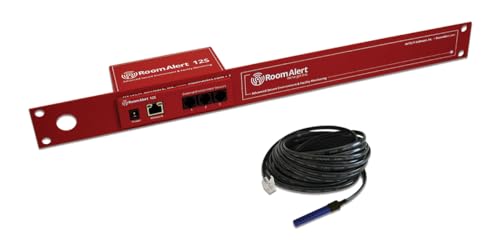
Best for complete, enterprise-grade monitoring with external sensors. The Room Alert 12SR tracks temperature, humidity, power, water leaks, and up to eight additional factors. It includes enhanced security features like HTTPS, TLS, and SNMP v3 encryption to protect data. Proactive alerts via email, text, or push deliver prompt notifications to resolve issues quickly. Limitation: higher initial setup complexity and larger footprint than compact monitors.
Who it’s best for: small to mid-sized data centers or facilities seeking a scalable, secure monitoring solution with robust sensor coverage. Why chosen: broad factor coverage and strong security align with enterprise risk management requirements.
Room Alert 32S

Best for large facilities and complex environments, the Room Alert 32S supports 32-sensor capacity and can monitor a wide range of environmental factors across extensive premises. It emphasizes real-time alerts via multiple channels and secure data communication, making it well-suited for enterprise facilities or data centers with numerous monitoring points. Limitation: higher setup and management requirements due to scale; requires planning for sensor placement across larger spaces.
Buying Guide: Key Considerations for Server Room Monitoring Systems
- Environment size and sensor needs: Choose a model that covers your space and supports the number and type of sensors you require.
- Alerting channels: Verify whether email, SMS, push, SNMP traps, and MQTT are supported to align with your incident response workflow.
- Connectivity options: Consider on-site Ethernet, PoE, or cellular options for locations with unreliable network access.
- Security and data integrity: Look for encryption (TLS/HTTPS) and secure protocols (SNMP v3) for sensitive facilities.
- Automation capabilities: Assess whether built-in relays or integrable automation help you trigger cooling, dehumidification, or alarms automatically.
- Power resilience: For critical rooms, evaluate battery backups and alarms for power outages and device disconnections.
- Scalability: If you expect growth, select systems that can add external sensors and scale across larger facilities.
FAQ
- What is the main advantage of a cellular-based monitor? It remains functional during local network outages since it uses cellular connectivity for alerts.
- Can these systems control cooling equipment automatically? Some models offer relay outputs to trigger fans, dehumidifiers, or alarms automatically when thresholds are breached.
- Do monitoring systems protect against water leaks? Yes, many models include water leak sensors and can notify you immediately to prevent damage.
- What should I consider when choosing between a compact monitor and a multi-sensor system? Start with current space and needs; a compact unit is easier to deploy, while multi-sensor systems support broader monitoring for large facilities.
- Are security features important for data center monitoring? Yes, enterprise-grade models provide encryption and secure communication to protect sensitive environmental data.
- Is ongoing subscription necessary for cellular monitors? Some offer included service for a set period; renewal terms vary by device and plan.