Best Septic Tank Electrical Box Options for Reliable System Control
Overall, choose a septic tank electrical box that offers robust water resistance, reliable insulation, and easy installation for your environment. This guide highlights five top options ideal for homeowners, contractors, and maintenance pros seeking dependable control and alarm capabilities for septic systems.
The following table summarizes the selected products, including who they’re best for and key considerations.
| Product | Best For | Why Selected | Limitations |
|---|---|---|---|
| LeMotech Junction Box | Outdoor installations needing IP65 protection | Sturdy ABS, water/dust resistance, easy modification with drilled openings | Small external size may limit larger wiring runs |
| SPI Bio Pump Septic System Control Panel | Systems requiring timer control and separate circuits | Includes 24 hr timer and dedicated circuit control for pump/alarm | Basic feature set; may need additional accessories for expansion |
| Upgraded CINVEI Septic Control Panel | High-water protection with audible/visual alerts | UL safety components, 110 dB alarm, float switch, 14 AWG cord | May require professional wiring for complex configurations |
| Zelinhol Sump Control Panel | Indoor/outdoor sump and septic tank alerts | Independent pump and alarm circuits, 110 dB alarm, flood protection | Some users may want additional mounting options for tight spaces |
| LuSumtly Outdoor Electrical Box | Durable, IP65-rated outdoor boxes with reserved holes | ABS plastic, drill-ready holes, weatherproof design | Reserved-hole design requires user drilling for wiring |
LeMotech Junction Box, IP65 Outdoor Enclosure

Best for: Outdoor electrical projects requiring weather resistance and simple modification. The IP65-rated enclosure provides strong protection against water and dust, and its ABS construction supports impact resistance. It is suitable for electronics placed in harsh environments where secure insulation is essential. Use the included NPT cable glands to enhance sealing when wiring through openings. Limitations include a relatively small external footprint, which may constrain large wiring bundles.
SPI Bio Pump Septic System Control Panel with Timer

Best for: Systems needing timer-based control with separate pump and alarm circuits. The control panel includes a 24-hour timer with 15-minute intervals and a manual pump test switch. It is well-suited for setups that require scheduled pump operation and independent circuit control. A limitation is that its feature set is centered on timer control; users with advanced monitoring may require additional modules.
Upgraded CINVEI Septic Control Panel

Best for: High-water alert scenarios with reliable audible/visual warnings. The kit includes a 110 dB alarm, float switch, and UL-recognized circuit breakers for safe operation. The separate leak alarm circuit helps prevent cross-circuit damage, and there is support for automatic or manual pump shutdown. Choose this if you want strong, independent protection against overflows. Caution: Ensure proper wiring to the alarm and pump circuits to maximize safety benefits.
CINVEI Septic Control Panel, Alarm and Pump Control

Best for: Installations needing a comprehensive alarm and pump control kit with 14 AWG power cord included. The high-water alarm with a 110 dB audible and visual alert helps prevent overflows, and the pre-wiring and terminal design supports straightforward operation. It includes a pump circuit breaker for external pumps. Limitation: Like many panel kits, optimal results rely on correct setup and wiring; professional installation can improve reliability.
Zelinhol Sump Control Panel with 110dB Alarm
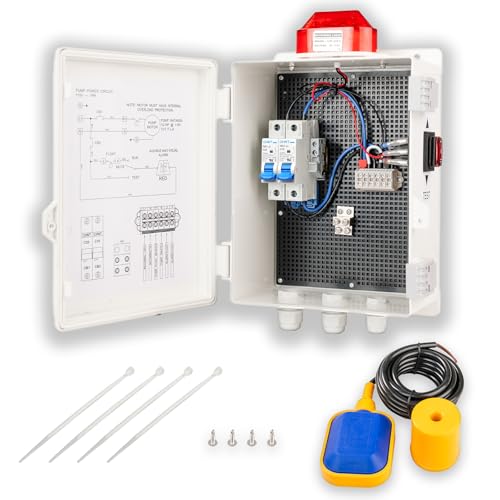
Best for: Homes needing a robust sump and septic tank warning system with independent alarm and pump control. The panel detects water levels via a float switch, sounds a 110 dB alarm, and can automatically start the pump for drainage. It also emphasizes flood protection and reliability in both indoor and outdoor settings. Limitation: The unit relies on correct placement of float sensors and wiring; ensure compliance with local safety codes during installation.
LuSumtly Outdoor Electrical Box with Reserved Holes

Best for: Basic outdoor junction boxes that require hole reservations for custom wiring. The design supports drilling as needed and uses ABS plastic for impact resistance and insulation. The IP65 rating adds weather protection, making it suitable for outdoor installations. Caution: Hole locations must be planned carefully to avoid compromising seal integrity; drill only as required with suitable seals.
Buying Guide: How to Choose the Right Septic Tank Electrical Box
- Weather resistance: Prioritize IP ratings (IP65 or higher) for outdoor use and environments with rain, dust, or snow.
- Electrical safety: Look for UL/RoHS compliance, proper insulation, and certified circuit breakers for pump and alarm circuits.
- Installation flexibility: Consider reserved holes, pre-drilled mounting plates, or easy access hinges to simplify wiring and maintenance.
- Alarm and monitoring: Decide if you need audible alarms (e.g., 110 dB), flashing lights, float switches, and independent circuits to prevent cross-talk between systems.
- Compatibility: Ensure the unit supports your pump type, wire gauge (e.g., 14 AWG), and power cord length required for your setup.
- Size and capacity: Confirm that the enclosure provides enough space for wiring, connectors, and any additional modules you may add later.
Frequently Asked Questions
- What is an IP65 rating and why does it matter for septic systems?
IP65 means the box is protected against dust and low-pressure water jets from any direction, which helps protect electrical components in wet, outdoor environments.
- Do I need separate alarm circuits for the septic tank?
Separate circuits help prevent failure of the alarm from affecting the pump and vice versa, improving overall reliability in critical prevention scenarios.
- Is UL certification important for a septic control panel?
UL-recognized components indicate adherence to safety standards, which reduces risk of electrical faults and improves compatibility with other safety devices.
- Can I install a septic control panel myself?
DIY installation is possible for qualified individuals with electrical knowledge, but professional installation is recommended for complex systems or high-risk configurations.
- How do I choose between a timer-based panel and a float-switch alarm panel?
Timer-based panels control pump cycles, useful for scheduled operation; float-switch alarms provide real-time water level monitoring and immediate response to high levels.