Best RV Power Supply System: Top 5 Power Converters for Reliable 12V Power
If you need dependable 12V DC power for an RV, boat, or off-grid setup, these seven options deliver smart charging, stable output, and safety features. This guide highlights five top choices, noting who each product is best for and where they excel. The table below compares key specs to help you decide quickly.
| Product | Best For | Output | Notes |
|---|---|---|---|
| PM4 100 Amp RV Power Converter | Heavy-Duty RV systems needing 100A | 12V-16.5V DC | Built-in 4-stage charger, smart protection |
| Yaheeda 110V AC to 12V DC Converter | Budget-friendly, flexible voltage | 12V, up to 50A peak | Adjustable input and built-in safety |
| VEVOR RV Power Converter 45 Amp | Smaller RVs or campers | 12V DC, up to 45A | Lithium & lead-acid compatibility |
| VAYALT DC 12V 50A Switching PS | Compact, multi-device setups | 12V ±10%, up to 50A | Full copper terminals, robust cooling |
| PowerMax PM3-100LK | Similar spec to PM4; alternative option | 12V DC, 100A | Similar features, ETL/cETL variants |
PM4 100 Amp RV Power Converter

The PM4 100 Amp Power Converter delivers a robust 100A of clean 12V-16.5V DC for demanding RV loads. It includes a built-in four-stage smart charger that supports fast, standard, and trickle charging modes, helping maintain battery health and readiness on long trips. This unit is well suited for larger RV setups, gaming, lighting, and accessory systems that draw significant current. Its automatic current limiting and protective features guard against overloads, high temperatures, and short circuits, reducing the risk of battery damage or electrical faults.
Best for: Owners with sizable RV electrical needs who want a single, reliable charger-converter combo. Choose this if you regularly run appliances in a mid- to large-sized RV and need steady power from 110V/120V sources.
Caution: The cooling fan activates only when the load requires it; ensure proper ventilation and avoid mounting in tight zero-clearance compartments to prevent overheating.
Yaheeda New Version Converter

The Yaheeda converter emphasizes versatility with adjustable input (110V/220V) and a peak output near 600W (50A). It supports multiple device profiles, such as 12V outputs at various amperages, making it adaptable for pumps, LED strips, and small monitors. A one-key on/off switch adds safety and fast power control, while an aluminum shell and integrated wiring simplify installation and reduce heat buildup.
Best for: RV owners seeking flexible input compatibility and a compact solution for moderate 12V loads. Choose this if you need adjustable voltage behavior and a simple control interface.
Caution: Efficiency can vary with resistive versus motor loads; ensure the device power rating aligns with your largest 12V load, and plan for adequate ventilation.
VEVOR RV Power Converter, 45 Amp

This VEVOR model provides 45A of clean 12V power, designed for mid-size RVs and campers. It supports both lead-acid and LiFePO4 battery chemistries and offers dedicated charging modes with a configurable output range from 13.0V to 16.5V. The unit is suitable for powering common RV electronics and extending battery life through optimized charging profiles. It is a practical option for users who want a reliable converter with lithium compatibility without stepping into higher amperage setups.
Best for: Smaller RVs or campers with moderate 12V devices who want a dedicated charger that accommodates common battery chemistries. Choose this if you prioritize LiFePO4 support alongside standard lead-acid charging.
Caution: This product is rated for up to 45A; exceeding the rated current for long periods could lead to overheating or reduced efficiency in high-load scenarios.
VAYALT DC 12V 50A Switching PS

The VAYALT 12V 50A switching power supply delivers up to 600W with adjustable 12V output and robust cooling. It’s designed for multi-device use, including CCTV cameras, LED strips, 3D printers, and computers. Its aluminum housing, full copper terminals, and integrated wiring streamline installation and enhance reliability in mobile or fixed RV setups.
Best for: Users needing a compact, versatile power supply to run several 12V devices simultaneously. Choose this when you want a single supply capable of handling multiple low-to-moderate power loads with solid thermal management.
Caution: The unit is best suited for devices under 600W total; avoid connecting high-power motors or resistant loads that exceed the rated peak without additional cooling or load balancing.
PowerMax PM3-55 RV Power Converter
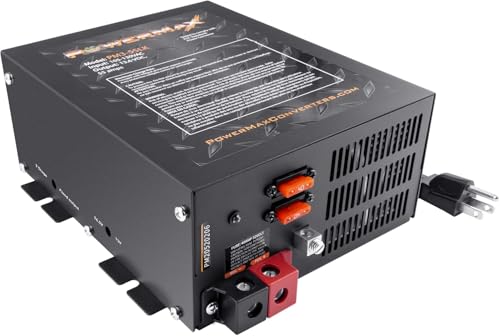
The PM3-55 from PowerMax offers quiet operation and a stable 13.6V–14.4V range suitable for RV systems, with a focus on calm performance and safety. Its LED status indicator helps users monitor operation, while compliance with UL and CUL standards provides assurance for safe use on the road or at a campsite. This unit is well suited for moderate-power RV loads that value steadiness and low noise.
Best for: RV owners seeking a reliable, low-noise converter with strong safety credentials for standard 12V systems. Choose this if you prioritize quiet operation and consistent voltage within a narrow range.
Caution: The voltage window is fixed; if your battery system requires higher regulation or LiFePO4-specific charging, you may want a model with more explicit battery-type settings.
PowerMax PM3-100LK

The PM3-100LK, a 100A PowerMax supply, is designed as a high-capacity 110V to 12V DC charger for RVs and off-grid contexts. It mirrors the PM4’s high-amperage capability, emphasizing three-stage charging and safe operation with a focus on installation simplicity and system-wide compatibility. This option provides a similar performance envelope to PM4 for users weighing different brand ecosystems or availability.
Best for: RV users who need a high-amperage, dependable converter with straightforward installation and broad compatibility. Choose this if you want a parallel option to PM4 with similar capabilities but from a different PowerMax line.
Caution: For installations with restricted space, verify clearance requirements and ensure adequate ventilation to maintain performance and longevity.
Buying Guide: Key Considerations When Selecting an RV Power Converter
- Amperage needs: Determine the highest continuous draw in your RV to pick a converter with ample headroom. A 45A–100A range covers most mid- to large-RV setups.
- Battery chemistry support: If you use LiFePO4 or alternate lead-acid configurations, verify that the charger supports your battery type and charging profile.
- Charging stages: Multi-stage charging improves battery longevity. Look for units with fast, standard, and trickle charging modes (Boost/Normal/Storage).
- Voltage range and stability: A stable 12V output between 13.0V and 16.5V is typical for modern RV systems; consider units with a fixed or adjustable setpoint to match your battery bank.
- Protection and safety: Overcurrent, overvoltage, overtemperature, and reverse polarity protections prevent damage to electronics and batteries.
- Installation and ventilation: Many converters require adequate airflow. Avoid cramped compartments without ventilation paths.
- Battery compatibility: Some models explicitly support LiFePO4; others target standard lead-acid. Confirm compatibility with your battery inventory.
- Noise and heat: Quiet operation and efficient thermal design improve comfort in living spaces and extend unit life in hot climates.
- Brand and service: Seek models from brands with documented spare parts availability and clear warranty terms, especially for high-amperage units.
FAQ
- What amperage converter do I need for a typical RV?
Most RVs benefit from a 45A to 100A converter depending on total load. Higher amperage provides headroom for lighting, appliances, and chargers without overheating.
- Can I use these converters with LiFePO4 batteries?
Yes, some models support LiFePO4; check the product features to confirm battery compatibility and recommended charging profiles.
- Are multi-stage charging modes important?
Multi-stage charging helps battery longevity by adjusting current and voltage as the battery charges, reducing wear and heat.
- Is installation difficult?
Installation is generally straightforward if you follow manufacturer guidelines. Many units claim quick installation without rewiring, but ensure proper ventilation and secure mounting.
- Should I choose a 110V-120V input model or a universal input model?
Universal input models offer flexibility for different regions or travel needs, but ensure the unit supports your local voltage range and generator output.
- What safety protections should I expect?
Look for overcurrent, overvoltage, overtemperature, and reverse polarity protection to safeguard both the converter and connected devices.