Best RV Inverters to Power Outlets on the Go
If you need reliable power for outlets in a recreational vehicle, these inverters convert 12V DC from your vehicle or battery into 110V/120V AC for everyday devices. This guide highlights five top options that balance output, safety features, and practical use cases. Best for longer road trips, camping, or off‑grid setups, each choice targets a different power need—from essential USB charging to high‑demand appliances.
Quick buyer table
| Product | Continuous Power | Key Benefit | Best For |
|---|---|---|---|
| POWERFUEL 1200W Inverter | Up to 1200W | 3 AC outlets, 4 USB ports, LCD live readout | Road trips with multiple devices |
| Cantonape 3000W Inverter | 3000W | 4 AC outlets, 4 USB ports, LCD with fault codes | High‑demand devices, RV full‑time use |
| LANDERPOW 3000W Inverter | 3000W | Pure sine wave, 5V USB-C, remote control | Sensitive electronics, off‑grid setups |
| HipEpic 200W Inverter | 200W | 6 ports total (2 AC, 4 USB), compact | Travel compact needs, lighter loads |
| PiSFAU 200W Inverter | 200W | 2 AC outlets, USB‑C, multiple USB ports | Simple charging, small appliances |
POWERFUEL 1200W Inverter For RV And Road Trips
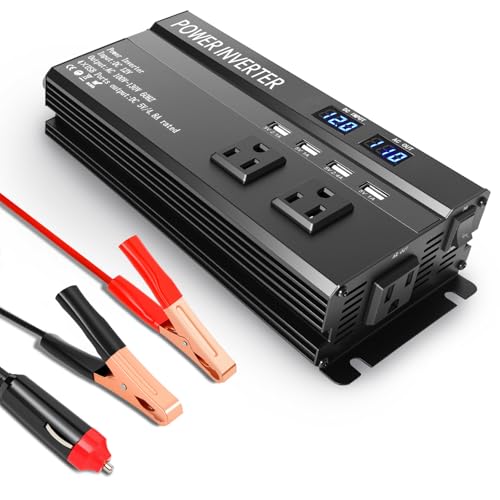
The POWERFUEL 1200W Inverter provides 1200W peak power with three AC outlets and four USB ports. It is designed for on‑the‑go power with a quiet, temperature‑controlled fan and an intelligent LCD display showing input/output voltage and battery status. This model is best for RV owners who need multiple devices powered simultaneously during road trips, camping, or daytime work sessions. A potential limitation is that high‑load starts on larger appliances may briefly strain the unit due to its 1200W peak rating.
BESTEK Power Inverter DC 12V To 110V, 300W

The BESTEK inverter delivers 300W continuous power with two AC outlets and dual USB ports (4.8A). It is compact and cigarette‑lighter ready, suitable for laptops, tablets, and other USB‑powered devices during road trips, camping, or daily commutes. It is a solid choice when you need reliable basic AC power without bulk. A caution: its 300W continuous rating may limit use for high‑wattage appliances like hairdryers or space heaters.
Cantonape 3000W Power Inverter With LCD

The Cantonape inverter offers 3000W continuous power with four AC outlets and four USB ports, ideal for RVs that require high capacity to run microwaves, air conditioners, or other demanding devices. The built‑in LCD displays input/output voltage, battery status, load, and frequency, with a remote control for easy operation. Best for users who need strong, multi‑outlet performance, but the higher wattage means greater size and initial cost. Limitation: wired remote control requires setup and, depending on configuration, installation considerations may apply for full RV use.
LANDERPOW 3000W Pure Sine Wave Inverter

The LANDERPOW 3000W inverter provides a true pure sine wave output with 3000W continuous power and 6000W surge capability. It includes multiple outlets, USB‑C 30W PD, and a remote control, making it suitable for RV use with sensitive electronics and high‑load devices. Best for long trips or off‑grid setups where clean power matters. A potential limitation is installation complexity and higher cost relative to smaller inverters.
YSOLX 300W Portable Inverter With 6 Ports

The YSOLX 300W inverter provides four USB ports plus two AC outlets, supporting multiple devices during travel. It includes an enhanced cooling system for longer use and a compact, easy‑to‑carry design. Best for travelers who need moderate power without bulk. Caution: 300W total continuous output may limit simultaneous use of a high‑wattage appliance like a laptop charger plus an air pump.
PiSFAU 200W Car Power Inverter

The PiSFAU 200W inverter offers two AC outlets and multiple USB ports, including USB‑C, suitable for everyday charging and light‑duty devices. It’s a compact option for minimal power needs on short trips. Best for travelers prioritizing portability over high power. Limitation: not ideal for running multiple high‑wattage appliances at once.
Buying Guide: What to Consider When Choosing an RV Inverter
- Power needs: Match continuous wattage to your typical load. If you run microwaves, AC units, or power tools, lean toward 3000W–3000W+ units. For charging phones and laptops, 200–600W may suffice.
- Output type: Pure sine wave inverters are safer for sensitive electronics; modified sine wave can work for basic devices but may cause hum or interference.
- Outlets and ports: Check the number of AC outlets and USB ports. USB‑C PD ports (like 30W) support faster charging for newer devices.
- Protection features: Look for over‑voltage, over‑current, short‑circuit, and thermal protection. An LCD or remote monitoring helps track status and prevent damage.
- Cooling: Fans or convection cooling affect noise levels and heat management during extended use.
- Installation: Consider whether the inverter is designed for under‑hood, cab, or dash installation, and whether you need a remote control.
- Portability vs. capacity: Higher wattage units are typically bulkier and heavier. Choose based on your trailer size and travel style.
FAQ
- What inverter size should I choose for an RV air conditioner?
- Is a pure sine wave inverter necessary for RV electronics?
- Can I run a microwave from an RV inverter?
- Do inverters protect my vehicle battery?
- What’s the advantage of USB‑C PD on an RV inverter?
- Should I choose a remote control inverter?
For running an RV air conditioner, you typically need a higher wattage inverter, often 2000W–3000W or more, depending on the specific AC unit and startup surge.
Pure sine wave inverters are generally better for sensitive electronics and devices with motors, reducing noise and potential damage.
Microwaves require substantial power and may exceed many inverters’ continuous rating. Use only models within the inverter’s continuous wattage limit and account for startup surge.
Most inverters include protections, but prolonged high draw may deplete the battery. Consider an auxiliary battery or solar setup for extended use.
USB‑C PD ports provide faster charging for modern devices and reduce the need for separate wall adapters during travel.
A remote control can simplify operation from a distance inside the RV, but ensure it is compatible with your installation.