Best RV Battery Charge Controllers for Safe, Efficient Power Management
Answering the essential question for RV owners: which charge controller best protects and extends your battery bank while delivering reliable solar performance on the road? This guide focuses on compact, reliable PWM and MPPT options that suit different RV setups, battery chemistries, and power needs. The top picks below are especially suitable for travelers, full-time RVers, and weekend explorers who want straightforward installation, clear monitoring, and durable outdoor operation.
Summary table of selected products
| Product | Best For | Key Benefit | Notes |
|---|---|---|---|
| Renogy Wanderer 10A | Small RV systems, budget setups | 4-stage charging, negative ground, compact | IP32 rated, great for simple packs |
| Renogy Adventurer 30A | Medium RVs, mixed battery types | Seamless 12/24V detection, robust protections | Wall-mount friendly |
| Renogy Voyager 20A | Outdoor use, boats and trailers | IP67 waterproof, PWM with smart protections | Flexible DC load control |
| Victron SmartSolar MPPT 15A/50V | Shade-rich sites, high-efficiency need | MPPT, synchronized charging across controllers | Bluetooth monitoring |
| SOLPERK 10A PWM Waterproof | All-weather RVs and boats | IP67, LED indicators, multi-protection | Simple, durable choice |
Renogy Wanderer 10A PWM Solar Charge Controller
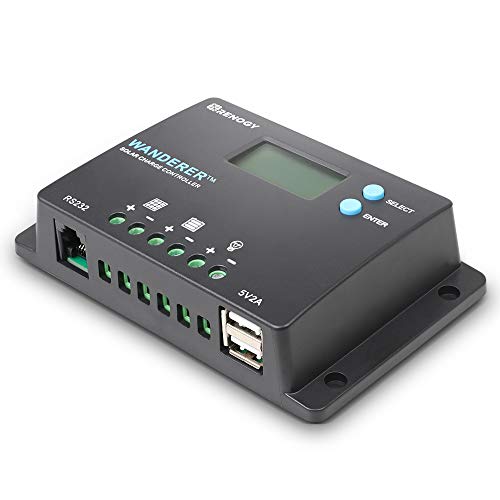
Features and design: The Wanderer 10A uses a Smart 4-Stage charging cycle (Bulk/Boost/Float/Equalization) to optimize flow for AGM, Gel, Flooded, and Lithium batteries. It offers a negative ground design for RV and marine systems and a compact size (about 5.2 x 3.1 inches) for tight electrical bays. The IP32 rating provides basic outdoor protection, and the built-in LCD offers straightforward status readouts.
Best for: RV beginners or compact solar setups where space is at a premium. The Wanderer is chosen for users who want a straightforward, conservative charger with strong baseline protection and simple installation.
Caution: While compact and affordable, it lacks higher-end MPPT efficiency and advanced remote monitoring. Expect moderate performance in heavily shaded or high-voltage scenarios.
Renogy Adventurer 30A PWM Solar Charge Controller

Features and design: The Adventurer 30A supports 12V/24V systems and charges multiple battery chemistries including Lithium, AGM, Gel, and Flooded. It uses 4-stage charging (Bulk/Boost/Float/Equalization) and is designed for seamless RV integration with negative-ground compatibility. The LCD provides real-time data and adjustments for better control of loads and panels.
Best for: RVers with medium-sized solar arrays who need a robust, flexible PWM controller that can accommodate different battery types and straightforward mounting in living quarters or control panels.
Caution: PWM performance is not as efficient as MPPT in shaded or high-voltage layouts; consider MPPT only if you expect frequent partial shading or larger solar arrays.
Renogy Voyager 20A PWM Waterproof Controller

Features and design: The Voyager 20A offers 4-stage charging for AGM, Gel, Flooded, and Lithium batteries, with an IP67 waterproof rating ideal for outdoor exposure. It supports 12V/24V systems and includes protections against reverse polarity, overcharge, short circuits, overload, and temperature-related issues. It also provides direct parameter adjustment for DC loads, converting panels and batteries into a reliable energy system.
Best for: RVs or boats where outdoor installation is common, and a rugged, weatherproof PWM controller is preferred. This model is a solid choice when you need reliable protection and simple monitoring in rough conditions.
Caution: As a PWM device, performance is best with well-matched panel voltage; in low sun or high-temperature environments, efficiency may lag MPPT options.
Victron Energy SmartSolar MPPT 15A/50V (Bluetooth)

Features and design: This MPPT controller uses advanced maximum power point tracking to maximize output from solar panels, even under shade. It supports 12/24V systems and can synchronize with other Victron SmartSolar units for system-wide optimization. Bluetooth connectivity enables monitoring and configuration via the Victron app for real-time status and historical data.
Best for: RVs with varying sun exposure, larger or multiple solar arrays, and users who value high efficiency and remote monitoring. The ability to synchronize multiple controllers is a plus for expanded systems.
Caution: MPPT controllers are typically higher in price and complexity. Ensure you have space for the Bluetooth setup and app monitoring if you rely on mobile access.
SOLPERK 10A PWM Waterproof Solar Charge Controller

Features and design: This 10A PWM controller is IP67 waterproof and designed for 12V/24V systems. It features automatic voltage detection, LEDs to indicate charging status, and multiple safety protections against under-voltage, over-voltage, overload, short circuits, and reverse polarity. It supports common battery chemistries including AGM, Gel, Flooded, and LiFePO4 to some extent.
Best for: RVs that spend time outdoors in varied weather and need clear, simple indicators of charging status plus strong protection in a compact package.
Caution: The LED indicators provide status but may be less informative than a full LCD in complex setups. Consider pairing with a separate battery monitor for detailed data.
Buying Guide: What to Consider When Choosing an RV Battery Charge Controller
What type of charger do I need: PWM vs MPPT?
PWM controllers are typically simpler, cheaper, and adequate for small to moderate solar arrays. MPPT controllers optimize energy harvest, especially in shaded conditions or with higher panel voltages. For larger RV systems or frequent shading, MPPT often justifies the higher cost.
Which battery chemistry will I use?
Most controllers in this list support multiple chemistries such as AGM, Gel, Flooded, and Lithium. Verify compatibility with your exact battery model and the charging profile you need, particularly for lithium batteries which may require more precise voltage and current controls.
System voltage and currents: 12V or 24V?
RV setups vary between 12V and 24V configurations. Ensure the controller supports your system voltage and that its rated current matches or exceeds your solar panel output to avoid throttling or overheating.
Weather and mounting: indoor vs outdoor?
Outdoor exposure benefits from IP ratings (IP67 or IP32). If the controller is mounted outside, consider waterproof models and how easily you can service or monitor them from your RV interior.
Monitoring and integration: how deep do you want data?
Some controllers offer LCDs on-device, while others pair with Bluetooth apps or network dashboards. Decide if you want on-device readouts or remote monitoring so you can adjust parameters while on the road.
Installation and space considerations
Compact dimensions and negative-ground capability can simplify installation in tight RV cabinets. Take measurements of your panel array, battery bank, and the available mounting area to ensure a clean fit.
Limitations to watch for
- PWM controllers are generally less efficient with higher panel voltages or complex battery chemistries.
- MPPT controllers require proper calibration and may be more sensitive to wiring and temperature.
- Outdoor-rated units may cost more but reduce risk in harsh environments.
FAQ
- What is the main difference between PWM and MPPT for RV use?
PWM is simpler and cheaper, good for small systems. MPPT is more efficient, especially with larger panels or partial shading.
- Can a single charge controller handle multiple battery types?
Many models support several chemistries, but verify compatibility with your specific battery type and recommended charging profile.
- Do I need Bluetooth or app monitoring?
App monitoring provides remote visibility and control, which is helpful for long trips or off-grid setups.
- Is IP rating important for RV use?
Yes, especially for outdoor installations. Higher IP ratings indicate better protection against water and dust.
- How do I know my solar setup needs MPPT?
Consider MPPT if you have a larger array, frequent shading, or want maximum energy harvest with longer cable runs.