Best RS-232 to RS-485 Converter for Serial Communication
The best choice for converting RS-232 signals to RS-485 or RS-422 depends on your environment and project needs. This guide highlights five reliable options designed for long-haul data, industrial reliability, and easy integration. It’s ideal for buyers who connect legacy serial devices to modern networks, or who need robust isolation and surge protection. The top picks are suited for businesses, test labs, automation engineers, and hobbyists working with industrial controllers, CNCs, or LED displays. Below you’ll find a quick product comparison, followed by detailed sections and a practical buying guide.
| Product | Best For | Key Benefit |
|---|---|---|
| DTECH RS232 to RS485 RS422 Mini-Size | Compact setups | No external power supply; three-wire TXD/RXD/GND |
| DTECH 4-Position Terminal Block Converter | Long-haul networks | Up to 4000 ft (1200 m); auto RX/TX control |
| waveshare RS232 to RS485 Converter | Isolated, interference-prone environments | Onboard isolation; LED indicators |
| DTECH Bi-Directional Active Converter | Versatile networks | RJ45 or terminal block; surge/ESD protection |
| XMSJSIY RS232 to RS485/RS422 Converter | Adaptive, plug-and-play | No jumper switching; adaptive mode |
DTECH RS232 to RS485 RS422 Mini-Size Converter
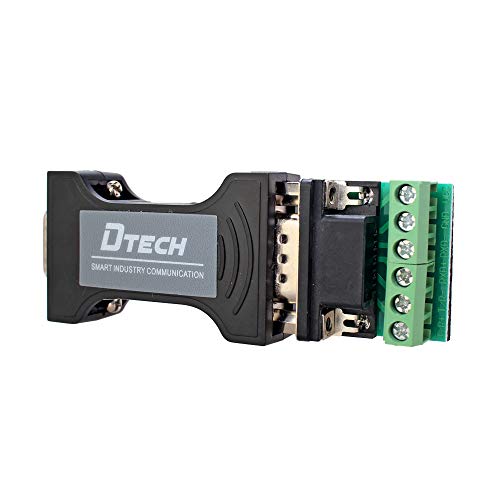
Best for compact installations where space is at a premium. This pro-grade adapter connects a COM port directly to RS-485 or RS-422 devices with a real three-wire interface (TXD, RXD, GND) and does not require an external power supply due to its serial charge pump technology. It’s ideal for developers and technicians who need a simple, reliable serial bridge in tight enclosures.
- Best for: Small enclosures, camera controllers, or test benches with limited space.
- Why selected: No external power makes setup quick and tidy.
- Caution: Ensure the device you connect uses true three-wire signaling for reliability.
DTECH RS232 to RS485 Converter with 4-Position Block

Best for long-haul data networks. It supports connections over distances up to 1200 meters and can host multiple bus nodes, with automatic RX/TX control to simplify operation in automated systems. It’s well suited for industrial control panels and equipment that require extended RS-485 networks.
- Best for: Large installations with long cable runs.
- Why selected: Automatic direction control reduces wiring complexity.
- Caution: Verify the total node count and network topology before deployment.
waveshare RS232 to RS485 Converter

Best for environments requiring robust isolation and anti-interference capabilities. This converter features onboard unibody power supply isolation and digital isolation, enabling stable operation without external power and reducing interference in challenging industrial settings. LED indicators help monitor data flow.
- Best for: Industrial floors with higher electrical noise or grounding concerns.
- Why selected: Strong isolation improves reliability in harsh environments.
- Caution: Isolation adds cost and may require careful grounding practices.
DTECH Bi-Directional Active RS232 to RS485/RS422

Best for flexible network configurations where devices may need RS-485 or RS-422 in either direction. It supports surge protection and safety features such as LED indicators for TX/RX, and comes with a power supply. It’s suitable for long-haul industrial links and lab setups requiring ease of use in mixed networks.
- Best for: Mixed RS-485/RS-422 networks and test setups.
- Why selected: Bidirectional support with visible status indicators aids troubleshooting.
- Caution: Ensure the RJ45/terminal options match your device connections before wiring.
XMSJSIY RS232 to RS485/RS422 Converter

Best for adaptable, plug-and-play replacements where no jumper settings are desired. This passive interface converter supports automatic direction switching and normal operation with optional external power. It’s appropriate for users who want a straightforward, maintenance-free RS-232 bridge to RS-485/RS-422 networks.
- Best for: Quick deployments and adaptative network needs.
- Why selected: Auto direction control simplifies setup in dynamic environments.
- Caution: As a passive converter, some setups may benefit from a powered option for higher reliability.
Buying Guide: RS-232 To RS-485/RS-422 Converters
When selecting an RS-232 to RS-485/RS-422 converter, consider signal direction control, isolation, maximum distance, and the environment where the device will operate. The right choice balances ease of use with protection features to safeguard legacy equipment and modern networks.
Key considerations
- Protection and isolation: Choose models with surge protection and electrical isolation for noisy or hazardous environments.
- Direction control: Automatic RX/TX control reduces configuration steps but verify compatibility with your controller.
- Distance and topology: Long-haul networks require robust drivers and support for multi-node buses (RS-485).
- Power requirements: Some adapters are bus-powered; others require a separate power supply or have built-in power options.
- Physical interfaces: Ensure port options (RJ45, terminal block) match your device connections.
Practical buyer questions
- What environment will the converter operate in? Industrial settings benefit from isolation and surge protection.
- Do you need bidirectional signaling or unidirectional data flow? Some devices support both RS-485 and RS-422.
- Is space a constraint? Mini-sized adapters are useful for compact enclosures.
- Will you connect many nodes on a single bus? Ensure the adapter supports the desired network length and node count.
- Is external power acceptable? Bus-powered converters reduce clutter but may limit performance in some layouts.
Quick feature reference
- Three-wire RS-232 to RS-485/RS-422 in compact form factors
- Automatic RX/TX control and surge/ESD protection on select models
- Onboard isolation to reduce ground loops and noise
- RJ45 and terminal-block options for flexible wiring
FAQ
- Do RS-232 to RS-485 adapters require drivers? No driver installation is typically needed; they act as passive bridges or simple adaptors.
- Will this work with USB-to-serial adapters? In most cases, yes, provided the host device supports RS-232 or TTL-level serial and the converter is connected to the RS-232 side.
- What is the typical distance for RS-485 networks? Commonly up to 1200 meters in long-haul configurations with proper network topology and termination.
- Is isolation always necessary? Isolation is beneficial in electrically noisy or high-voltage environments but adds cost and may require careful grounding.
- Can I mix RS-422 and RS-485 on the same bus? Some adapters support both; confirm mode compatibility with your devices before wiring.
- What maintenance is required? Regular inspection of cables and connectors, plus confirming TX/RX indicators show active data.