Best Roller Lever Limit Switches for Precise Machine Positioning
Choosing the right roller lever limit switch is essential for safely and accurately detecting moving parts in CNC machines, mills, 3D printers, and automation systems. This guide highlights reliable models with roller lever actuators, SPDT or DPDT configurations, and IP ratings that suit industrial environments. Read on to compare top options, understand key specs, and learn what to consider when selecting a limit switch for your application.
The following table provides a quick overview of the chosen products, including brand, main actuator type, nominal ratings, and the intended use. Use it as a quick reference when narrowing down your choices.
| Product | Brand | Actuator & Configuration | Ratings | Notes |
|---|---|---|---|---|
| WLCA12-2-Q Adjustable Roller Lever Limit Switch | Baomain | 1 NO + 1 NC, Momentary | UI 380V, Ith 10A; Ue 250V, Ie 1.5A | Rotary roller lever, high-voltage capable |
| ME-8108 Adjustable Roller Lever Arm Limit Switch | TWTADE | NC + NO (DPDT), Momentary | AC 250V 5A; DC 115V 0.4A | Compact mini switch with roller lever |
| BM-3104 TZ-3104 Roller Lever Plunger | Baomain | 1 NO + 1 NC, SPDT | 5A 250VAC | IP67 waterproof, CNC/3D printers compatibility |
| WLCA12-2-Q Two-Pack Roller Lever Switch | HUAREW | 1 NO + 1 NC, Momentary | UI 380V, Ith 10A | Double-circuit type for broader monitoring |
| ME-8108 Two-Piece Set | TWTADE | NC + NO (DPDT), Momentary | AC 250V 5A | Pack of two; versatile for robotics |
Baomain WLCA12-2-Q Adjustable Roller Lever Limit Switch
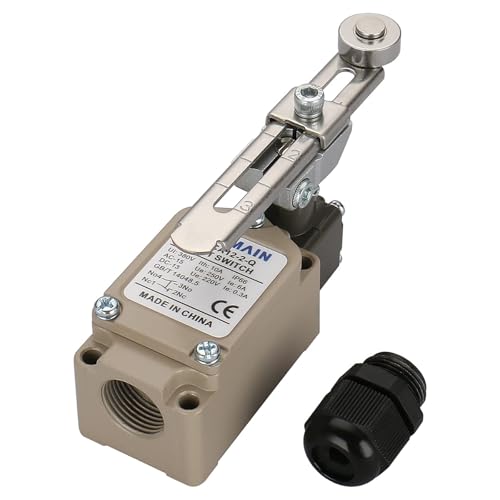
The WLCA12-2-Q model from Baomain features a roller lever actuator with a 1 NO + 1 NC configuration suitable for momentary signaling. It supports a UI of 380V and Ith of 10A, with a Ue of 250V and Ie of 1.5A, making it appropriate for higher-load applications in automation setups. Roller dimensions and mounting details are included to help with mounting accuracy in CNC or robotic environments.
TWTADE ME-8108 Adjustable Roller Lever Arm Limit Switch

The ME-8108 is a compact limit switch with a rotary adjustable lever arm and a roller, offering NC + NO (DPDT) contacts. It is rated for AC 250V at 5A and DC 115V at 0.4A, with a roller diameter around 18 x 7 mm and a lever arm length near 9.2 cm. This model is commonly used in CNC mills and routers, providing reliable actuation with robust mounting options.
Baomain BM-3104 Limit Switch With Roller Lever Plunger

The BM-3104 is a TZ-3104 roller lever plunger limit switch designed as an OEM-style replacement for CNC machines, 3D printers, and automated doors. It features a 1 NO + 1 NC configuration and is rated for 5A at 250VAC, supporting precise control and safety interlock functions in compact installations. It emphasizes reliable mechanical performance for repetitive positioning tasks.
HUAREW WLCA12-2-Q Adjustable Roller Lever Arm Limit Switch

The HUAREW WLCA12-2-Q offers a 1 NO + 1 NC configuration in a compact two-pack format. Rated at UI 380V and Ith 10A, with Ue 250V and le values set for reliable performance in double-circuit monitoring. This model is suitable when multiple limit detections are required in a single machine, such as on multi-axis equipment or safety interlocks in automation lines.
TWTADE 2Pcs ME-8108 Adjustable Roller Lever Arm Limit Switch
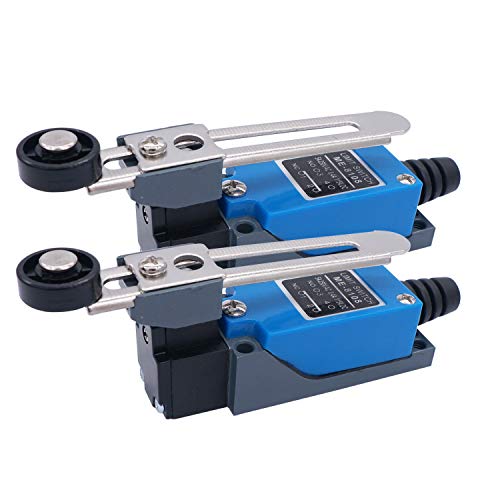
This listing provides a 2-pack offer of the ME-8108 with NC + NO (DPDT) configuration. It maintains the same actuator specs and voltage ratings as the single unit, making it a cost-effective option for dual-channel sensing on a machine bed or automated process where synchronized actuation is required.
Joinfworld Waterproof Roller Lever Limit Switch

The Joinfworld IP67-rated roller lever limit switch is SPDT with 3 pins and pre-wired capability. It features a removable lever, enabling customization for different mechanical setups, and is designed to withstand moisture and dust in challenging environments. This model provides robust safety interlock and signaling in rugged industrial settings.
HiLetgo KW12-3 Roller Lever Limit Switch

The HiLetgo KW12-3 is a compact limit switch with a roller lever and SPDT configuration. It offers normally open and normally closed contacts with a small footprint suitable for tight spaces in hobbyist and light industrial applications. Rated for AC 125–250V, this switch supports up to 5A, making it a practical choice for precision positioning tasks.
Buying Guide: Key Considerations For Roller Lever Limit Switches
When selecting a roller lever limit switch, consider these factors to ensure reliable operation and safety in your setup:
- Contact configuration: Choose SPDT (1NO+1NC) for signaling and safety interlock, or DPDT (NC+NO) for dual-channel monitoring. Ensure the configuration matches your control system.
- Voltage and current ratings: Match UI (voltage input), Ith (continuous current), and Ie (load current) to your system. Exceeding ratings can reduce lifespan or cause failures.
- Actuator type and travel: A roller lever provides a smooth actuation in moving parts. Verify roller dimensions and lever length to fit your mechanical clearance and stroke requirements.
- Environmental protection: IP ratings indicate resistance to dust and water. IP67 is a strong choice for conveyors, outdoors, or damp environments.
- Mounting and installation: Check mounting hole sizes and thread diameters. Ensure compatibility with your chassis or enclosure and ease of wiring.
- Reliability and duty cycle: Look for switches designed for repetitive cycling in automation, CNC, and robotics to minimize maintenance.
- Size and form factor: In tight spaces, compact switches with shorter lever arms can be advantageous, while larger models may offer greater durability.
- Maintenance and replacement: Some models offer removable levers or easy replacement inserts. Consider ease of maintenance for long-term use.
In practice, many hobbyists and professionals rely on multiple switches in a single machine to monitor axis limits and safety interlocks. For critical safety applications, select models with IP67 rating and DPDT configurations for redundancy. For routine position sensing, SPDT switches with standard ratings often provide sufficient performance at a lower cost.