Best RO Hot and Cold Water Dispensers for Your Kitchen
Answering the need for convenient, dual-temperature purified water, these RO hot and cold dispensers cater to households seeking quick hot beverages, cold drinks, and reliable filtration. The top picks here are suited for different buyers: compact countertop models for small kitchens, robust under-sink systems for whole-home convenience, and bottleless setups that reduce ongoing bottle purchases. The following five products were selected for their balance of filtration performance, temperature versatility, and ease of use.
| Product | Type | Best For | Key Benefit |
|---|---|---|---|
| Waterdrop KJ600 | Under Sink RO with Heating | Cooks, coffee lovers, large households | Tankless hot water with adjustable 104–203°F |
| Avalon Self Cleaning Bottleless Cooler | Under Sink RO with Bottleless | Families that want bottleless filtration | 4-stage filtration with dual filtration system |
| PHILIPS Countertop RO ADD6928DG/37 | Countertop RO with Hot & Cold | Families needing easy setup | 6-stage mineralization with Aquaporin tech |
| Waterdrop CT01 | Countertop Hot & Cold Filtration | Small spaces, flexible setup | Not RO, minerals retained, multiple presets |
| Waterdrop A2G | Under Sink RO with Hot/Cold | Tech-savvy households | 6-stage filtration, mineral infusion, temp control |
Waterdrop KJ600: First RO With Heating Function

The Waterdrop KJ600 integrates a reverse osmosis filtration system with an instant hot water dispenser. It provides hot and cold water with adjustable temperatures from 104℉ to 203℉. This model is designed for users who want immediate hot beverages, soups, or quick meals alongside purified cold water. The system features 5-stage filtration to reduce TDS, PFOS/PFOA, fluoride, arsenic, nitrate, lead, and mercury. Best for households that need on-demand hot water without a separate kettle or boiler, and for cooks who want precise hot water for beverages and recipes. A potential limitation is that external conditions like weather can subtly affect the final water temperature for hot water, especially when the cup is far from the dispensing point.
- Best for: cooks, coffee and tea lovers, and larger households needing ready hot water.
- Why selected: combines purification and heating in a compact under-sink package with tankless design.
- Caution: temperature may vary with ambient conditions and cup positioning.
Avalon Self Cleaning Bottleless Cooler
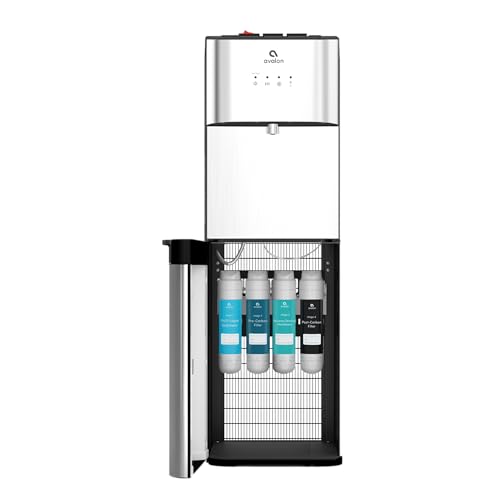
Avalon’s bottleless water cooler provides hot and cold water with a 4-stage filtration setup. The system includes a full installation kit and a dual filtration pathway designed to reduce ongoing bottle purchases. It’s best for households seeking bottleless operation and a straightforward under-sink installation. A notable limitation is that the kit requires plumbing work and regular filter changes to maintain performance.
- Best for: families seeking a bottleless filtration solution with under-sink installation.
- Why selected: comprehensive filtration with a long-filter life and cost savings from not buying bottled water.
- Caution: installation depends on under-sink plumbing compatibility and regular maintenance.
PHILIPS Countertop RO ADD6928DG/37

The Philips countertop RO system delivers a six-stage filtration process enhanced by Aquaporin technology. A notable feature is the remineralization stage, which adds back beneficial minerals to improve taste. It stores filtered water in a 6L tank and has a 1.8L jug, making it suitable for families that value a ready-to-serve water jug. It is best for users who want a high level of filtration with mineral reintroduction and a visible real-time TDS readout. A limitation is that it dispenses water at room temperature only, which may not satisfy hot water needs without a separate heating setup.
- Best for: households prioritizing mineral-rich filtered water with a visible TDS display.
- Why selected: strong filtration with remineralization and real-time TDS feedback.
- Caution: does not provide hot water without an additional heating option; non-RO alternative note.
Waterdrop CT01 Countertop Filtration

Waterdrop CT01 is a countertop hot and cold dispenser that uses a 6-stage filtration process while retaining minerals. It is explicitly not an RO system, making it better for those who want to preserve mineral content while still enjoying purified water. It offers five temperature presets and customizable volume, plus a Favorite Mode to save the most-used settings. Best for: small kitchens, apartments, or users who prefer a simpler, mineral-preserving filtration system. Limitation: it is not RO, so TDS reduction may be less dramatic than full RO units.
- Best for: compact spaces where mineral retention matters and RO is not required.
- Why selected: convenient, programmable, and mineral-retaining filtration with hot/cold delivery.
- Caution: not a true RO system; may not reduce TDS as aggressively as RO units.
Waterdrop A2G Mineral Countertop RO

The Waterdrop A2G combines under-sink RO filtration with a mineral infusion and both hot and cold water outputs. It features a 6-stage filtration process and a 3:1 pure-to-drain ratio, which can reduce wastewater compared to some older RO designs. Best for tech-forward households that want quick access to hot and cold purified water with mineral balance. A limitation is the need for countertop space and a compatible water line connection under the sink or surface mounting where allowed.
- Best for: households seeking mineral-enhanced RO water with hot/cold options.
- Why selected: balanced filtration with mineral infusion and convenient temperature control.
- Caution: requires installation space and water line routing; not ideal for ultra-tight counters.
Buying Guide: Choosing The Right RO Hot And Cold Dispenser
- Filtration depth: Do you want RO-level purification that reduces dissolved solids and common contaminants, or is mineral-retention filtration sufficient for your needs?
- Temperature range: Do you need precise hot water temperatures for coffee, tea, or cooking, or are basic hot/cold outputs enough?
- Installation type: Under-sink systems save countertop space but require plumbing; countertop models are easier to install but occupy counter real estate.
- Water waste: Some RO systems use more water. Look for models with better pure-to-drain ratios or tankless heating to reduce waste.
- Maintenance: Consider filter replacement frequency, availability, and the total cost of ownership over time.
- Bottleless vs bottled: Bottleless systems eliminate bottle deliveries but require a fixed water line and filtration maintenance; bottled options may fit renters or simpler setups.
- Smart features: Some units offer real-time TDS displays, preset temperature memory, or “Favorite Mode” for repeated recipes and beverages.
Frequently Asked Questions
- What does RO stand for and why is it used in water dispensers?
RO stands for reverse osmosis. It uses a semi-permeable membrane to remove dissolved solids, contaminants, and many minerals to produce purified water. This is useful for households needing strong filtration for taste, odor, and potential contaminants.
- Is mineralization important after RO filtration?
Mineralization adds back beneficial minerals to improve taste and health profiles. Some users prefer mineralization to retain minerals that RO systems may remove in the final water.
- Can these systems provide instant hot water safely?
Yes, many models feature tankless or rapid-heating functions designed for near-instant hot water. Always follow manufacturer safety instructions and keep the system away from heat sources that could affect performance.
- Do I need professional installation for under-sink RO systems?
Some models require professional installation, especially those with complex plumbing or integration with existing fixtures. Others offer plug-and-play setup for countertop or bottleless configurations.
- Which is better for a small kitchen: countertop or under-sink?
Countertop units save under-sink space and are easier to install, while under-sink systems free up counter space and can be integrated with cabinetry for a cleaner look.
- How often do filters need replacement?
Replacement intervals vary by model and water quality. Typical RO systems require filters every 6–12 months, while mineralization cartridges may last longer. Check the product’s maintenance schedule.