Best Commercial Reverse Osmosis Systems for Businesses
For clinics, restaurants, laboratories, and light industrial settings, reliable commercial reverse osmosis (RO) systems deliver consistent, high-purity water. This guide highlights five top choices designed for steady output, easy monitoring, and durable performance. Each option balances capacity, filtration stages, and pressure management to support diverse commercial needs without compromising water quality.
Summary of Selected Products
| Product | Brand | Capacity (GPD) | Key Benefit |
|---|---|---|---|
| iSpring CRO1000 4-Stage Tankless Commercial RO | iSpring | 1000 | High flow, tankless design, easy pressure monitoring |
| iSpring RCS5T Commercial Tankless RO | iSpring | 500 | 5-stage filtration, booster pump option, low waste |
| Waterdrop G3P600 Tankless RO System | Waterdrop | 600 | 8-stage filtration, smart faucet, compact tankless design |
| Premier Light Commercial 800 GPD RO System | Premier Water Systems | 800 | Light commercial build, booster pump included |
| Oceanic Commercial RO/DI System | Oceanic | 300-800 | RO/DI versatility, built-in booster pump |
iSpring CRO1000 4-Stage Tankless Commercial RO

The CRO1000 is a true commercial-grade RO system with a high output of 1,000 GPD. Its tankless design provides on-demand filtered water with a flow rate of 0.7 GPM. Built-in inlet and outlet gauges support simple pressure monitoring. An optional PMP1000 booster pump is recommended for 80 psi or lower water pressure. The system features a high-efficiency 4-stage filtration with a 1,000 GPD membrane housed in stainless steel for durability. Its filters include a transparent sediment stage and dual carbon blocks for improved taste.
iSpring RCS5T Commercial Tankless RO Water Filter
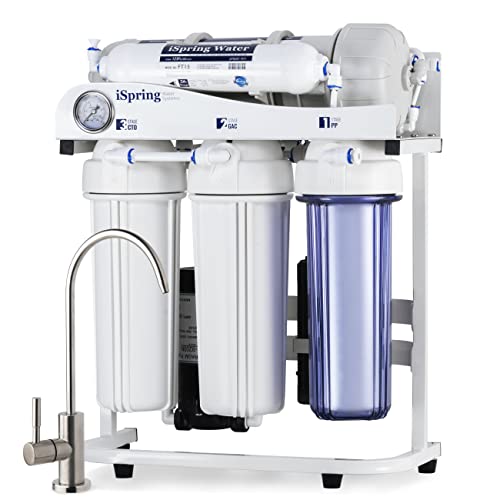
The RCS5T delivers 5-stage filtration with a 500 GPD membrane designed for light commercial use. Stages include PFAS reduction, sediment removal, carbon filtration, and an RO membrane, followed by a final stage to improve taste. It uses a low-waste 1.5:1 pure-to-drain ratio and includes a booster pump option to maximize production when water pressure is a concern. Suitable for restaurants, salons, labs, and small offices seeking steady, high-quality RO water.
iSpring RCS5T+T20M 500 GPD RO System

This 5-stage RO system combines a 500 GPD membrane with a 20-gallon pre-pressurized tank to support moderate-demand commercial environments. The filtration stages remove PFAS, heavy metals, pesticides, and chlorine, while the final stage improves taste. A built-in booster pump enhances production, making it suitable for light commercial applications in dining, offices, and clinics.
Premier Light Commercial 800 GPD RO System

The Premier Light Commercial system offers up to 800 GPD in a compact package designed for restaurants, bars, salons, and labs. It arrives pre-assembled with a booster pump and all required filters, facilitating straightforward installation. The unit emphasizes high production with low waste and is built with components rated for NSF standards, ensuring reliable water filtration for business settings with modest footprint requirements.
Oceanic Commercial Grade RO/DI System
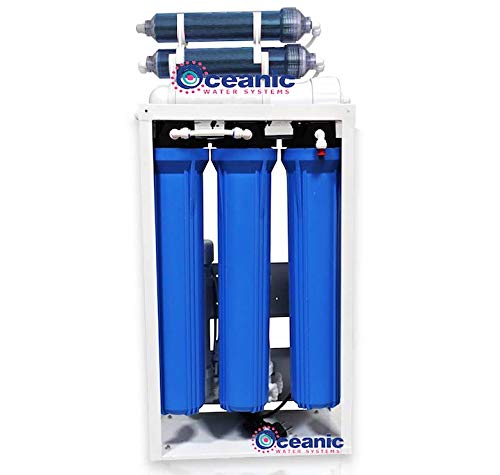
This commercial RO/DI filtration system provides hundreds of gallons per day of clean, ultra-pure water, suitable for aquarium facilities, laboratories, hospitals, and high-demand environments. It includes a booster pump to maintain optimal pressure and robust DI polishing for 0 TDS output when used with DI cartridges after the RO stage. It is tested to remove 99% of contaminants and supports high-purity requirements across multiple commercial applications.
Buying Guide
Key purchase considerations
- Capacity needs: Match GPD to daily water demand, with headroom for peak usage and future growth.
- Pressure and pumping: Systems with booster pumps perform better under low-pressure conditions; consider pump availability and energy use.
- Filtration stages: More stages improve contaminant removal (PFAS, metals, chlorine) but may increase maintenance.
- Tank vs. tankless: Tankless designs save space and provide on-demand water but may require more robust filtration and monitoring.
- Warranty and service: Look for commercial-grade components, readily available replacement parts, and local service support.
Comparative perspectives
- High-demand environments require 800–1000 GPD systems with robust membrane size and stainless steel housings for durability.
- Filtration sophistication (5-stage or 8–9-stage) supports better impurity removal, especially in areas with PFAS or high TDS.
- Tankless options reduce space needs but may demand precise pressure management and regular maintenance checks.
- Budget considerations should weigh initial cost against ongoing maintenance, energy use, and water savings from lower waste ratios.