Best Residential Water Well Monitoring and Filtration Systems for Home Water Security
Answering the need for safe, reliable home water, this guide highlights five well-suited options for monitoring and filtering residential water. These products target households that rely on well or mixed municipal-water supplies and seek practical, low-maintenance solutions. The top picks cover comprehensive filtration, water level monitoring, and easy installation. Ideal buyers include homeowners seeking proactive water safety, remote monitoring capabilities, and straightforward system upgrades without complex maintenance.
| Product | Type | Best For |
|---|---|---|
| PRO+AQUA Elite Series GEN2 PRO-100-E | Whole House Filtration | Small to mid-sized homes needing comprehensive filtration for well or city water |
| YoLink Water Level Monitoring Sensor | Smart Water Level Monitor | Homes needing remote water level alerts and early warnings |
| VEVOR 3-Stage Whole House Filter | Filtration System | Areas with hard water needing sediment, scale, and odor reduction |
| EcoPure EPW2 Whole Home Filtration | Universal Filter System | Municipal or well water with common sediment and taste/odor concerns |
| Express Water RO5DX 5-Stage Under Sink | Point-of-Use Reverse Osmosis | Better-tasting drinking water and heavy-metal reduction at the point of use |
PRO+AQUA Elite Series GEN2 PRO-100-E Overview
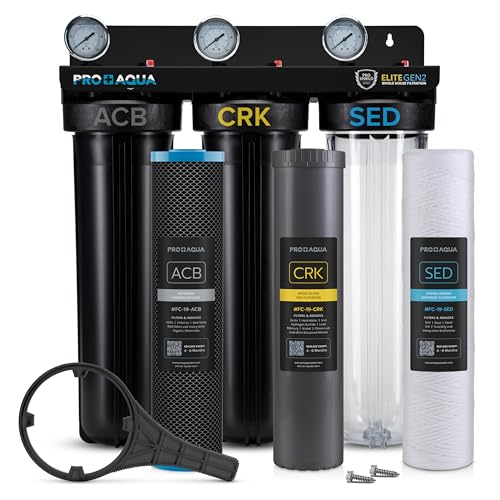
The PRO+AQUA Elite 3-Stage Whole House Filtration System greets small-to-mid-sized homes with 1–3 bathrooms, delivering filtered water to every outlet. Designed for both well and city water, it operates without regeneration, backwash, draining, or electricity. Stage 1 Sediment filtration reduces rust, dust, silt, and dirt, helping maintain clarity and protect Stage 2 and 3 filters. Stage 2 CRK media lowers heavy metals and hydrogen sulfide odors, while inhibiting bacteria growth. This system is ideal for buyers seeking a robust, low-maintenance, whole-house solution.
Best for: Homes needing a reliable, professional-grade filtration system for mixed water sources without electrical requirements. Better for those prioritizing overall home water quality with visible filter monitoring in clear housings.
Caution: Not designed for remote monitoring; verify compatibility with your water chemistry if heavy metals or high salinity are present beyond filter capabilities.
YoLink Water Level Monitoring Sensor

The YoLink Water Level Monitoring Sensor provides smart, long-range monitoring for critical water locations. It offers up to 105dB siren capability and is compatible with Alexa and IFTTT via the included YoLink Hub. The system supports water level alerts, enabling early detection of rising or receding water levels in wells, tanks, or storage ponds. Its LoRa-based long-range communication helps reach areas where Wi-Fi is unreliable, making it well-suited for homes with buried or distant water storage points.
Best for: Homeowners who want real-time water-level alerts and reliable remote monitoring, especially in basements, outbuildings, or properties with limited Wi-Fi coverage. Better for proactive flood and leak prevention.
Caution: Requires a compatible hub and network setup; consider power reliability for uninterrupted alerts in areas with frequent outages.
VEVOR 3-Stage Whole House Filter System

The VEVOR 3-Stage Whole House Filter System uses a sediment, PHO (polyphosphate), and CTO (activated carbon) sequence to address common contaminants, reduce scale, and improve taste and odor. Its sturdy frame supports both floor-standing and wall-mounted installation, with a built-in pressure gauge to monitor performance. This setup is especially practical for homes in hard-water regions or where routine maintenance is a priority.
Best for: Buyers seeking a cost-effective, easy-to-install filtration upgrade that tackles sediment, scale, and odors at the whole-house level. Better for those who want straightforward maintenance with visible indicators.
Caution: The product relies on filter replacements; ensure you have compatible filters and space for installation and future replacements.
EcoPure EPW2 Whole Home Filtration

The EcoPure EPW2 is designed for comprehensive whole-home protection against sediment and chlorine taste and odor. It is compatible with EcoPure’s standard filters and many major brands, offering flexible replacement options. The system aims to shield plumbing and appliances while delivering cleaner water at every faucet. The included mounting bracket, pressure release button, and sump wrench contribute to easier installation and maintenance.
Best for: Homeowners who want reliable sediment and chlorine reduction with flexible filter options and straightforward maintenance across municipal or well water supplies. Better for those who value universal fit with multiple replacement choices.
Caution: Replacement frequency depends on water quality; poor water conditions can require more frequent filter changes.
Express Water RO5DX 5-Stage Under Sink

The Express Water RO5DX is a five-stage under-sink reverse osmosis system that reduces up to 99.99% of impurities including lead, chlorine, fluoride, PFAs/PFOs, and heavy metals. It delivers safer, better-tasting drinking water and includes a deluxe chrome faucet. This point-of-use purifier is designed for households focusing on drinking-water quality improvement, with easy installation that most DIYers can manage without professional help.
Best for: Buyers prioritizing drinking-water quality and heavy-metal reduction at the tap. Better for those who want a clear upgrade path to better tasting water without changing whole-home fixtures.
Caution: This is a point-of-use system and does not treat water at every faucet; it complements a whole-home filtration strategy rather than replacing it.
Buying Guide: Key Considerations for Residential Well Monitoring and Filtration
- Water source and quality: Determine whether your primary need is whole-home filtration, drinking water purification, or both. Well water often benefits from sediment, iron, and heavy metal reduction, while city water may emphasize taste and odor removal.
- Filtration vs. monitoring: Combine a robust filtration system with a level-monitoring device if you rely on wells or storage tanks. This approach helps detect issues early and avoid sudden outages.
- Maintenance and replacement: Consider filter lifespans, replacement costs, and how easy it is to replace filters. Systems with visible housings or sensors can simplify upkeep.
- Installation and space: Assess whether you want a whole-house unit with wall-mount or floor-standing options, or a point-of-use system for specific taps. Ensure space for hoses, fittings, and future filter changes.
- Monitoring capabilities: If remote alerts matter, prioritize devices with smartphone notifications, hubs, or compatibility with smart-home ecosystems. Reliability during outages is a practical benefit to consider.
- Safety and certifications: Look for systems with recognized certifications where applicable, and verify that the product specifications match your water concerns (sediment, taste/odor, heavy metals, etc.).
Frequently Asked Questions
- What is the difference between whole-house filtration and point-of-use filtration?
– Whole-house filtration treats water at the source to protect all fixtures and appliances, while point-of-use filtration targets drinking water at a specific tap or appliance. - Do I need a water level monitor for a residential well?
– A level monitor helps detect changes in water levels, aiding pumps and storage management, especially in seasonal or low-yield wells. - How often should I replace filters in a whole-home system?
– Replacement frequency depends on water quality and usage; follow manufacturer guidelines and monitor differential pressure when available. - Can I install a whole-house filtration system myself?
– Many systems are designed for DIY installation, but complex setups or difficult plumbing may benefit from a professional installation. - Is reverse osmosis necessary for every home?
– RO systems are excellent for drinking water but are not a substitute for whole-house filtration. They complement broader filtration strategies when safe drinking water is a priority. - What maintenance does a filtration system require?
– Regular filter changes, occasional sanitization of housings, and checking connections for leaks help maintain performance.